UK invoice template with no VAT
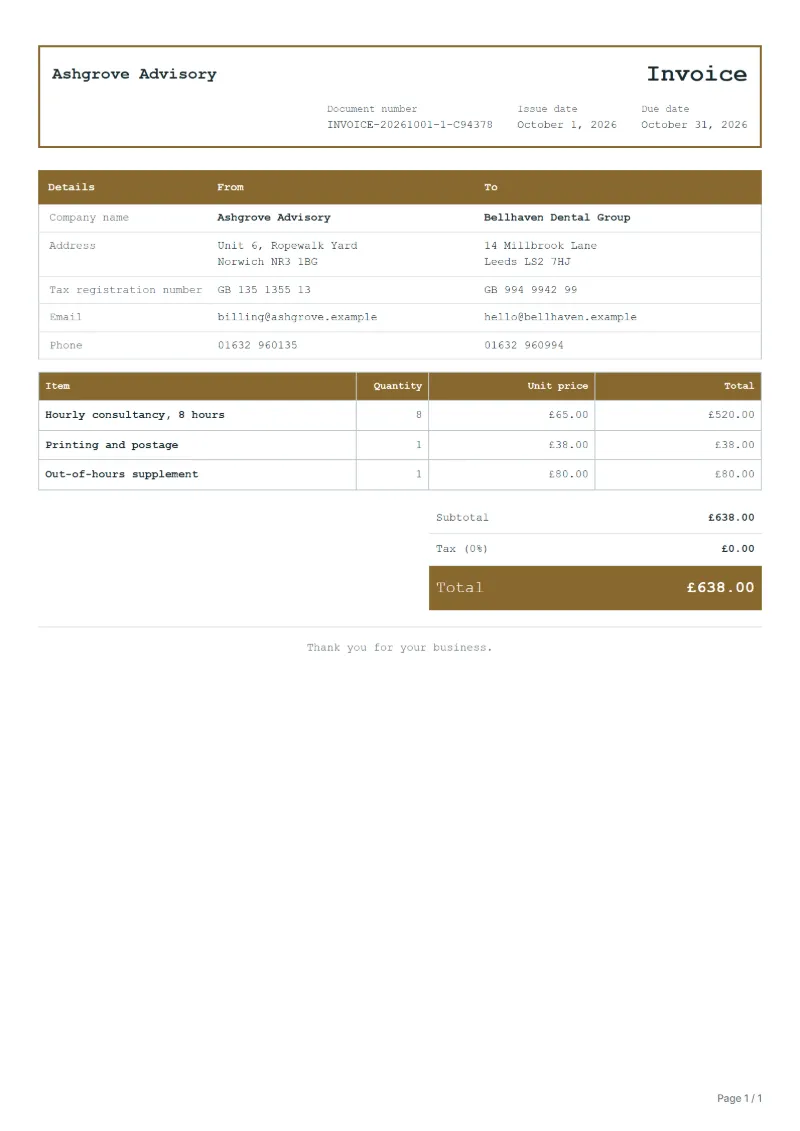
UK invoice template with no VAT line, for a business under the VAT threshold or not registered. Sample lines: hourly consultancy, printing and a supplement.
Templates by country
- Hourly consultancy, 8 hours
- Printing and postage
- Out-of-hours supplement
Preparation guide
Example workflow
Confirm scope and quantities
Example: reconcile the approval and work record for "Hourly consultancy, 8 hours" to establish the quantity for this invoice.
Record delivery and acceptance
Check completion for every line, including "Out-of-hours supplement". Match the delivery record to approved quantities and record who accepted the work.
Send the billing record
Send the final charges, delivery reference and due date to the customer, then reconcile payment against the invoice number.
This invoice suits any UK business that does not charge VAT, not only sole traders: a small limited company or a partnership below the threshold uses the same layout. The sample is a consultant billing hours, printing and postage, and an out-of-hours supplement. One detail is easy to miss when you are not registered: the costs you pass on include the VAT you paid on them, which you cannot reclaim, so you recharge the full amount.
Fields to prepare
- Deliverables and line items
- Hourly consultancy, 8 hours, Printing and postage, Out-of-hours supplement: record the quantities actually supplied and the service period.
- Hourly consultancy, 8 hours
- Split the hours by day or by task if the client’s approval process needs it, for example 5 hours on 2 March and 3 on 4 March.
- Printing and postage
- Recharge the full amount you paid, VAT included, because a business that is not registered cannot reclaim the VAT on its costs.
- Out-of-hours supplement
- Say when the work took place, such as a Saturday call-out, and the supplement rate agreed before it was done.
- Quantity and billing unit
- Use the agreed unit, such as hours, units or a fixed project, and record both quantity and rate.
- Reference and dates
- Add the purchase reference, service period and delivery date to distinguish this work from other orders.
- Scope to agree
- Give the invoice number, the invoice date and the supply date, describe each charge, and keep the VAT number empty with the rate at 0%. Check your last 12 months of taxable turnover each month against the registration threshold.
Before sending
- Does “Hourly consultancy, 8 hours” show the quantity actually supplied, not the quantity first quoted?
- Is “Printing and postage” charged at the rate the customer agreed to, with any change approved?
- Is “Out-of-hours supplement” finished and accepted, or does it belong on a later invoice?
Show 4 more
- Separate additional work from the original scope and check its approval record.
- Distinguish included expenses from separately billed expenses and reconcile supporting records.
- Match completed work to the order or approval record, and confirm the payment due date and amounts already received.
- Confirm document language (en), country setting (GB), and the customer's currency and date-format requirements.
Worked example with sample figures
The figures below are invented to show how the template adds up: 3 lines in GBP, with no tax added.
| Item | Quantity × unit price | Amount |
|---|---|---|
| Hourly consultancy, 8 hours | 8 × £65.00 | £520.00 |
| Printing and postage | 1 × £38.00 | £38.00 |
| Out-of-hours supplement | 1 × £80.00 | £80.00 |
| Total | £638.00 | |
Net amount £638.00, VAT £0.00, total payable £638.00.
What the document must show
These details make an invoice easier to approve and to file.
- Your business name, address and registration or tax number
- The customer's name and address
- Issue date and a document number you do not reuse
- Each line item with quantity, unit price and amount
- Tax shown separately from the net amount, and the total payable
- Payment terms: due date, bank details or accepted payment methods
The VAT here is 20%, applied to the net amount and shown as its own line.
A UK invoice without VAT: what to show, what to leave off
This is the invoice for a business that does not charge VAT, because it is under the registration threshold or has not registered. The list is GOV.UK’s; the right-hand text says where each detail goes in QuoteBill.
- A unique invoice number
- One unbroken sequence, never reused. A field of the document, with the issue date.
- Your business name, address and contact information
- In the company details. A sole trader also shows their own name, and an address for legal documents if they use a business name.
- The name and address of the customer
- In the customer details.
- What you are charging for
- A clear description on each line, with its quantity and price. The sample lines are consultancy by the hour, printing and postage, and an out-of-hours supplement: replace them with your own.
- The supply date and the invoice date
- The issue date is a field of the document. QuoteBill has no field for the date the service was provided: write it in the line description or in the notes.
- The amounts charged and the total owed
- The totals show the net amount and the total owed, which are equal while the tax rate is 0%.
- No VAT number and no VAT line
- GOV.UK lists the VAT amount only “if applicable”. Leave the tax registration number empty and keep the rate at 0%.
A worked example
A consultant under the threshold bills eight hours at £65 (£520), printing and postage at £38 and an out-of-hours supplement of £80. The invoice total is £638: there is nothing to add for VAT, so the net amount and the total owed are the same figure, and no VAT number is printed.
These are the template’s sample lines with their sample prices. Replace them with your own hours, costs and client details.
Why you may not be charging VAT
GOV.UK says you must register for VAT if your total taxable turnover for the last 12 months goes over £90,000, or you expect it to go over £90,000 in the next 30 days. You may register voluntarily below that, and you do not have to register if you only sell VAT-exempt or out-of-scope goods and services.
Taxable turnover is the total value of everything you sell that is not VAT-exempt or out of scope. Zero-rated sales count towards it. It is turnover, not profit.
What changes compared with the UK VAT invoice template
- The VAT number
- The VAT template has you enter it. A VAT invoice must include your VAT number, and you do not have one yet, so here it stays empty.
- The VAT line
- The VAT template shows VAT at the standard rate on its own line. Here the rate starts at 0%, so the total is the sum of your lines.
- The kind of invoice
- GOV.UK says VAT invoices must be used when you and your customer are both VAT-registered and carry more information than non-VAT invoices. This page is the shorter, non-VAT invoice.
The day you cross the threshold
GOV.UK gives an example: if on 15 July your total taxable turnover for the last 12 months is £100,000, the first time it has gone over the threshold, you must register by 30 August and your effective date of registration is 1 September. You must pay HMRC any VAT you owe from the date they register you.
Watch your turnover each month, and move to the UK VAT invoice template from your effective date.
Questions about invoicing in the UK without VAT
- Can I use this template below the VAT threshold?
- Yes. Below £90,000 of taxable turnover, registration is voluntary according to GOV.UK, so an unregistered business invoices without VAT.
- Do I have to write “VAT not applicable” on the invoice?
- GOV.UK’s invoice list does not ask for it and QuoteBill does not add one. If a customer wants it said, a short line in the notes such as “Not VAT registered” does.
- What if I only sell VAT-exempt services?
- GOV.UK says you do not have to register if you only sell VAT-exempt or out-of-scope goods and services. Whether yours are exempt is a question for HMRC or an adviser, not for this template.
- Does the £90,000 count my profit?
- No. GOV.UK counts taxable turnover: everything you sell that is not exempt or out of scope, zero-rated sales included.
- UK VAT invoice template (VAT on its own line)
- Sole trader invoice template
- Guide: UK VAT invoice requirements
Official sources: GOV.UK (HMRC): Invoices - what they must include (2026-10-06)
Official sources: GOV.UK (HMRC): Register for VAT (2026-10-06)
Official sources: GOV.UK (HMRC): Charge, reclaim and record VAT (2026-10-06)
Official rate reference: HMRC: VAT rates
Full requirements: UK VAT invoice requirements: full, simplified, modified
Frequently asked questions
I trade as a limited company below the threshold. Is this template right for me?
Yes, the invoice is the same without VAT. GOV.UK adds that a limited company shows its full name as it appears on its certificate of incorporation; enter it as the company name in the company details.
A client asks me for a VAT invoice. What do I tell them?
That you are not VAT-registered and cannot issue one, and that this invoice is what you can provide. They cannot reclaim VAT on it, because none is charged.
How is the VAT worked out on this invoice?
The VAT here is 20%, applied to the net amount and shown as its own line. With nothing added, the total in the worked example above stays at the net amount of £638.00.
Can I use it in another language or currency?
Yes. The document language can be set to any of 33 languages, and changing the country setting updates the currency, the date format and the tax rate.
Can I add my logo and signature?
Yes. The From section of the editor has a place for your company logo and for a signature or seal image. Uploading a picture needs a free account, and a member can keep both in settings so that every new document starts with them.
Read next
Reading for the UK invoice template with no VAT: How to write an invoice: a step-by-step example and Invoice numbering: sequences and corrections. The VAT and GST calculator works out the tax line for you.