Membership dues statement template
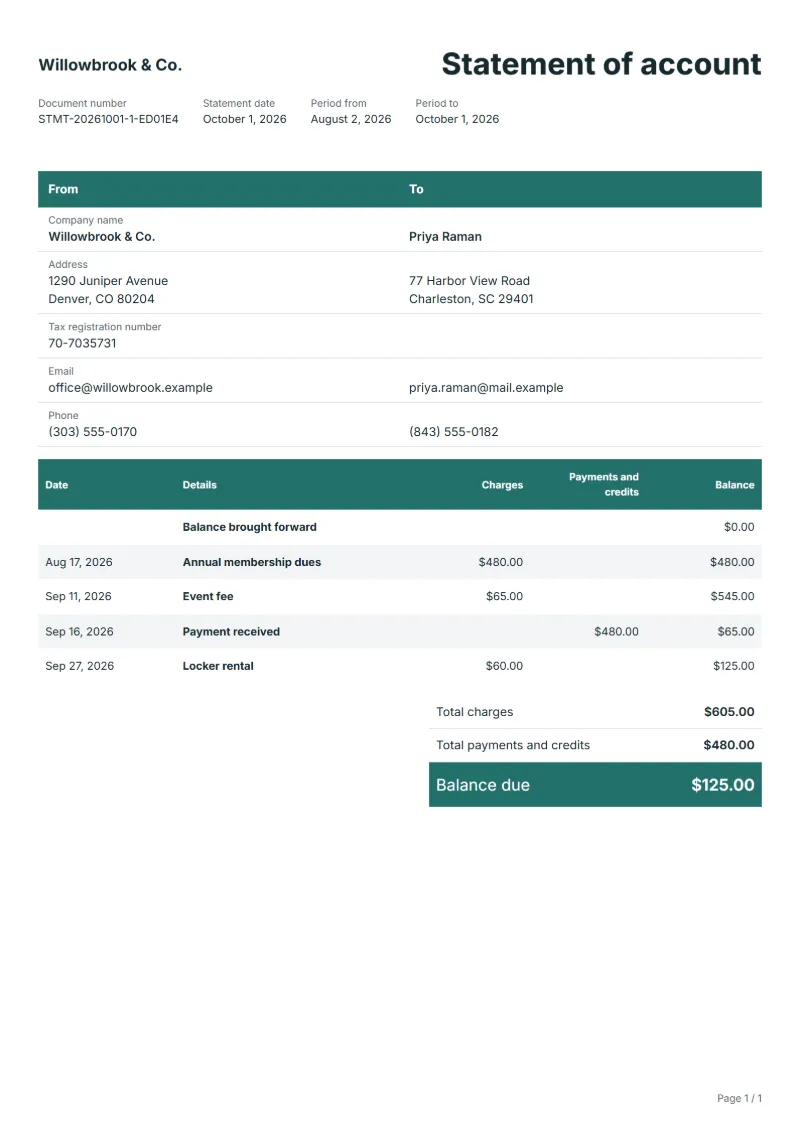
Membership dues statement template for clubs and associations: annual dues, event fees and locker rental against payments, with the balance still owed.
Templates by industry
- Annual membership dues
- Event fee
- Payment received
- Locker rental
Preparation guide
Example workflow
Collect the period's documents
Example: list "Annual membership dues" and every other invoice, receipt and credit note for the customer in the period, oldest first.
Check the running balance
Confirm the balance after each line, including "Locker rental", matches your accounts for this customer.
Send and follow up
Send the statement with the balance due and payment terms, then follow up on invoices past due.
Clubs, associations and societies send this statement to members whose account carries more than the annual dues: an event fee, a locker, a court or room booking. Volunteer treasurers often find that members pay the dues and forget the extras, or pay the same item twice. Listing each charge and payment by date for one member, with the membership number, settles those questions without searching old emails and leaves a clear record for the year-end check of the accounts.
Fields to prepare
- Deliverables and line items
- Annual membership dues, Event fee, Payment received, Locker rental: list each invoice, payment and credit by date, with its document number.
- Annual membership dues
- Give the membership year the dues cover and the category, such as full, junior or family, since each category is priced differently.
- Event fee
- Name the event and its date, and say whether the fee also covers guests the member brought.
- Payment received
- Record the method and the date; for cash taken at the club, note who received it.
- Locker rental
- Give the locker number and the period it covers, and whether a key deposit is held separately.
- Period and balance brought forward
- Give the statement date and the period it covers, and carry over the balance from the previous statement.
- Charges and payments
- Enter each invoice under charges and each payment or credit note under payments and credits, at the amount on the document itself. "Add from my documents" copies those amounts from your saved documents for this customer.
- Scope to agree
- Name the member and membership number, set the year's dues and extra charges against payments, and state what is still owed.
Before sending
- Does “Annual membership dues” carry the number and amount of the document it comes from?
- Has every payment for “Event fee” been entered on the day it arrived?
- Would the customer find “Payment received” in their own ledger at the same amount?
Show 4 more
- Does “Locker rental” carry the number and amount of the document it comes from?
- Check the statement period, the balance brought forward and that every payment received is listed.
- List each invoice once, at the total it was issued for, and each credit note with the payments.
- Say how the customer can pay the balance due, and quote the numbers of any invoices past due.
Worked example with sample figures
The entries below are invented to show how the balance runs: 4 entries in USD over a period of 60 days.
- 45 days before the statement date: Annual membership dues, charged $480.00; balance $480.00
- 20 days before the statement date: Event fee, charged $65.00; balance $545.00
- 15 days before the statement date: Payment received, paid $480.00; balance $65.00
- 4 days before the statement date: Locker rental, charged $60.00; balance $125.00
Balance due at the end of the period: $125.00.
What the document must show
These details make a statement of account easier to approve and to file.
- Your company name and address
- The customer's name
- Statement date and period
- Balance brought forward
- Each invoice, payment and credit with date and number
- Running balance and balance due
A statement adds no tax of its own: each line carries an invoice, a payment or a credit at the amount on that document, and the balance runs on from the balance brought forward.
Frequently asked questions
A member paid the dues but not the extras. What do we send?
This statement with the open items, and a short note asking for payment by a given date. Whether unpaid extras affect membership depends on your club’s rules, so quote the rule if there is one rather than threatening anything.
Does every member need a statement?
No. A member who paid only the dues needs a receipt at most. Statements are for accounts with several charges, part payments or a balance still open.
A member resigns mid-year. Is part of the dues refunded?
That depends on your rules. If a refund is due, issue a credit note and it appears on the statement as a credit; if not, the statement simply shows the dues as paid and a note can quote the rule.
How is the balance on this statement worked out?
A statement adds no tax of its own: each line carries an invoice, a payment or a credit at the amount on that document, and the balance runs on from the balance brought forward. In the worked example above the entries end at a balance of $125.00.
Can I download it as Excel, Word or PDF?
Yes. A PDF needs no account: fill in the template and use Print / PDF. The Excel and Word files download from this page with a free account, and the spreadsheet keeps its formulas, so changing a charge or a payment updates the running balance and the balance due.
Read next
Reading for the Membership dues statement template: Unpaid invoice: follow-ups, part payments and statements and Invoice payment terms: Net 15, Net 30, due dates. For an account that is overdue, the Payment reminder template is the next step.