UK VAT invoice requirements: full, simplified, modified
What HMRC says a full UK VAT invoice must show, when a simplified or modified invoice is enough, when no VAT invoice is needed, with a worked 20% example.
At a glance
Worked example Total payable: £1,350 + £270 = £1,620
The short answer
If you are VAT-registered and sell standard-rated or reduced-rated goods or services to another VAT-registered business in the UK, you give it a VAT invoice, normally within 30 days of the supply. A full VAT invoice carries a sequential number, the dates, both parties, your VAT number, a line-by-line breakdown with the VAT rate and the VAT total in sterling.
Two shorter forms exist. A sale of £250 or less including VAT can take a simplified invoice, and a retailer asked for a VAT invoice on a larger sale can give a modified one that shows VAT-inclusive amounts. Everything below follows HMRC’s VAT Notice 700/21, read on 5 October 2026; check it again before you rely on a detail.
What a full VAT invoice must show
Notice 700/21 lists these entries for a full VAT invoice:
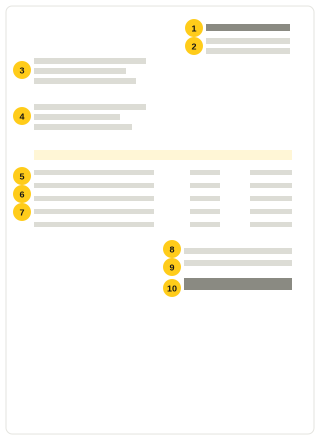
- A unique sequential number, from one or more series, that identifies the invoice.
- The time of supply, also called the tax point, and the date of issue if it differs.
- Your name, your address and your VAT registration number.
- The name and address of the customer you are invoicing.
- A description sufficient to identify the goods or services supplied.
- For each description: the quantity or extent, the VAT rate and the amount excluding VAT.
- The unit price of each item, excluding VAT.
- The gross total amount payable, excluding VAT.
- The rate of any cash discount you offer.
- The total amount of VAT charged, expressed in sterling.
Simplified and modified invoices
A business that is not a retailer may issue a simplified invoice when the supply is £250 or less including VAT. It needs your name, address and VAT number, the time of supply, a description, and for each VAT rate the total payable including VAT and the rate charged. It does not name the customer, so a buyer who needs to show who was billed will ask for a full one.
A retailer that makes a supply of more than £250 and is asked for a VAT invoice gives either a full invoice or a modified invoice showing VAT-inclusive values. Most freelancers and business-to-business services never need either short form: a full invoice works for any amount.
| Full VAT invoice | Simplified invoice | Modified invoice | |
|---|---|---|---|
| When | Any amount (a full invoice works for any sale) | Supply of £250 or less including VAT, by a business that is not a retailer | A retailer's supply of more than £250, when asked for a VAT invoice |
| What it shows | All ten entries: number, time of supply, both parties, VAT number, description, quantity, rate, amounts, VAT total in sterling | Your name, address and VAT number, time of supply, description, and for each VAT rate the total including VAT and the rate | VAT-inclusive values |
| Note | Most freelancers and business services use this one | Does not name the customer: a buyer who must show who was billed asks for a full one | Most freelancers and business services never need it |
When no VAT invoice is needed
A business that is not VAT-registered does not charge VAT, so its invoice shows no VAT at all. Registration becomes compulsory once taxable turnover over the last 12 months goes above £90,000, the threshold GOV.UK gave on 5 October 2026. A registered business does not always have to issue a VAT invoice either; Notice 700/21 names these cases:
- The invoice is only for exempt or zero-rated sales within the UK.
- The customer runs a self-billing arrangement, or you issue authenticated receipts.
- You make a gift of goods on which VAT is due.
- You sell goods under one of the second-hand margin schemes.
Worked example: a design studio’s VAT invoice
A VAT-registered studio finishes a branding job for a VAT-registered client on 2026-10-02 and invoices on 2026-10-05. Both dates go on the invoice: the time of supply and the date of issue. The standard rate of 20% applies to both lines; the prices are illustrative.
Now a small sale: a print costing £180 including VAT. The VAT inside a VAT-inclusive price at 20% is one sixth of it, 180 × 20 ÷ 120 = £30, so the net amount is £150. That sale is under £250, so a simplified invoice showing £180 including VAT at 20% is enough unless the buyer asks for a full one.
| Item | Working | Amount |
|---|---|---|
| Brand workshop | 1 × £600 | £600 |
| Logo concepts | 3 × £250 | £750 |
| Total excluding VAT | £600 + £750 | £1,350 |
| VAT at 20% | £1,350 × 0.20 | £270 |
| Total payable | £1,350 + £270 | £1,620 |
| VAT inside a £180 VAT-inclusive print | 180 × 20 ÷ 120 | £30 (net £150) |
| Item | Working | Amount |
|---|---|---|
| Brand workshop | 1 × £600 | £600 |
| Logo concepts | 3 × £250 | £750 |
| Total excluding VAT | £600 + £750 | £1,350 |
| VAT at 20% | £1,350 × 0.20 | £270 |
| Total payable | £1,350 + £270 | £1,620 |
Making a UK VAT invoice in QuoteBill
Start from the UK VAT invoice template, which sets “Country / currency” to the United Kingdom: pounds, and the 20% standard rate from QuoteBill’s published tax data with its source. Enter your VAT number and, for a business customer, theirs in “Tax registration number”, then describe each line with its quantity and unit price.
Know the limits. QuoteBill applies one VAT rate to the whole invoice and prints it beside the VAT total, so a sale mixing 20%, 5% and 0% lines needs separate invoices or accounting software that splits them. There is no field for the time of supply, so write it in “Notes” when it differs from the issue date. The page prints one currency: invoicing in euros or dollars, add the sterling VAT figure in the notes yourself. QuoteBill does not check your VAT number or file anything with HMRC.
Check before you send
Run through the full-invoice list against the PDF:
0/6
Questions people ask
Do I need the words “VAT invoice” on it?
Notice 700/21 lists content, not a title. Calling it “Invoice” with all the entries above is common; what matters is that the VAT number, the rates and the VAT total are there.
Can I issue a VAT invoice before I am registered?
No. You cannot charge VAT until you are registered. If you are waiting for your VAT number, GOV.UK explains how to invoice in the meantime and reissue later; follow that guidance rather than guessing a number.
How long do I have to issue it?
Normally within 30 days of the date of supply, under section 3 of Notice 700/21. Keep a copy of every VAT invoice you issue.
My client is in the EU. Is this still the guide to follow?
A sale to a business outside the UK follows other rules on where the supply is taxed. Read the EU guide for what an EU invoice holds, and take advice on whether UK VAT applies.
Sample contracts, forms and tools
Sources
536 Free Invoice, Quote & Receipt Templates
UK VAT invoice template
UK VAT invoice template: VAT on its own line at your rate, with your VAT number. Fill it in online; Excel and Word come with a free account.
Free invoice generator
Download the invoice as Excel or Word with working formulas (free for QuoteBill members), or edit it online with your logo and tax settings and save a PDF.
Credit note template
Free credit note (credit memo) template: reduce or cancel an invoice you already sent, quoting its number and the reason. Download Excel or Word, or save a PDF.
Sole trader invoice template
Invoice template for a UK sole trader: your name and business name, a unique number, supply date and total, with no VAT line. Sample lines for design work.