Bricklayer invoice template
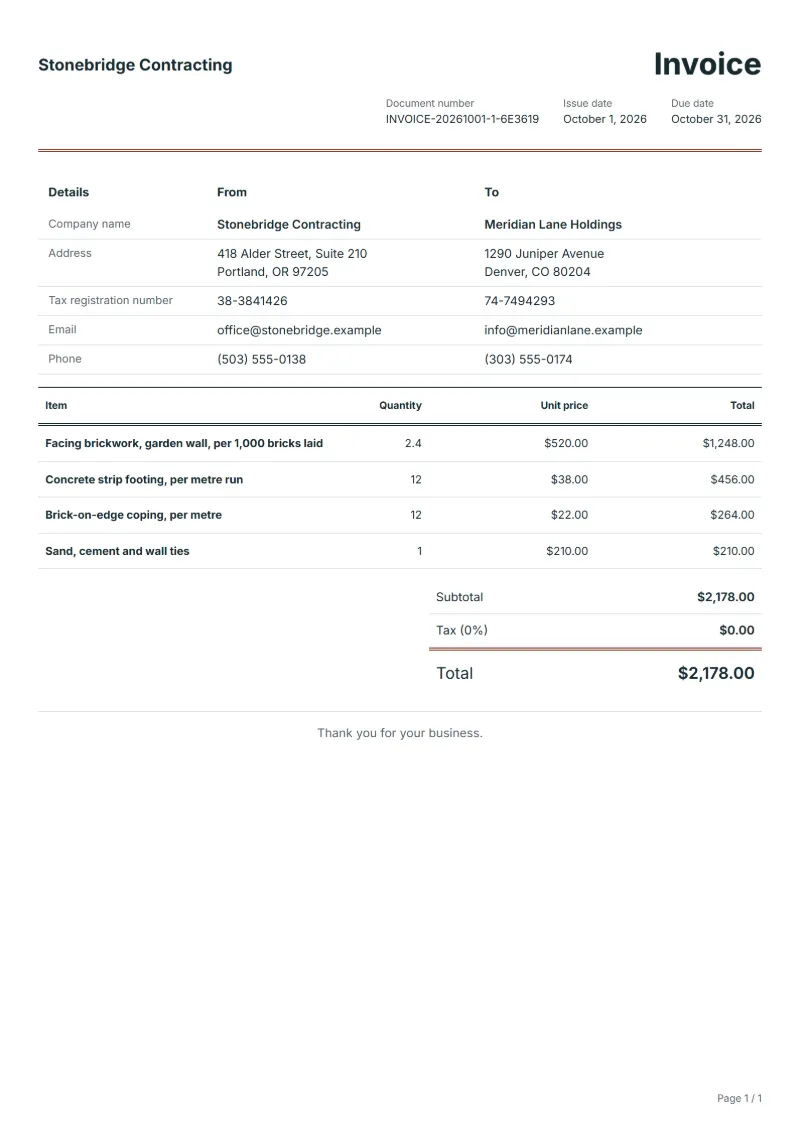
Bricklayer invoice template: bill brickwork per thousand bricks or per m², with the footing, the coping and the sand and cement on separate lines.
Templates by industry
- Facing brickwork, garden wall, per 1,000 bricks laid
- Concrete strip footing, per metre run
- Brick-on-edge coping, per metre
- Sand, cement and wall ties
Preparation guide
Example workflow
Confirm scope and quantities
Example: reconcile the approval and work record for "Facing brickwork, garden wall, per 1,000 bricks laid" to establish the quantity for this invoice.
Record delivery and acceptance
Check completion for every line, including "Sand, cement and wall ties". Confirm completed quantities, site photos, agreed test results and any remaining remedial work.
Send the billing record
Send the final charges, delivery reference and due date to the customer, then reconcile payment against the invoice number.
Bricklayers price walls in different ways: per thousand bricks laid, per square metre of face, or by the day for repairs and repointing. Whichever you use, the client should be able to recount it, so this invoice states the unit on each line and keeps the footing, the coping course and the materials separate. For a garden wall or a small extension, the client can then check the brick count against the deliveries and the length of the wall against the plan.
Fields to prepare
- Deliverables and line items
- Facing brickwork, garden wall, per 1,000 bricks laid, Concrete strip footing, per metre run, Brick-on-edge coping, per metre, Sand, cement and wall ties: record the quantities actually supplied and the service period.
- Facing brickwork, garden wall, per 1,000 bricks laid
- Count bricks from the merchant’s deliveries less the pallets left over, or from courses times length, and write which method you used.
- Concrete strip footing, per metre run
- Give the footing length, width and depth as dug, because a deeper trench found on site is the usual reason for a higher figure.
- Brick-on-edge coping, per metre
- Price the coping per metre along the top of the wall and say whether it is brick-on-edge or a bought coping stone.
- Sand, cement and wall ties
- Materials read best as one line with the merchant’s totals; wall ties and damp-proof course belong here, not in the brick rate.
- Site and measured quantities
- Record the site, work zones, areas, lengths or counts, and access hours.
- Materials and work stages
- Specify materials, labor, removal, disposal and making-good allowances, and completion criteria for each stage.
- Scope to agree
- State how the brickwork is counted, per thousand bricks or per square metre, and keep footings, copings and materials on lines of their own.
Before sending
- Does “Facing brickwork, garden wall, per 1,000 bricks laid” show the quantity actually supplied, not the quantity first quoted?
- Is “Concrete strip footing, per metre run” charged at the rate the customer agreed to, with any change approved?
- Is “Brick-on-edge coping, per metre” finished and accepted, or does it belong on a later invoice?
Show 4 more
- Does “Sand, cement and wall ties” show the quantity actually supplied, not the quantity first quoted?
- Agree how quantity changes following measurement or drawing revisions will be approved.
- Confirm client-supplied materials and work that other contractors must finish first.
- Match completed work to the order or approval record, and confirm the payment due date and amounts already received.
Worked example: a garden wall with a brick coping
The figures are an example, in dollars, with an example tax rate of 8%. A bricklayer digs and pours a 12-metre footing, lays 2,400 facing bricks for a garden wall and finishes it with a brick-on-edge coping.
- Brick count: 2,400 as delivered by the merchant, one returned pallet already subtracted.
- Footing and coping: 12 metres each, measured along the wall.
| Item | Quantity × unit price | Amount |
|---|---|---|
| Facing brickwork, garden wall, per 1,000 bricks laid | 2.4 × $520.00 | $1,248.00 |
| Concrete strip footing, per metre run | 12 × $38.00 | $456.00 |
| Brick-on-edge coping, per metre | 12 × $22.00 | $264.00 |
| Sand, cement and wall ties | 1 × $210.00 | $210.00 |
| Subtotal | $2,178.00 | |
| Sales tax (8%) | $174.24 | |
| Total | $2,352.24 | |
The lines total $2,178.00; tax at 8% is $174.24; the client pays $2,352.24. Frost days go in the notes with their dates rather than on a line.
Mistakes on a bricklayer’s invoice
- Quoting per thousand bricks and invoicing per square metre.
- Charging bricks broken in cutting as bricks laid.
- Leaving the footing depth out, so a deeper dig looks like an overcharge.
- Hiding wall ties and mortar in the brick rate where nobody can see them.
What the document must show
These details make an invoice easier to approve and to file.
- Your business name, address and registration or tax number
- The customer's name and address
- Issue date and a document number you do not reuse
- Each line item with quantity, unit price and amount
- Tax shown separately from the net amount, and the total payable
- Payment terms: due date, bank details or accepted payment methods
The sales tax depends on where the work is supplied, so set the rate that applies to your customer before sending.
Official rate reference: US government: state and local taxes
Frequently asked questions
Should I bill per thousand bricks or per square metre?
Use the unit your quotation used, so the two can be compared. Per thousand suits a wall of one brick type; per square metre suits faces with many openings or mixed bonds.
Frost stopped the work for three days: can I charge for them?
Not unless the contract says so. Note the lost days and their dates on the invoice so the client understands why the finish date moved.
How do I bill bricks the client sourced to match an old wall?
Bill the laying at your rate and write that the bricks were supplied by the client. Cleaning reclaimed bricks can go on a separate labour line if that was agreed.
Can I invoice the footing before the wall goes up?
If the quotation set stage payments, yes: invoice the footing as its own stage once it is poured and name that stage on the line.
How is tax calculated on this template?
The sales tax depends on where the work is supplied, so set the rate that applies to your customer before sending. The editor keeps the net amount, the tax and the total apart, and recalculates all three when you change a quantity, a unit price or the country setting.
Can I email it to the customer?
Yes, from your own mail app. With a free account, the editor’s download menu offers Email this document, which opens your mail app with a message about the document already written. QuoteBill sends nothing itself, so save the PDF and attach it before you send.
Read next
Reading for the Bricklayer invoice template: How to write an invoice: a step-by-step example and Invoice numbering: sequences and corrections. The VAT and GST calculator works out the tax line for you.