Photo and image release (model release) template
A person lets you use photos, video or audio of them: purpose, media, territory, duration, withdrawal and minors. A sample contract you can read in full, edit in QuoteBill and sign online with a secure link.
Sample — review with a lawyer · Simple electronic signature with an audit trail
Who it is for
For a photographer, filmmaker, business or organiser who wants a person’s written permission to use photos, video or audio of them, for example for a website, a campaign or a publication.
Rules on image rights and on consent to be pictured differ by country, and a minor’s consent must come from a parent or guardian, who is added as a further party.
What it covers
14 clauses, in this order. Each one is in the sample text below, and you can edit, remove or add clauses before you send.
1. Purpose
What the agreement is for: the Person Shown permits the Producer to use photos, video and sound recordings in which they appear, for the purposes below.
2. Images covered
Blanks for the date, place and occasion. It covers the photos, video and audio of the person, including their likeness and voice, and any images made from them.
3. Permission and its scope
A non-exclusive permission limited by blanks for the purpose, the media, the territory and the duration. A use outside these limits needs a new permission.
4. Editing and limits on use
The Producer may crop, edit and caption the images but may not show the person in a false or demeaning way, or make it look as if they endorse a product, a view or a cause.
5. Name and credit
A blank for whether the person is named with the images and how the credit reads.
6. No payment
The person receives no payment or other benefit unless a blank says what was agreed.
7. Third parties
The Producer’s clients, publishers, printers and platforms may use the images within the permission. The Producer does not sell them as stock images or for other uses.
8. Ownership and approval
The Producer owns the images, but the person keeps their own rights in likeness, name and voice. There is no right to approve images before use unless a blank says so.
9. Withdrawal
The person may withdraw the permission for future uses on a set number of days’ notice. A blank states the limits, such as copies already printed. The Producer then stops new uses and removes the images from its own channels where it can.
10. Personal data
The images may be personal data. The Producer handles them as the law that applies to it requires, keeps them only as long as needed and explains on request how they are stored and used.
11. Minors and guardians
For a person under a set age, or too young to consent alone where they live, a parent or legal guardian also signs as a further party, named in a blank. A minor’s signature alone is not relied on.
12. Confirmations
The person confirms they are free to give the permission, for example no agency or employer contract prevents it, and have read the agreement. The Producer confirms it will stay within the permission.
13. Release of claims
Within the permission, the person makes no claims for the use of the images, such as for privacy or image rights, as far as the law allows. Uses outside it, false or demeaning uses and claims that cannot be waived are excluded.
14. Governing law and disputes
The law you name applies. The sides first try to settle a dispute in good faith, and otherwise the courts you name decide.
There is no price schedule: this agreement involves no payment.
The sample text
The whole sample, as QuoteBill starts it. Text in double square brackets, like [[10]], is a blank to fill in or check, and QuoteBill does not let you send a contract while one is left. The clause text is written in English, Korean, Japanese and German; in other languages a contract starts in English for you to translate.
Read the sample text
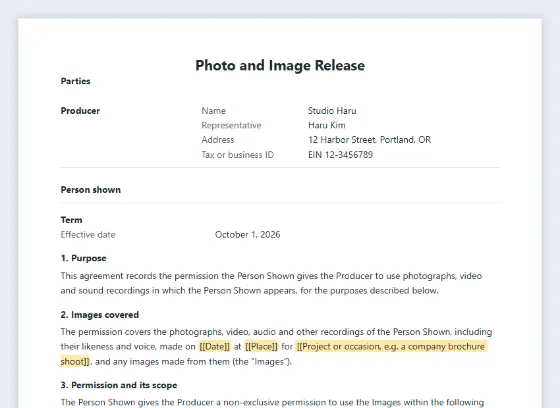
Photo and Image Release
Parties: Producer · Person shown
1. Purpose
This agreement records the permission the Person Shown gives the Producer to use photographs, video and sound recordings in which the Person Shown appears, for the purposes described below.
2. Images covered
The permission covers the photographs, video, audio and other recordings of the Person Shown, including their likeness and voice, made on [[Date]] at [[Place]] for [[Project or occasion, e.g. a company brochure shoot]], and any images made from them (the “Images”).
3. Permission and its scope
The Person Shown gives the Producer a non-exclusive permission to use the Images within the following limits:
Purpose: [[Purpose, e.g. the Producer’s website, social media and printed brochures]]
Media: [[Media, e.g. online, print, broadcast, exhibition]]
Territory: [[Territory, e.g. worldwide]]
Duration: [[Duration, e.g. 5 years from the date of this agreement / without a time limit]]
A use outside these limits needs a new permission.
4. Editing and limits on use
The Producer may crop, edit and retouch the Images, combine them with other material and add captions, as long as the result does not show the Person Shown in a false or demeaning way. The Producer does not use the Images to suggest that the Person Shown endorses a product, a service, a political view or a cause, unless it is named under Permission and its scope.
5. Name and credit
The Producer [[may / may not]] name the Person Shown together with the Images. Where a name is used, it appears as: [[Name or credit line]]
6. No payment
The Person Shown receives no payment or other benefit for this permission, except as written here: [[none / the payment or benefit agreed]]
7. Third parties
The Producer may allow its clients, publishers, printers and platforms to use the Images within the permission. The Producer does not sell or license the Images to others as stock images or for any use outside the permission.
8. Ownership and approval
The Producer owns the Images and the rights in them, except for the Person Shown’s own rights in their likeness, name and voice, which this agreement does not transfer. The Person Shown has no right to approve the Images before they are used, except as written here: [[none / the approval the Person Shown may require]]
9. Withdrawal
The Person Shown may withdraw this permission for future uses by giving notice in writing or in electronic form, with [[30]] days’ notice. Limits on withdrawal: [[e.g. it does not affect copies already printed or distributed, finished works or uses already made]]
After a withdrawal the Producer makes no new use of the Images and, where reasonably possible, removes them from its own website and social media within [[30]] days. Rights that the law gives the Person Shown, for example under privacy and data protection law, remain unaffected.
10. Personal data
The Images show a person and may be personal data. The Producer handles them as the law that applies to it requires, keeps them only as long as the purposes in this agreement need, and tells the Person Shown on request how they are stored and used.
11. Minors and guardians
If the Person Shown is under [[18]] years old, or under the age at which they can give this permission on their own where they live, a parent or legal guardian also signs this agreement as a further party and confirms that they have the authority to give the permission. Parent or guardian: [[Name of parent or guardian and relationship]]
The Producer does not rely on a minor’s signature alone.
12. Confirmations
The Person Shown confirms that they are free to give this permission, for example that no contract with an agency, employer or another producer prevents it, and that they have read and understood this agreement. The Producer confirms that it will use the Images only within this permission.
13. Release of claims
Within the permission, the Person Shown does not make claims against the Producer for the use of the Images, such as for violation of privacy or image rights, as far as the law allows. This does not cover use outside the permission, use that shows the Person Shown in a false or demeaning way, or claims that the law does not allow to be waived.
14. Governing law and disputes
This agreement is governed by the law stated under Governing law. The parties will first try to settle any dispute in good faith. Otherwise the courts stated under Jurisdiction decide, unless mandatory law provides otherwise.
Governing law
[[Country or state whose law applies]]
Jurisdiction
[[Courts that decide disputes, e.g. the courts of your city]]
How to use it
Choose the template
Press the button to use this template. If you are not signed in, you first sign in or sign up for free and then come straight back to it.
Start a draft
The new-contract page opens with this template marked. Press its card to create a draft. Your company details fill in Party A, and you fill in the blanks, the other party and, where the template has one, the price schedule.
Send it for signature
You sign first, then send each signer a secure link and, by another route, an access code. Signers need no account.
Next steps
Your client opens the link on any device and needs no account. See what the signing looks like on the E-Contracts page, and read which kind of electronic signature is enough for which document.
What it is, and what it is not
QuoteBill creates a simple electronic signature with an audit trail. In the EU, the UK, the US and Korea a signature is not denied legal effect only because it is electronic, and in Japan most contracts need no particular form at all. What a simple electronic signature proves in a dispute depends on the evidence behind it, and some documents need another form.
It is not a qualified or advanced electronic signature, and QuoteBill does not verify who the signers are. It records the use of the link and access code you delivered, so anyone who has both can sign. The signature certificate lists every link issued and, for each action by the sender or a signer, its IP address and browser where they could be read.
Some documents need another form. Wills, many real-estate transfers, guarantees and some employment documents must, in some countries, be handwritten, notarised or signed with a qualified signature. The templates are samples, not legal advice: review them with a lawyer.
Other contract templates
Website design and development agreement
Pages and scope, client content, design sign-off, launch, warranty and ownership of the site.
Graphic design agreement
Concepts and revisions, final files, usage rights, fonts and stock licences, credit and a kill fee.
Photography agreement
Shoot date, deliverables, usage licence, releases, cancellation, overtime and lost images.
Video production agreement
Script and storyboard, shoot days, edits and revisions, delivery formats, footage rights and licences.