Artwork commission agreement template
An artist makes an illustration, painting or sculpture to order: sketches, fee, delivery, ownership and use rights. A sample contract you can read in full, edit in QuoteBill and sign online with a secure link.
Sample — review with a lawyer · Simple electronic signature with an audit trail
Who it is for
For an illustrator, painter or sculptor taking a commission, and for the person or business ordering a piece, who want sketches, price, delivery, ownership and each side’s use of the work in writing.
Owning the artwork, holding the copyright and the artist’s moral rights are separate things, and the rules, including resale rights, differ by country; check what the buyer may do beyond owning the object.
What it covers
14 clauses, in this order. Each one is in the sample text below, and you can edit, remove or add clauses before you send.
1. Purpose
What the agreement is for: the Artist creates the artwork below to the Client’s order, and what the Client may do with it afterwards.
2. The artwork
A blank describes the kind, subject, medium, size and number of pieces and the brief. The Artist decides style and technique within the brief, and the work is original, not a copy of another artist’s work.
3. Sketches and changes
The Artist sends a sketch for approval first, and a set number of rounds of changes to the sketch is included. Major changes after approval are extra and charged at a rate in a blank.
4. Schedule and delivery
The Artist plans to finish by a date in a blank and hands over by collection, shipping or digital files. The date moves for the time the Client takes to give feedback or materials; delays are reported early.
5. Fee and deposit
The fee comes from the price schedule. A deposit, as a percentage in a blank, starts the work; the balance is due before handover. Materials, framing, packing and shipping are included unless shown separately.
6. Ownership and copyright
The Client owns the physical work once paid in full and handed over. The copyright stays with the Artist unless a blank says it is assigned. Owning the object is not the right to copy it.
7. The Client’s use of the Artwork
Where the copyright stays with the Artist, the Client may display and photograph the work and use pictures for the uses in a blank. Prints, ads for others and licensing need the Artist’s consent. No machine-learning use.
8. The Artist’s own use
From a date in a blank the Artist may show the work in its portfolio, online, in exhibitions and books and sell prints, unless the Client objects for privacy. The Artist keeps its sketches and studies.
9. Signature, credit and moral rights
The Artist signs where it suits the work and the Client does not remove the signature or claim the work as someone else’s. A blank sets the credit. Moral rights stay as the law provides; none that cannot be given up is given up.
10. Reference material and subjects
The Client states it may give the reference material and has the permissions needed for real people, characters or brands shown. The Artist may decline an unlawful or hateful subject and keeps the fee for the work done.
11. Packing, shipping and risk
The Artist packs with care. The risk passes to the Client on handover or to the carrier on shipping. A blank says who arranges and pays for shipping and insurance; damage on arrival is reported with photos within a set number of days.
12. Cancellation
Before the sketch is approved, the Client may cancel on notice and the deposit covers the work done, as far as the law allows. After approval the Artist keeps a share of the fee. If the Artist cannot finish, it refunds the rest.
13. Liability and independence
The Artist works with care. A change of taste is not a defect where the work follows the brief and approved sketch, as far as the law allows. Liability is capped by a blank, with legal exceptions. The Artist is independent, not an employee.
14. Governing law and disputes
The law you name applies. The sides first try to settle a dispute in good faith, and otherwise the courts you name decide.
A price schedule (items, quantities and prices) is part of this contract. It starts empty, in your currency, and the clauses on fees and payment point to it.
The sample text
The whole sample, as QuoteBill starts it. Text in double square brackets, like [[10]], is a blank to fill in or check. A figure or time such as [[10]] that you leave as it is is used as shown when you send; a blank that needs your own words must be filled first. The clause text is written in English, Korean, Japanese and German; in other languages a contract starts in English for you to translate.
Read the sample text
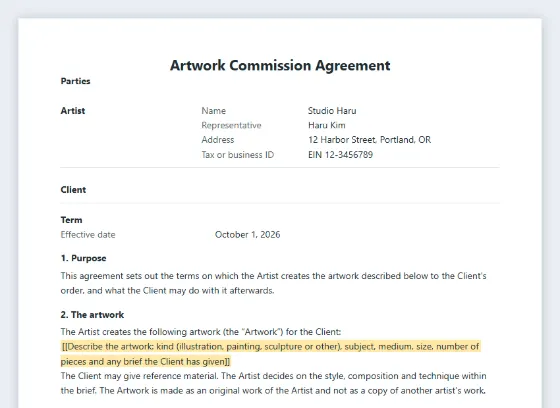
Artwork Commission Agreement
Parties: Artist · Client
1. Purpose
This agreement sets out the terms on which the Artist creates the artwork described below to the Client’s order, and what the Client may do with it afterwards.
2. The artwork
The Artist creates the following artwork (the “Artwork”) for the Client:
[[Describe the artwork: kind (illustration, painting, sculpture or other), subject, medium, size, number of pieces and any brief the Client has given]]
The Client may give reference material. The Artist decides on the style, composition and technique within the brief. The Artwork is made as an original work of the Artist and not as a copy of another artist’s work.
3. Sketches and changes
Before the final work the Artist sends [[1]] sketch or concept for approval. The Client approves it or sends clear comments in writing or in electronic form within [[5]] days. The fee includes [[1]] round of changes to the sketch. After the Client has approved the sketch, major changes are an extra service and, if the Artist agrees to them, are charged at [[Hourly rate or fee per change]].
4. Schedule and delivery
The Artist plans to complete the Artwork by [[Completion date]] and hands it over by [[collection by the Client / shipping to the address given / digital files in the agreed format]]. The date moves by the time the Client takes to give feedback, approvals or materials. If the Artist cannot keep the date, it tells the Client without delay and proposes a new one.
5. Fee and deposit
The Client pays the fees shown in the price schedule of this contract. A deposit of [[30]]% is due on signing, to start the work; how it is treated on cancellation is set out under Cancellation. The balance is due before the Artwork is handed over or the final files are released. The costs of materials, framing, packing and shipping are included in the fee unless the price schedule shows them separately.
6. Ownership and copyright
The Client becomes the owner of the physical Artwork, if there is one, when it has paid in full and the Artwork has been handed over. The copyright in the Artwork stays with the Artist, unless this applies: [[no transfer of the copyright / the copyright is assigned to the Client on full payment, as far as the law that applies allows]].
Ownership of the object and ownership of the copyright are separate things. Owning the object does not give the right to copy the Artwork beyond what this agreement allows.
7. The Client’s use of the Artwork
Where the copyright stays with the Artist, the Artist grants the Client a non-exclusive, perpetual licence to display the Artwork, to photograph it and to use pictures of it for [[the permitted uses, e.g. display in the Client’s premises, website and social media / personal use only]] in [[all countries]]. Selling copies, prints or merchandise, using the Artwork in advertising for others and licensing it to others need the Artist’s consent in writing or in electronic form and may carry a further fee.
The Client does not use the Artwork to train or test machine-learning models, except as follows: [[no exception / the exception agreed]]. A Client who sells the physical Artwork passes these limits on to the buyer.
8. The Artist’s own use
The Artist may photograph the Artwork and show it in its portfolio, on its website and social media, in exhibitions and in books, and may make prints and other reproductions of it for sale, from [[the date of delivery / the date the Client first shows the Artwork in public]], unless the Client has asked in writing or in electronic form, for reasons of privacy, that the Artist does not. The Artist keeps the sketches and studies it made.
9. Signature, credit and moral rights
The Artist signs the Artwork in the usual way where this suits the work, and the Client does not remove the signature or present the Artwork as the work of someone else. The Client credits the Artist as [[the credit wording, e.g. the Artist’s name or handle / no credit required]] where the Artwork is shown in public online or in print and credits are customary.
The Artist’s moral rights, such as the right to be named and to object to a distortion of the Artwork, stay with the Artist as the law that applies provides. No right that the law does not allow to be given up is given up.
10. Reference material and subjects
The Client states that it has the right to give the Artist the reference material it provides, for this purpose. Where the Artwork shows a real person, or another person’s character, brand or artwork, the Client has the permission that the Artwork and the Client’s intended uses need, and the Artist may ask for proof.
The Artist may decline, or stop work on, a subject that is unlawful or hateful or that the Artist is not willing to make. The Artist then keeps the part of the fee that matches the work done and returns the rest of the deposit.
11. Packing, shipping and risk
The Artist packs a physical Artwork with care. The risk of loss or damage passes to the Client when the Artwork is handed over to the Client or, where it is shipped, to the carrier. Shipping and insurance: [[the Client arranges and pays for shipping and insurance / the Artist arranges shipping at the Client’s cost / included in the fee]]. A damage found on arrival is reported to the carrier and to the Artist, with photos, within [[3]] days.
12. Cancellation
The Client may cancel before the sketch is approved on [[7]] days’ notice in writing or in electronic form; the deposit is then kept for the work done, as far as the law allows. After the sketch is approved, the Client may still cancel, and the Artist keeps [[50]]% of the fee for the work done.
If the Artist cannot finish the Artwork, for example because of illness, it refunds the part of the fee for the work not done or, if the Client agrees, finishes it later. Further claims are excluded as far as the law allows.
13. Liability and independence
The Artist works with care and skill. Where the Artwork follows the brief and the approved sketch, a change of taste is not a defect, as far as the law allows. The Artist is not responsible for damage that arises from the way the Client stores, displays or transports the Artwork after handover.
Except for intent, gross negligence, personal injury or where the law does not allow a limitation, each party’s total liability under this agreement is limited to [[the fees paid or payable under it / a fixed amount]]. The Artist is an independent person or business, and this agreement does not create an employment, partnership or agency relationship.
14. Governing law and disputes
This agreement is governed by the law stated under Governing law. The parties will first try to settle any dispute in good faith. Otherwise the courts stated under Jurisdiction decide, unless mandatory law provides otherwise.
Payment terms
The deposit is payable within [[7]] days of signing and the balance before the Artwork is handed over or shipped, by bank transfer to the account stated on the invoice.
Governing law
[[Country or state whose law applies]]
Jurisdiction
[[Courts that decide disputes, e.g. the courts of your city]]
How to use it
Choose the template
Press the button to use this template. If you are not signed in, you first sign in or sign up for free and then come straight back to it.
Start a draft
The new-contract page opens with this template marked. Press its card to create a draft. Your company details fill in Party A, and you fill in the blanks, the other party and, where the template has one, the price schedule.
Send it for signature
You sign first, then send each signer a secure link and, by another route, an access code. Signers need no account.
Next steps
Your client opens the link on any device and needs no account. See what the signing looks like on the E-Contracts page, and read which kind of electronic signature is enough for which document.
Already signed? Make the invoice from the signed contract: the parties and the price lines carry over, in full or for a deposit. The guide on turning a quotation into an invoice shows how to review the new draft, its dates and the PDF.
What it is, and what it is not
QuoteBill creates a simple electronic signature with an audit trail. In the EU, the UK, the US and Korea a signature is not denied legal effect only because it is electronic, and in Japan most contracts need no particular form at all. What a simple electronic signature proves in a dispute depends on the evidence behind it, and some documents need another form.
It is not a qualified or advanced electronic signature, and QuoteBill does not verify who the signers are. It records the use of the link and access code you delivered, so anyone who has both can sign. The signature certificate lists every link issued and, for each action by the sender or a signer, its IP address and browser where they could be read.
Some documents need another form. Wills, many real-estate transfers, guarantees and some employment documents must, in some countries, be handwritten, notarised or signed with a qualified signature. The templates are samples, not legal advice: review them with a lawyer.
Other contract templates
Website design and development agreement
Pages and scope, client content, design sign-off, launch, warranty and ownership of the site.
Graphic design agreement
Concepts and revisions, final files, usage rights, fonts and stock licences, credit and a kill fee.
Photography agreement
Shoot date, deliverables, usage licence, releases, cancellation, overtime and lost images.
Video production agreement
Script and storyboard, shoot days, edits and revisions, delivery formats, footage rights and licences.