Video editor agreement template (YouTube, TikTok, short-form)
A creator engages a freelance video editor: footage and rights, revisions, fees, ownership, AI tools and account access. A sample contract you can read in full, edit in QuoteBill and sign online with a secure link.
Sample — review with a lawyer · Simple electronic signature with an audit trail
Who it is for
For a YouTuber, TikToker or other creator who hires a freelance video editor, and for the editor: footage and rights, revisions, fees, who owns the videos, AI tools and account access in writing.
Whether a freelancer counts as independent differs by country, and platform rules on sponsored content and on music differ; check both before you rely on this sample.
What it covers
15 clauses, in this order. Each one is in the sample text below, and you can edit, remove or add clauses before you send.
1. The project
Blanks for the platform and channel, the format, the usual length and the number of videos. The Editor edits what the Creator provides and does not shoot new footage unless the agreement says so.
2. Material from the Creator
The Creator supplies footage, audio, music and brand assets in good time and states that it holds the rights, including the permission of people shown. The Editor need not check where material comes from but flags doubtful items.
3. Editing work and delivery
Blanks say whether cuts, captions, thumbnails, colour and sound are included. First cut and final video follow set numbers of business days; the files come in a format and by a method from blanks.
4. Revisions
A blank number of revision rounds is included, with feedback in one list. The Editor’s own mistakes do not count. More rounds and changes after approval cost the rate in a blank.
5. Fees and payment
Fees follow the price schedule, charged per video, per hour or as a retainer (a blank). A deposit comes first, agreed costs are charged at cost, and late payment lets the Editor pause and claim as the law provides.
6. Ownership of the videos
On full payment the Creator owns the edited video as far as the law allows; before that, review use only. Source material stays the Creator’s; the Editor keeps its general tools, templates and know-how.
7. Credit and portfolio
A blank sets the Editor’s credit. A finished video goes into the Editor’s portfolio only with the Creator’s consent, and a blank decides whether, when and whether the channel is named.
8. Use of AI tools
The Editor says which AI tools it uses on the Creator’s material and does not upload unreleased footage to a tool that keeps it or trains on it without consent. It tells the Creator which parts were made with AI.
9. Access to accounts
The Creator never shares a password: files go by folder, link or a limited channel role from a blank. The Editor does not change channel, payment or monetisation settings and publishes only when asked.
10. Music and third-party content
A blank says who clears music, stock footage and other third-party content. The Editor adds nothing the Creator has not approved and helps replace an item a rights holder objects to.
11. Confidentiality
Unreleased videos, scripts, release dates and sponsor details stay confidential and are not shown early; the Editor deletes the material when asked or after a set period. The duty lasts a set number of years.
12. Results and liability
No promise of views, subscribers, income or monetisation; platform decisions are the platform’s. Liability is limited by a blank, with no limit for intent, gross negligence or personal injury.
13. Independent contractor
As far as the law allows, the Editor is an independent contractor who sets its own way of working and may work for others. How freelancers are classified differs by country, and mandatory law prevails.
14. Termination
Either side can end it on set notice, or at once for a serious breach not put right in time. The Creator pays for the work done; the ownership, AI, confidentiality and liability terms continue.
15. Governing law and disputes
The law you name applies. The sides first try to settle a dispute in good faith, and otherwise the courts you name decide.
A price schedule (items, quantities and prices) is part of this contract. It starts empty, in your currency, and the clauses on fees and payment point to it.
The sample text
The whole sample, as QuoteBill starts it. Text in double square brackets, like [[10]], is a blank to fill in or check. A figure or time such as [[10]] that you leave as it is is used as shown when you send; a blank that needs your own words must be filled first. The clause text is written in English, Korean, Japanese and German; in other languages a contract starts in English for you to translate.
Read the sample text
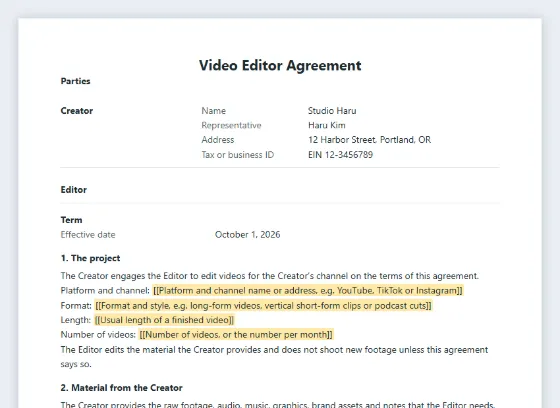
Video Editor Agreement
Parties: Creator · Editor
1. The project
The Creator engages the Editor to edit videos for the Creator’s channel on the terms of this agreement.
Platform and channel: [[Platform and channel name or address, e.g. YouTube, TikTok or Instagram]]
Format: [[Format and style, e.g. long-form videos, vertical short-form clips or podcast cuts]]
Length: [[Usual length of a finished video]]
Number of videos: [[Number of videos, or the number per month]]
The Editor edits the material the Creator provides and does not shoot new footage unless this agreement says so.
2. Material from the Creator
The Creator provides the raw footage, audio, music, graphics, brand assets and notes that the Editor needs, in a usable form and in good time, through [[a shared folder / download links]]. The Creator states that it owns the material or has the rights it needs to hand it to the Editor for editing and to publish the finished videos, including the permission of the people who appear in it, and that, to its knowledge, the material does not infringe the rights of others. The Editor may rely on this statement and does not have to check where material comes from, but it tells the Creator if some material looks unusable or may cause a rights problem. The source material stays the Creator’s.
3. Editing work and delivery
The Editor edits the videos as set out in this list:
Cuts and pacing: [[included / not included, with notes on style or reference videos]]
Captions and subtitles: [[included, in which languages / not included]]
Thumbnails: [[included, how many per video / not included]]
Colour correction and grading: [[included / not included]]
Sound clean-up and mixing: [[included / not included]]
The Editor delivers a first cut of each video within [[3]] business days of receiving the complete material, and the final video within [[2]] business days of the Creator’s approval or last feedback. A date moves by the time the Creator needs to provide material or feedback. The Editor delivers the final files in [[Format and resolution, e.g. MP4, 1080p or 4K, 16:9 or 9:16]] through [[a shared folder / a download link]].
4. Revisions
Each video includes [[2]] rounds of revisions. The Creator gives the feedback for a round in one consolidated list within [[5]] business days of receiving a cut. Correcting the Editor’s own mistakes does not count as a revision. Further rounds, and changes after the Creator has approved a video, such as a new cut for another platform or a change that needs new material, are charged at [[Rate per hour or per round]].
5. Fees and payment
The Creator pays the fees shown in the price schedule of this contract, charged [[per video / per hour / as a monthly retainer]]. A deposit of [[30]]% is payable before the work starts and is credited against the last invoice. Costs agreed in advance, such as stock footage, plug-ins, fonts or paid music, are charged at cost against receipts once the Creator has approved them in writing or in electronic form. If a payment is late, the Editor may pause the work after notifying the Creator and may claim interest or compensation for late payment as the law that applies provides.
6. Ownership of the videos
When the Creator has paid the fees for a video in full, the Editor assigns to the Creator, as far as the law that applies allows, the rights that arise from the Editor’s work on that video. Where the law that applies does not allow this, the Editor grants the Creator an exclusive, perpetual licence to use the video in the same way. Until payment the Creator may use the video only to review and approve it, unless the Editor agrees otherwise in writing or in electronic form.
The Creator’s source material, such as footage, music and brand assets, stays the Creator’s at all times. The Editor keeps its general tools, presets, templates, techniques and know-how, including those it develops while working on the videos, and may use them for others, but it does not reuse the Creator’s material or brand assets.
7. Credit and portfolio
Credit for the Editor: [[The credit wording, e.g. “Edited by name” in the video description / no credit]]
The Editor may show a finished video, or excerpts of it, in its portfolio, on its website and on social media only with the Creator’s consent. The Creator’s decision: [[no portfolio use / portfolio use after the video is published, without naming the channel / portfolio use after the video is published, naming the channel]]
8. Use of AI tools
Before it uses an AI tool on the Creator’s material, the Editor tells the Creator which tools it uses and for what, for example for transcription, captions, noise removal, upscaling or generated images. Tools the Editor expects to use: [[none / the tools and what for]]
The Editor does not upload the Creator’s unreleased footage, audio, scripts or other material to a tool or service that keeps it, uses it to train a model or lets others see it, unless the Creator has agreed in writing or in electronic form.
The Editor checks AI-made output such as captions before delivery and tells the Creator which parts of a video were created or changed with AI tools, so that the Creator can label them where the law or the rules of the platform require.
9. Access to accounts
The Creator never has to give the Editor a password or a two-step verification code. Files are exchanged through [[a shared folder / download links / upload by the Editor to the Creator’s channel with a limited role]].
If the Creator gives the Editor a role on a channel or in a tool, it gives only the rights the work needs, using the role feature of the platform, and may withdraw the role at any time. The Editor does not share the access, does not change channel, ownership, payment or monetisation settings, and does not publish unless the Creator asks it to in writing or in electronic form. When this agreement ends, the Creator removes the access and the Editor deletes any shared link or means of access it still holds.
10. Music and third-party content
[[The Creator / The Editor]] obtains the licences for music, sound effects, stock footage, fonts and other third-party content used in the videos. Where the Editor obtains it, it names the source and the licence terms and charges the cost only after the Creator has approved it.
The Editor adds no third-party content that the Creator has not approved. The rules of platforms on music, sponsored content and copyright claims differ, and the Creator decides where and how a video is published. If a rights holder objects to an item in a delivered video, the parties tell each other without delay, and the Editor helps to replace the item at [[Rate per hour]].
11. Confidentiality
The Editor keeps the Creator’s unreleased videos, scripts, release dates, sponsor and brand details and account information confidential and uses them only for this agreement, except where the law requires disclosure or the information is already public. The Editor does not publish or show an unreleased video before the Creator has released it. At the Creator’s request, or [[90]] days after this agreement ends, the Editor deletes the Creator’s material, apart from what the law requires it to keep. This duty lasts [[3]] years after this agreement ends.
12. Results and liability
The Editor works with reasonable care and skill but does not promise any number of views or subscribers, any income or advertising revenue, any sponsorship or any monetisation. Decisions of the platform, such as age limits, the loss of monetisation or copyright claims, are the platform’s.
Except for intent, gross negligence, personal injury or where the law does not allow a limitation, each party’s total liability under this agreement is limited to [[the fees paid or payable under this agreement / a fixed amount]].
13. Independent contractor
As far as the law that applies allows, the Editor works as an independent contractor and not as an employee of the Creator. The Editor decides how, where and when to work within the agreed dates, uses its own equipment and software, may work for other clients, and is responsible for its own taxes, social contributions and insurance as the law that applies requires.
How the law treats freelancers differs by country. Where mandatory law treats the relationship differently, mandatory law prevails over this clause.
14. Termination
Either party may end this agreement by [[7]] days’ notice in writing or in electronic form. Either party may end it at once by notice if the other party seriously breaches it and does not put this right within [[7]] days of being asked to.
When the agreement ends, the Creator pays the fees for the videos delivered and, for a video in progress, the share of its fee that matches the work done. Amounts already paid are credited and any excess is refunded. The Editor hands over the work in progress after payment, and the rights in what the Creator has paid for pass as stated under Ownership of the videos. The clauses on ownership, AI tools, confidentiality and liability continue after the end.
15. Governing law and disputes
This agreement is governed by the law stated under Governing law. The parties will first try to settle any dispute in good faith. Otherwise the courts stated under Jurisdiction decide, unless mandatory law provides otherwise.
Payment terms
Each invoice is payable within [[14]] days of receiving it, by bank transfer to the account stated on the invoice. The deposit is payable before the work starts. The Editor delivers the final files of a video [[on payment of the invoice for it / with that invoice]].
Governing law
[[Country or state whose law applies]]
Jurisdiction
[[Courts that decide disputes, e.g. the courts of your city]]
How to use it
Choose the template
Press the button to use this template. If you are not signed in, you first sign in or sign up for free and then come straight back to it.
Start a draft
The new-contract page opens with this template marked. Press its card to create a draft. Your company details fill in Party A, and you fill in the blanks, the other party and, where the template has one, the price schedule.
Send it for signature
You sign first, then send each signer a secure link and, by another route, an access code. Signers need no account.
Next steps
Your client opens the link on any device and needs no account. See what the signing looks like on the E-Contracts page, and read which kind of electronic signature is enough for which document.
Already signed? Make the invoice from the signed contract: the parties and the price lines carry over, in full or for a deposit. The guide on turning a quotation into an invoice shows how to review the new draft, its dates and the PDF.
What it is, and what it is not
QuoteBill creates a simple electronic signature with an audit trail. In the EU, the UK, the US and Korea a signature is not denied legal effect only because it is electronic, and in Japan most contracts need no particular form at all. What a simple electronic signature proves in a dispute depends on the evidence behind it, and some documents need another form.
It is not a qualified or advanced electronic signature, and QuoteBill does not verify who the signers are. It records the use of the link and access code you delivered, so anyone who has both can sign. The signature certificate lists every link issued and, for each action by the sender or a signer, its IP address and browser where they could be read.
Some documents need another form. Wills, many real-estate transfers, guarantees and some employment documents must, in some countries, be handwritten, notarised or signed with a qualified signature. The templates are samples, not legal advice: review them with a lawyer.
Other contract templates
Website design and development agreement
Pages and scope, client content, design sign-off, launch, warranty and ownership of the site.
Graphic design agreement
Concepts and revisions, final files, usage rights, fonts and stock licences, credit and a kill fee.
Photography agreement
Shoot date, deliverables, usage licence, releases, cancellation, overtime and lost images.
Video production agreement
Script and storyboard, shoot days, edits and revisions, delivery formats, footage rights and licences.