Voice-over and talent agreement template
A voice talent is booked for recording sessions: fee, usage rights, buy-out or royalties, credit and minors. A sample contract you can read in full, edit in QuoteBill and sign online with a secure link.
Sample — review with a lawyer · Simple electronic signature with an audit trail
Who it is for
For a studio, agency or business that hires a voice actor or narrator, and for the voice talent, who want sessions, fee, usage, credit and protection of the voice from synthetic copies in writing.
Rules on performers’ rights, buy-outs, royalties and employment status, and on work by children, differ by country; where a minor records, a parent or guardian is added as a further party.
What it covers
14 clauses, in this order. Each one is in the sample text below, and you can edit, remove or add clauses before you send.
1. Purpose
What the agreement is for: the Talent records the voice work below for the Producer, and how the recordings may be used.
2. The project and the role
Blanks for the project, the role (narration or a character, language, accent) and the script length. The Producer supplies script and directions before each session and reports changes early.
3. Recording sessions
Blanks for dates, place (the Producer’s or the Talent’s own studio), session length and file format. A set number of pick-up sessions is included for a set time; further sessions are charged at a rate in a blank.
4. Fee and expenses
The fee comes from the price schedule. Expenses agreed in advance are paid at cost against receipts. The fee covers only the uses stated under Usage rights.
5. Usage rights
Blanks for media, territory and term, and whether the fee is a buy-out or a usage fee with royalties. Any other use needs the Talent’s consent and may cost extra. Performers’ rights that cannot be assigned are unaffected.
6. The Talent’s voice and synthetic voices
The Talent keeps its rights in its voice, manner of speaking and name. The recordings are not used to create, train or test a synthetic or cloned voice or digital replica unless the Talent agrees separately.
7. Editing and approval
The Producer may cut, clean and mix the recording but not rearrange the Talent’s words into something new or change their meaning. A blank says whether the Talent may hear the final mix before release.
8. Content and association
The Producer says before the first session what the project is, including whether it is political, adult or promotes a controversial cause. The Talent need not record unlawful, hateful or harmful content, and no suggested endorsement.
9. Credit
Where credits are customary, the Talent is credited with the wording in a blank, and a missing credit is corrected as soon as it is noticed.
10. Cancellation and postponement
If the Producer cancels or postpones on short notice, it pays a share of that session’s fee. If the Talent is ill or has an emergency, they agree a new date. Further claims are excluded as far as the law allows.
11. Minors and guardians
For a person under a set age, or too young to sign alone where they live, a parent or guardian signs as a further party, named in a blank. The Producer follows the rules on work by children, and fees are paid as the law requires.
12. Confidentiality and files
The Talent keeps the script and project confidential until release. The Producer keeps the Talent’s raw files safe, uses them only for the project and deletes them a set number of days after final delivery.
13. Warranties, liability and independence
The Talent is free to make the recording and the Producer may use the script. Liability is capped by a blank, with the legal exceptions. The Talent is independent as far as the law allows, and its legal protections stay.
14. Governing law and disputes
The law you name applies. The sides first try to settle a dispute in good faith, and otherwise the courts you name decide.
A price schedule (items, quantities and prices) is part of this contract. It starts empty, in your currency, and the clauses on fees and payment point to it.
The sample text
The whole sample, as QuoteBill starts it. Text in double square brackets, like [[10]], is a blank to fill in or check. A figure or time such as [[10]] that you leave as it is is used as shown when you send; a blank that needs your own words must be filled first. The clause text is written in English, Korean, Japanese and German; in other languages a contract starts in English for you to translate.
Read the sample text
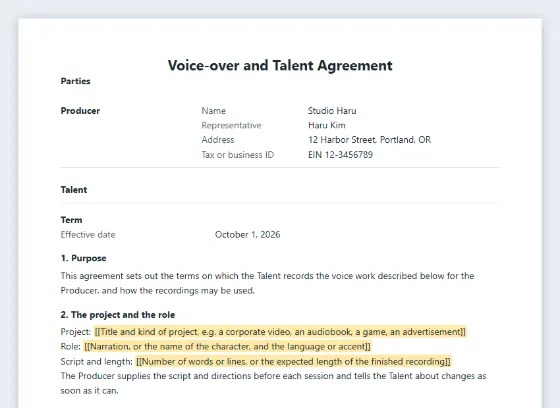
Voice-over and Talent Agreement
Parties: Producer · Talent
1. Purpose
This agreement sets out the terms on which the Talent records the voice work described below for the Producer, and how the recordings may be used.
2. The project and the role
Project: [[Title and kind of project, e.g. a corporate video, an audiobook, a game, an advertisement]]
Role: [[Narration, or the name of the character, and the language or accent]]
Script and length: [[Number of words or lines, or the expected length of the finished recording]]
The Producer supplies the script and directions before each session and tells the Talent about changes as soon as it can.
3. Recording sessions
The recording sessions take place on [[Dates]] at [[the Producer’s studio / the Talent’s own studio]] and last about [[2]] hours each. Where the Talent records at its own studio, it delivers clean, unprocessed files in [[the agreed format, e.g. WAV, 48 kHz, 24 bit]] by [[Delivery date]].
[[2]] pick-up sessions for corrections and changes to the script are included for [[12]] months after the first session. Further sessions are charged at [[Session rate]].
4. Fee and expenses
The Producer pays the fees shown in the price schedule of this contract. Expenses that were agreed in advance, such as travel, are paid at cost against receipts. The fee covers the uses stated under Usage rights and no others.
5. Usage rights
The Producer may use the recording in the Project within these limits:
Media: [[Media, e.g. online, TV, radio, in-game]]
Territory: [[Territory, e.g. worldwide]]
Term: [[Term, e.g. 2 years from first release / without a time limit]]
The fee is [[a buy-out for these uses / a usage fee for these uses, with royalties as shown in the price schedule]].
A use outside these limits, such as another project, another medium or a longer term, needs the Talent’s consent in writing or in electronic form and may carry a further fee. Rights and remuneration that the law gives to performers and that cannot be assigned, for example through collecting societies, are not affected by this agreement.
6. The Talent’s voice and synthetic voices
The Talent keeps all rights in its own voice, in its manner of speaking and in its name. The Producer does not use the recordings, or any other recording of the Talent, to train, test or create a synthetic or cloned voice or a digital replica of the Talent, and does not let anyone else do so, unless the Talent has agreed separately in writing or in electronic form: [[no exception / the exception agreed]]
7. Editing and approval
The Producer may edit the recording for the Project, for example cut it to length, remove noise and mix it with music and sound effects. It does not rearrange or combine the Talent’s words so that they say something new or change the meaning, and does not use the recording to create new lines.
The Talent may hear the final mix before release: [[yes / no]]
8. Content and association
Before the first session the Producer tells the Talent what the Project is about, including whether it is political, adult in nature or promotes a controversial product or cause: [[Nature of the Project]]. The Talent need not record content that it reasonably considers unlawful, hateful or harmful. The Producer does not use the recording to suggest that the Talent endorses a product, service or cause other than the Project.
9. Credit
The Producer credits the Talent as [[the credit wording, e.g. “Voice: name of the Talent” / no credit]] in the credits or the description of the Project, where credits are customary. If a credit is missing, the Producer puts this right as soon as it learns of it.
10. Cancellation and postponement
If the Producer cancels or postpones a session on less than [[48]] hours’ notice, it pays [[50]]% of the session fee for that session. If the Talent cannot attend because of illness or an emergency, it tells the Producer without delay and the parties agree a new date. Further claims are excluded as far as the law allows.
11. Minors and guardians
If the Talent is under [[18]] years old, or under the age at which it can sign for itself where it lives, a parent or legal guardian also signs this agreement as a further party, confirms that they have the authority to sign for the Talent and agrees to the recording. Parent or guardian: [[Name of parent or guardian and relationship]]
The Producer follows the rules that apply to work by children, such as hours, breaks, supervision and any permit or licence that is required, and a parent or guardian may attend the sessions. Fees for a minor are paid as the law that applies requires.
12. Confidentiality and files
The Talent keeps the script and the Project confidential until the Producer releases them and does not share the recordings before then. The Producer keeps the Talent’s raw files safe, uses them only for the Project and deletes them [[90]] days after the final delivery, unless it needs them to deal with a claim or the Talent agrees otherwise.
13. Warranties, liability and independence
The Talent states that it is free to make these recordings and that no agreement it has, for example with an agent, a guild or a union, prevents it. The Producer states that it has the right to use the script and any other material it provides.
Except for intent, gross negligence, personal injury or where the law does not allow a limitation, each party’s total liability under this agreement is limited to [[the fees paid or payable under it / a fixed amount]].
The Talent is engaged for this Project only. As far as the law that applies allows, it is an independent person and not an employee of the Producer; protections that the law that applies gives to performers stay as they are.
14. Governing law and disputes
This agreement is governed by the law stated under Governing law. The parties will first try to settle any dispute in good faith. Otherwise the courts stated under Jurisdiction decide, unless mandatory law provides otherwise.
Payment terms
The fee is payable within [[14]] days of receiving the invoice, or of the last session if that is later, by bank transfer to the account stated on the invoice.
Governing law
[[Country or state whose law applies]]
Jurisdiction
[[Courts that decide disputes, e.g. the courts of your city]]
How to use it
Choose the template
Press the button to use this template. If you are not signed in, you first sign in or sign up for free and then come straight back to it.
Start a draft
The new-contract page opens with this template marked. Press its card to create a draft. Your company details fill in Party A, and you fill in the blanks, the other party and, where the template has one, the price schedule.
Send it for signature
You sign first, then send each signer a secure link and, by another route, an access code. Signers need no account.
Next steps
Your client opens the link on any device and needs no account. See what the signing looks like on the E-Contracts page, and read which kind of electronic signature is enough for which document.
Already signed? Make the invoice from the signed contract: the parties and the price lines carry over, in full or for a deposit. The guide on turning a quotation into an invoice shows how to review the new draft, its dates and the PDF.
What it is, and what it is not
QuoteBill creates a simple electronic signature with an audit trail. In the EU, the UK, the US and Korea a signature is not denied legal effect only because it is electronic, and in Japan most contracts need no particular form at all. What a simple electronic signature proves in a dispute depends on the evidence behind it, and some documents need another form.
It is not a qualified or advanced electronic signature, and QuoteBill does not verify who the signers are. It records the use of the link and access code you delivered, so anyone who has both can sign. The signature certificate lists every link issued and, for each action by the sender or a signer, its IP address and browser where they could be read.
Some documents need another form. Wills, many real-estate transfers, guarantees and some employment documents must, in some countries, be handwritten, notarised or signed with a qualified signature. The templates are samples, not legal advice: review them with a lawyer.
Other contract templates
Website design and development agreement
Pages and scope, client content, design sign-off, launch, warranty and ownership of the site.
Graphic design agreement
Concepts and revisions, final files, usage rights, fonts and stock licences, credit and a kill fee.
Photography agreement
Shoot date, deliverables, usage licence, releases, cancellation, overtime and lost images.
Video production agreement
Script and storyboard, shoot days, edits and revisions, delivery formats, footage rights and licences.