Performance and booking agreement (DJ, band, speaker) template
A booked performance: date, fee and deposit, technical needs, recording, cancellation and events beyond control. A sample contract you can read in full, edit in QuoteBill and sign online with a secure link.
Sample — review with a lawyer · Simple electronic signature with an audit trail
Who it is for
For a DJ, band, speaker, entertainer or other artist booked for an event, and the organiser booking them, when the date, fee, equipment, recording and cancellation should be agreed in writing.
Taxes, work permits and music licensing for a performance differ by country, especially when the performer travels abroad; check them for the country of the event.
What it covers
15 clauses, in this order. Each one is in the sample text below, and you can edit, remove or add clauses before you send.
1. Purpose
What the agreement is for: the Organiser books the Performer for an event and the Performer agrees to perform.
2. The performance
Blanks for the event, date and venue, the type of performance and its length. The Performer decides content, style and set list within them.
3. Fee and deposit
The fee comes from the price schedule or a blank. A set percentage is due on signing as a deposit and is returned only if the Performer is ill or an event beyond control stops the show. Each side bears its own taxes.
4. Schedule and sound check
Blanks for the load-in, sound check and start times. Changes are announced early, and extra time at the Organiser’s request is charged at a set rate if the Performer agrees.
5. Technical requirements and rider
The Organiser provides stage, power, sound and lighting as listed or in an attached rider, tested before the sound check. The Performer brings its own instruments. Hospitality has a blank.
6. Travel and accommodation
A blank for who pays travel, accommodation and local transport, and the limits that apply where the Organiser pays against receipts.
7. Recording and promotion
The Organiser may use the Performer’s name and supplied photos to promote the event. Recording or livestreaming needs written consent that states the use. The Performer keeps all rights in the performance.
8. Licences and permits
The Organiser obtains and pays for the licences and permits for the venue and event, such as for public performance of music. The Performer arranges its own work permit or visa. Blanks allow other splits.
9. Cancellation by the Organiser
Early cancellation costs the deposit, later cancellation a set share of the fee and very late cancellation all of it. The Performer tries to fill the date and credits what it earns.
10. Illness and cancellation by the Performer
If the Performer cannot perform, it tells the Organiser at once and offers a new date or a comparable replacement. If neither is accepted, it refunds what it was paid.
11. Events beyond control
Severe weather, an official order or a venue closure excuses both sides. They try to agree a new date; otherwise a blank decides whether payments are refunded in full or less costs already incurred.
12. Safety and conduct
The Organiser provides a safe stage, power, security and a lockable room for equipment. The Performer follows reasonable house rules and may stop the show in serious danger.
13. Liability
Each side answers for damage it causes. The Organiser answers for venue and audience safety and for equipment damaged there. Other loss is capped at the fee, with the usual exceptions such as intent and personal injury.
14. Independent parties
The Performer is an independent business or artist; no employment, partnership or agency is created, and the Organiser gives no instructions on how to perform.
15. Governing law and disputes
The law you name applies. The sides first try to settle a dispute in good faith, and otherwise the courts you name decide.
A price schedule is optional: add one if you want the amounts in a table, or write the agreed amount into the payment clause.
The sample text
The whole sample, as QuoteBill starts it. Text in double square brackets, like [[10]], is a blank to fill in or check, and QuoteBill does not let you send a contract while one is left. The clause text is written in English, Korean, Japanese and German; in other languages a contract starts in English for you to translate.
Read the sample text
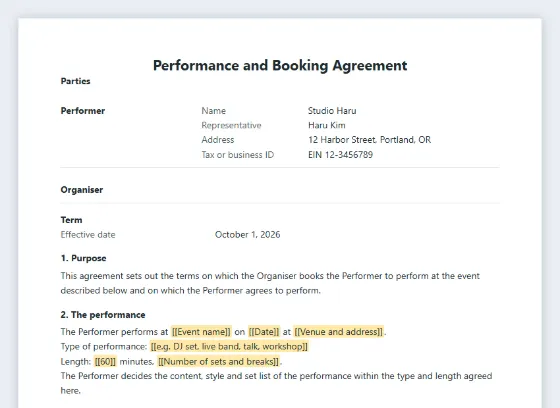
Performance and Booking Agreement
Parties: Performer · Organiser
1. Purpose
This agreement sets out the terms on which the Organiser books the Performer to perform at the event described below and on which the Performer agrees to perform.
2. The performance
The Performer performs at [[Event name]] on [[Date]] at [[Venue and address]].
Type of performance: [[e.g. DJ set, live band, talk, workshop]]
Length: [[60]] minutes, [[Number of sets and breaks]].
The Performer decides the content, style and set list of the performance within the type and length agreed here.
3. Fee and deposit
The Organiser pays the Performer the fee shown in the price schedule of this contract or, if there is none, [[Fee and currency]], on the payment terms stated in this contract. A deposit of [[30]]% is due on signing to confirm the booking; it is not refundable except as stated under Illness and cancellation by the Performer and Events beyond control. The balance is due as stated in the payment terms.
Each party is responsible for its own taxes. Where the law requires the Organiser to withhold tax or social contributions from the fee, it may do so and gives the Performer proof of the amounts paid over.
4. Schedule and sound check
The Organiser gives the Performer and its crew access to the venue from [[Load-in time]]. The sound check takes place at [[Sound check time]] and the performance starts at [[Start time]]. The Organiser tells the Performer of any change to the running order as early as it can. If the performance starts late or is extended at the Organiser’s request, the Performer may charge [[Overtime rate]] per hour or part hour for the additional time, if it agrees to the extension.
5. Technical requirements and rider
The Organiser provides the stage, power, sound system, lighting, backline and other equipment as described here: [[Technical requirements, or attach the rider]]
The Performer brings its own instruments, equipment and any items listed here as its own: [[List]]
Hospitality and meals: [[Hospitality, or none]]
The equipment the Organiser provides must be in working order and tested before the sound check.
6. Travel and accommodation
Travel to and from the venue, accommodation, parking and local transport are [[paid by the Organiser / paid by the Performer / included in the fee]]. Where the Organiser pays, it books or reimburses the costs against receipts, within the limits stated here: [[Limits, e.g. economy travel and a standard hotel room]]
7. Recording and promotion
The Organiser may use the Performer’s name, logo and the promotional photos the Performer supplies to advertise the event. Audio or video recording, livestreaming or broadcasting of the performance needs the Performer’s consent in writing or in electronic form, which states how the recording may be used. Recording by the Organiser: [[not allowed / allowed for the following use]]
The Performer keeps all rights in its performance and material. The venue’s rules on photography and recording by the audience apply, and the Organiser asks the audience to follow them.
8. Licences and permits
The Organiser obtains the permits and licences needed for the venue and the event, such as for public performance of music, safety, capacity and noise, and pays the fees for them, unless the parties write otherwise here: [[none / the exceptions]]
The Performer is responsible for any permit it needs to work in the country of the venue, such as a work permit or visa, unless the parties write otherwise here: [[none / the exceptions]]
9. Cancellation by the Organiser
If the Organiser cancels more than [[30]] days before the performance, the Performer keeps the deposit. If it cancels [[30]] days or less before, [[50]]% of the fee is due, and if it cancels [[7]] days or less before, the full fee is due. The Performer makes reasonable efforts to take another booking for the date, and any amount it earns from one reduces the amount due.
10. Illness and cancellation by the Performer
If the Performer cannot perform because of illness, an accident or another serious reason, it tells the Organiser as soon as it can and offers a new date or a comparable replacement performer. If the Organiser accepts neither, the Performer refunds the deposit and any other amount paid. Further claims are excluded as far as the law allows.
11. Events beyond control
Neither party is liable for failing to perform because of an event beyond its control, such as severe weather, an official order, a power failure, a serious accident or the closure of the venue. The affected party tells the other without delay. The parties try to agree on a new date. If they cannot, amounts already paid are [[refunded in full / refunded less the costs the Performer has already incurred]].
12. Safety and conduct
The Organiser provides a safe place to perform, including a stable stage, a safe power supply, suitable security and crowd management, and a lockable room for the Performer’s equipment. The Performer follows the venue’s reasonable safety and house rules and may stop the performance if there is a serious danger.
13. Liability
Each party is liable for damage it causes, as the law provides. The Organiser is responsible for the safety of the venue and the audience and for damage to the Performer’s equipment caused by the venue, its staff or the audience. The Performer does not promise a particular attendance or audience response. Except for intent, gross negligence, personal injury or where the law does not allow a limitation, each party’s liability for other loss is limited to the fee.
14. Independent parties
The Performer is an independent business or artist. This agreement does not create an employment, partnership or agency relationship, and the Organiser gives no instructions on how the Performer performs.
15. Governing law and disputes
This agreement is governed by the law stated under Governing law. The parties will first try to settle any dispute in good faith. Otherwise the courts stated under Jurisdiction decide, unless mandatory law provides otherwise.
Payment terms
The deposit is payable within [[7]] days of signing and the balance [[on the day of the performance, before it starts]], by [[bank transfer to the account stated on the invoice / cash against a receipt]].
Governing law
[[Country or state whose law applies]]
Jurisdiction
[[Courts that decide disputes, e.g. the courts of your city]]
How to use it
Choose the template
Press the button to use this template. If you are not signed in, you first sign in or sign up for free and then come straight back to it.
Start a draft
The new-contract page opens with this template marked. Press its card to create a draft. Your company details fill in Party A, and you fill in the blanks, the other party and, where the template has one, the price schedule.
Send it for signature
You sign first, then send each signer a secure link and, by another route, an access code. Signers need no account.
Next steps
Your client opens the link on any device and needs no account. See what the signing looks like on the E-Contracts page, and read which kind of electronic signature is enough for which document.
Already signed? Make the invoice from the signed contract: the parties and the price lines carry over, in full or for a deposit. The guide on turning a quotation into an invoice shows how to review the new draft, its dates and the PDF.
What it is, and what it is not
QuoteBill creates a simple electronic signature with an audit trail. In the EU, the UK, the US and Korea a signature is not denied legal effect only because it is electronic, and in Japan most contracts need no particular form at all. What a simple electronic signature proves in a dispute depends on the evidence behind it, and some documents need another form.
It is not a qualified or advanced electronic signature, and QuoteBill does not verify who the signers are. It records the use of the link and access code you delivered, so anyone who has both can sign. The signature certificate lists every link issued and, for each action by the sender or a signer, its IP address and browser where they could be read.
Some documents need another form. Wills, many real-estate transfers, guarantees and some employment documents must, in some countries, be handwritten, notarised or signed with a qualified signature. The templates are samples, not legal advice: review them with a lawyer.
Other contract templates
Website design and development agreement
Pages and scope, client content, design sign-off, launch, warranty and ownership of the site.
Graphic design agreement
Concepts and revisions, final files, usage rights, fonts and stock licences, credit and a kill fee.
Photography agreement
Shoot date, deliverables, usage licence, releases, cancellation, overtime and lost images.
Video production agreement
Script and storyboard, shoot days, edits and revisions, delivery formats, footage rights and licences.