Bookkeeping and accounting services agreement template
A bookkeeper or accountant keeps a client’s books and prepares reports: services, what is not included, deadlines, fees. A sample contract you can read in full, edit in QuoteBill and sign online with a secure link.
Sample — review with a lawyer · Simple electronic signature with an audit trail
Who it is for
For a freelance bookkeeper, accountant or accounting firm and a small business or individual who hires them, who want the services, the records, the deadlines and the fees written down.
Accounting, tax and audit services are licensed or restricted in many countries, and tax filing, record-keeping and data rules differ; check what the provider may do and what applies before you sign.
What it covers
13 clauses, in this order. Each one is in the sample text below, and you can edit, remove or add clauses before you send.
1. Purpose
What the agreement is for: the bookkeeping and accounting services the Service Provider performs for the Client, what each side must do and how the fees are paid.
2. Services
A blank to describe the services and deliverables, such as recording transactions, reconciliations, reports and annual accounts. Anything not described is extra work.
3. What is not included
Tax advice, legal advice, audits, financial planning and representing the Client before authorities are out unless a blank adds them. Reserved services are done only by someone licensed.
4. Licence and professional standards
A blank for the licence or registration the law requires. The provider works with reasonable care under the accounting rules that apply and says at once if it loses a licence it needs.
5. Client’s duties
The Client delivers complete, correct records by a date in a blank, keeps the originals and stays responsible for its records, its decisions, approving the accounts and its own filings. A contact person is named.
6. Schedule and deadlines
Blanks for the report dates and the annual accounts. The provider meets authority deadlines for agreed filings if it has complete records by a set date. Late records push its dates back.
7. Fees and invoicing
Fees come from the price schedule, with a choice of fixed, hourly or per document. Extra work is approved first and charged at a blank rate; expenses are at cost with approval.
8. Records, access and handover
The provider keeps the records safe and uses them only for the services. Blanks name the systems and the days to hand records back; copies only as far as the law requires.
9. Confidentiality and personal data
Financial and business information stays confidential for a blank number of years. Personal data in the records is processed only for the services and as the law requires, with a separate agreement where needed.
10. Errors and liability
Errors the provider caused are corrected free if reported in time. A blank sets the cap on liability, with the usual exceptions. Fines caused by the Client’s late or incomplete records stay with the Client.
11. Term and termination
Blanks for the term, renewal and notice. Either side may end it for serious breach. The Client pays for work done, records are handed back, and filing deadlines in the notice period stay with the provider.
12. Independent parties and changes
The provider is an independent business, not an employee, and answers for its staff and subcontractors. This contract is the whole agreement; changes need both sides’ written or electronic agreement.
13. Governing law and disputes
The law you name applies. The sides first try to settle a dispute in good faith, and otherwise the courts you name decide.
A price schedule (items, quantities and prices) is part of this contract. It starts empty, in your currency, and the clauses on fees and payment point to it.
The sample text
The whole sample, as QuoteBill starts it. Text in double square brackets, like [[10]], is a blank to fill in or check. A figure or time such as [[10]] that you leave as it is is used as shown when you send; a blank that needs your own words must be filled first. The clause text is written in English, Korean, Japanese and German; in other languages a contract starts in English for you to translate.
Read the sample text
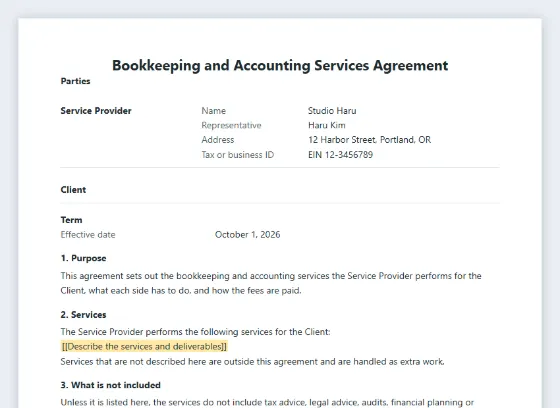
Bookkeeping and Accounting Services Agreement
Parties: Service Provider · Client
1. Purpose
This agreement sets out the bookkeeping and accounting services the Service Provider performs for the Client, what each side has to do, and how the fees are paid.
2. Services
The Service Provider performs the following services for the Client:
[[Describe the services and deliverables]]
Services that are not described here are outside this agreement and are handled as extra work.
3. What is not included
Unless it is listed here, the services do not include tax advice, legal advice, audits, financial planning or representing the Client before authorities: [[none / the additional services included]]
Where the law reserves a service to a licensed or registered professional, only a person who holds the required licence performs it.
4. Licence and professional standards
The Service Provider confirms that it holds the registrations and licences that the law that applies requires for the services in this agreement: [[Licence or registration, or: none required]]
It works with reasonable care and skill, following the accounting rules that apply to the Client, and tells the Client at once if it loses a licence it needs.
5. Client’s duties
The Client gives the Service Provider complete, correct and timely records and information in the agreed form, by [[Date in each period, e.g. the 10th of each month]].
The Client keeps the original documents as the law requires, and stays responsible for the content of its records, for its own decisions, for approving the accounts and for any filing that the law makes the Client’s own duty.
The Client’s contact person: [[Name and contact details]]
6. Schedule and deadlines
The Service Provider delivers [[monthly / quarterly]] reports by [[Date, or number of days after the period]] and the annual accounts by [[Date]].
The Service Provider meets the deadlines set by authorities for the filings it has agreed to make, provided it receives complete records by [[Date, or number of days before the deadline]].
If the Client delivers records late or incomplete, the Service Provider’s dates move by the same time.
7. Fees and invoicing
The Client pays the fees shown in the price schedule of this contract, which are charged [[as a fixed amount per period / by the hour / per document]].
Work outside the services described is charged at [[Hourly rate]] per hour after the Client has approved it in writing or in electronic form. Expenses, such as filing fees, are charged at cost with the Client’s prior approval.
The Service Provider invoices [[monthly in arrears]], and the Client pays on the payment terms stated in this contract. Taxes are added where the law requires.
8. Records, access and handover
The Service Provider keeps the Client’s records safe and uses them only for the services. The Client gives access to [[Systems, e.g. bank feeds or accounting software]] only as far as needed. The Service Provider keeps its working papers for as long as the law that applies requires.
The Service Provider hands over the Client’s records and data in a usual format within [[14]] days after this agreement ends or the Client asks, and may keep copies only as far as the law that applies requires.
9. Confidentiality and personal data
The Service Provider keeps the Client’s financial and business information confidential, uses it only for the services and shares it only with staff and subcontractors who need it and are bound to confidentiality, except where the law requires disclosure. The duty continues for [[5]] years after this agreement ends, or longer where the law requires.
Personal data in the Client’s records, such as that of customers, suppliers or employees, is processed only for the services and as the law that applies requires. Where the law requires a separate agreement on data processing, the parties sign one: [[not needed / the agreement to be signed]]
10. Errors and liability
The Service Provider corrects errors it caused at no extra charge if the Client tells it within [[30]] days after receiving the work or, if later, within a reasonable time after finding the error.
Except for intent, gross negligence, personal injury or where the law does not allow a limitation, the Service Provider’s total liability under this agreement is limited to [[Amount, or the fees paid in the previous 12 months]].
Fines, interest or surcharges that authorities impose because the Client delivered records late or incomplete, or did not follow the Service Provider’s advice, are borne by the Client.
11. Term and termination
This agreement starts on the effective date and runs for [[12]] months. After that it [[renews for further periods of one month / ends]] unless a party ends it.
Either party may end it with [[30]] days’ notice in writing or in electronic form, or at once if the other seriously breaches it and does not remedy the breach within [[14]] days of being asked to.
The Client pays the fees for services performed until the end date, and the Service Provider hands over the records as stated above. Deadlines of authorities that fall within the notice period stay the Service Provider’s duty for the filings it agreed to make.
12. Independent parties and changes
The Service Provider is an independent business, not the Client’s employee, and decides how it performs the services. It may use staff or subcontractors who are bound by the same duties and stays responsible for them. This contract is the entire agreement between the parties on the services. Changes are valid only if both parties agree to them in writing or in electronic form.
13. Governing law and disputes
This agreement is governed by the law stated under Governing law. The parties will first try to settle any dispute in good faith. Otherwise the courts stated under Jurisdiction decide, unless mandatory law provides otherwise.
Payment terms
The fees are invoiced [[monthly in arrears]] and are payable within [[14]] days of receiving the invoice, by bank transfer to the account stated on the invoice.
Governing law
[[Country or state whose law applies]]
Jurisdiction
[[Courts that decide disputes, e.g. the courts of your city]]
How to use it
Choose the template
Press the button to use this template. If you are not signed in, you first sign in or sign up for free and then come straight back to it.
Start a draft
The new-contract page opens with this template marked. Press its card to create a draft. Your company details fill in Party A, and you fill in the blanks, the other party and, where the template has one, the price schedule.
Send it for signature
You sign first, then send each signer a secure link and, by another route, an access code. Signers need no account.
Next steps
Your client opens the link on any device and needs no account. See what the signing looks like on the E-Contracts page, and read which kind of electronic signature is enough for which document.
Already signed? Make the invoice from the signed contract: the parties and the price lines carry over, in full or for a deposit. The guide on turning a quotation into an invoice shows how to review the new draft, its dates and the PDF.
What it is, and what it is not
QuoteBill creates a simple electronic signature with an audit trail. In the EU, the UK, the US and Korea a signature is not denied legal effect only because it is electronic, and in Japan most contracts need no particular form at all. What a simple electronic signature proves in a dispute depends on the evidence behind it, and some documents need another form.
It is not a qualified or advanced electronic signature, and QuoteBill does not verify who the signers are. It records the use of the link and access code you delivered, so anyone who has both can sign. The signature certificate lists every link issued and, for each action by the sender or a signer, its IP address and browser where they could be read.
Some documents need another form. Wills, many real-estate transfers, guarantees and some employment documents must, in some countries, be handwritten, notarised or signed with a qualified signature. The templates are samples, not legal advice: review them with a lawyer.
Other contract templates
Service agreement
Services, deliverables, acceptance, fees and intellectual property.
Freelance or consulting agreement
Independent contractor work with fees, intellectual property and confidentiality.
Marketing services agreement
An agency runs campaigns: scope, ad spend paid separately, approvals, reporting and account ownership.
Social media management agreement
Running a business’s social accounts: posting, approvals, account access, replies, reporting and ownership.