Staffing or temporary agency agreement template
An agency supplies temporary workers to a client company: orders, rates, invoicing, safety and workers’ rights. A sample contract you can read in full, edit in QuoteBill and sign online with a secure link.
Sample — review with a lawyer · Simple electronic signature with an audit trail
Who it is for
For a staffing agency, or a company that uses one, who want the ordering, charge rates, invoicing, safety duties and replacement terms written down; local law sets the licence and the workers’ rights.
Agency work is regulated and differs by country: licences, workers’ rights, equal pay, maximum assignment length and fees are set by local law, and employment law is mandatory. Get local advice first.
What it covers
16 clauses, in this order. Each one is in the sample text below, and you can edit, remove or add clauses before you send.
1. Purpose
What the agreement is for: the Agency supplies workers to the Client for temporary assignments. The law of the country where the work is done decides who may supply workers and what rights they have, and it goes first.
2. Licence and status
The Agency confirms any licence or registration the law requires, with a blank for its number, and the Client confirms it may use agency workers. The Agency is the Workers’ employer unless the local law says otherwise.
3. Assignment orders
The Client orders Workers in writing, stating role, skills, number, place, dates, hours and rate. The Agency makes reasonable efforts without promising availability, and no assignment lasts longer than the law allows.
4. Direction and workplace
The Client directs the day-to-day work within the role, treats Workers without discrimination, provides a safe workplace, equipment, induction and the access the law requires, and gives no work outside the role or the law.
5. Rates and charges
Charge rates come from the price schedule or a blank, with a blank for overtime, travel and other charges. Taxes are added as the law requires, and the rates cover the Workers’ pay, the Agency’s legal costs and its fee.
6. Timesheets and invoicing
The Client approves timesheets within a set number of days or says which hours it disputes. Undisputed hours count as approved. The Agency invoices, the Client pays the undisputed part on time.
7. Workers’ pay and equal treatment
The Agency pays the Workers on time with the tax, contributions, leave and sick pay the law requires, whether or not it has been paid yet. The Client gives the information needed for equal treatment. Workers pay no fee.
8. Safety and training
Each side does what the law requires for safety. The Client gives the site induction and equipment, the Agency gives general information and checks the qualifications named in a blank. Accidents are reported at once.
9. Replacing a Worker
The Client may ask for a replacement with reasons, and the Agency supplies one within the days in a blank where it can. No Worker is removed for a reason the law protects, and the Agency may withdraw a Worker for legal or safety reasons.
10. Taking on a Worker directly
The Client may ask to take a Worker on directly under the legal rules. A blank sets any fee or period, which applies only as far as the law allows. A Worker is never blocked from a job or made to pay.
11. Confidentiality and personal data
Each side keeps the other’s confidential information secret, except where the law requires or allows disclosure. Each handles personal data, including the Workers’, as the law requires and answers for its own processing.
12. Liability and insurance
Each side carries the insurance the law requires, with a blank naming it, and answers for the loss it causes within the legal limits. A blank sets a limit where the law allows one, never for intent, gross negligence, injury or death.
13. Term and termination
The agreement starts on the effective date and is open-ended or fixed-term (you choose). Notice is a number of days in a blank, with immediate ending for serious breach or loss of a licence. Running assignments continue to their end.
14. Workers’ rights and mandatory law
The agreement reduces no right the law gives the Workers, who are not parties. If it gives less than the local law requires, that law applies. Information, written statements and forms the law requires are given.
15. Changes and notices
This contract is the whole agreement apart from rights the law gives and the orders under it. Changes need both sides’ written or electronic agreement where the law allows that form, and notices go to the addresses stated.
16. Governing law and disputes
The law you name applies. The sides first try to settle a dispute in good faith, and otherwise the courts you name decide.
A price schedule (items, quantities and prices) is part of this contract. It starts empty, in your currency, and the clauses on fees and payment point to it.
The sample text
The whole sample, as QuoteBill starts it. Text in double square brackets, like [[10]], is a blank to fill in or check. A figure or time such as [[10]] that you leave as it is is used as shown when you send; a blank that needs your own words must be filled first. The clause text is written in English, Korean, Japanese and German; in other languages a contract starts in English for you to translate.
Read the sample text
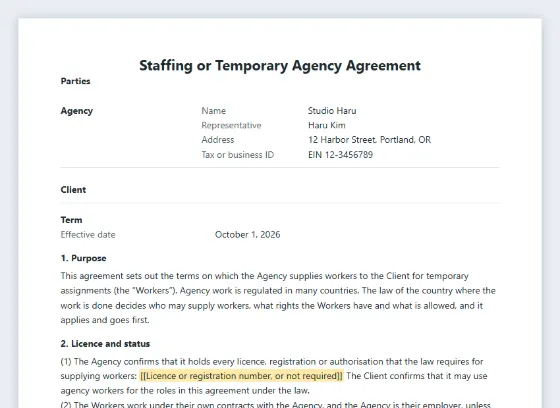
Staffing or Temporary Agency Agreement
Parties: Agency · Client
1. Purpose
This agreement sets out the terms on which the Agency supplies workers to the Client for temporary assignments (the “Workers”). Agency work is regulated in many countries. The law of the country where the work is done decides who may supply workers, what rights the Workers have and what is allowed, and it applies and goes first.
2. Licence and status
(1) The Agency confirms that it holds every licence, registration or authorisation that the law requires for supplying workers: [[Licence or registration number, or not required]] The Client confirms that it may use agency workers for the roles in this agreement under the law.
(2) The Workers work under their own contracts with the Agency, and the Agency is their employer, unless the law of the country where the work is done provides otherwise.
3. Assignment orders
(1) The Client asks for Workers by an order in writing or in electronic form that states the role, the skills or qualifications needed, the number of Workers, the place, the start date and expected length, the hours and the charge rate: [[Assignment details, or order form attached]]
(2) The Agency chooses suitable Workers and makes reasonable efforts to supply them, without promising that Workers will always be available. An assignment never lasts longer than the law allows.
(3) Before an assignment starts, the Agency gives each Worker the information about it that the law requires.
4. Direction and workplace
(1) During an assignment the Client directs the Worker’s day-to-day work within the role in the order, and treats the Worker with respect and without discrimination.
(2) The Client provides a safe workplace, the equipment and the site induction that the law requires, and gives the Worker the access to facilities and information that the law requires for agency workers.
(3) The Client does not give a Worker work that is outside the role, that the Worker is not trained or allowed to do, or that the law does not allow agency workers to do.
5. Rates and charges
(1) The Client pays the Agency the charge rates shown in the price schedule of this contract or, if there is none, [[Charge rate and currency per hour or day, by role]]
(2) Overtime, night, weekend and public-holiday work is charged at: [[the same rate / the rates or multiples]] Travel, expenses and other charges: [[none / the arrangement]]
(3) Taxes on the charges are added as the law requires. The charge rates cover the Workers’ pay, the costs that the law places on the Agency as employer, such as social contributions, insurance and leave, and the Agency’s fee.
6. Timesheets and invoicing
(1) The Client approves each Worker’s timesheet within [[3]] working days after the period ends, or tells the Agency within that time which hours it disputes. Hours that are not disputed are treated as approved.
(2) The Agency invoices the Client on the payment terms stated in this contract. The Client pays the undisputed part on time, and the parties settle any dispute in good faith.
7. Workers’ pay and equal treatment
(1) The Agency pays the Workers on time and withholds and pays the tax, social contributions and insurance that the law requires. It also gives the Workers the leave, sick pay and other benefits that the law requires, whether or not the Client has paid the Agency yet.
(2) Where the law gives agency workers the right to the same pay and conditions as the Client’s own staff, the Client gives the Agency the information needed to comply, and the charge rates are set with that in mind.
(3) The Agency does not charge a Worker a fee for finding or giving them an assignment.
8. Safety and training
(1) Each party does what the law requires of it for the Workers’ health and safety. The Client gives the site-specific safety induction and equipment. The Agency gives general safety information and checks that each Worker has the qualifications, licences and training required for the role: [[Required qualifications or training, or none]]
(2) The Worker and the Client tell the Agency at once about any accident, injury or serious safety concern, and the Agency and the Client cooperate in dealing with it and in making any report that the law requires.
9. Replacing a Worker
(1) If the Client considers that a Worker is not suitable, it tells the Agency with its reasons, and the Agency supplies a replacement within [[2]] working days where it can. The Client does not ask for a Worker to be removed or replaced for a reason that the law protects, such as discrimination.
(2) The Agency may withdraw a Worker where the law, the Worker’s rights or the Worker’s safety require it, and tells the Client without delay.
10. Taking on a Worker directly
(1) The Client may ask to take on a Worker directly. The parties then follow the rules that the law sets for this. Fee or notice for taking on a Worker directly: [[no fee / the fee, or the length of assignment after which no fee is due]]
(2) Such a fee applies only as far as the law allows. Nothing in this agreement stops a Worker from taking a job with the Client or anyone else, or makes the Worker pay.
11. Confidentiality and personal data
(1) Each party keeps the other’s confidential business information secret and uses it only for this agreement, except where the law requires or allows disclosure. The Agency makes sure that the Workers are bound, as the law allows, to keep the Client’s confidential information secret.
(2) Each party handles personal data, including the Workers’ data, as the law requires and is responsible for its own processing. The Client uses the Workers’ data only for the assignment.
12. Liability and insurance
(1) Each party carries the insurance that the law requires of it: [[Insurance held by the Agency and by the Client, or as required by law]]
(2) Each party is responsible for loss or damage it causes, within the limits the law sets. Limit of each party’s liability to the other, where the law allows a limit: [[Limit, or none]]
(3) No limit applies to liability for intent, gross negligence, injury or death, or to anything else that the law does not allow to be limited.
13. Term and termination
(1) This agreement starts on the effective date and is [[open-ended / for a fixed term ending on the end date]].
(2) Either party may end it by giving [[30]] days’ notice in writing or in electronic form. Either party may end it at once for a serious breach that is not put right within a reasonable time, or if the other party loses a licence that the law requires.
(3) Assignments already under way continue on the terms of their orders until they end, unless the parties agree otherwise. The Client pays for all work done up to the end.
14. Workers’ rights and mandatory law
This agreement does not reduce any right that the law gives the Workers, including rights to pay, safety, rest, equal treatment, and protection against dismissal and discrimination. The Workers are not parties to it. If anything in it would give a Worker less than the law of the country where the work is done requires, that law applies instead. Where that law requires information or a written statement to be given to a Worker, or a particular form for this agreement, the parties see that it is given and met.
15. Changes and notices
This contract, including its price schedule, is the entire agreement on the supply of Workers, apart from the rights the law gives and the orders under it. Changes are valid only if both parties agree to them in writing or in electronic form, where the law allows that form. Notices are given to the addresses stated for the parties, or to another address a party has notified.
16. Governing law and disputes
This agreement is governed by the law stated under Governing law. The parties will first try to settle any dispute in good faith. Otherwise the courts stated under Jurisdiction decide, unless mandatory law provides otherwise.
Payment terms
The Agency invoices the Client [[weekly / monthly]] in arrears for the hours worked as approved on the timesheets, plus taxes as the law requires. The Client pays each invoice within [[14]] days of receiving it, by bank transfer to the account the Agency names.
Governing law
[[Country or state whose law applies]]
Jurisdiction
[[Courts that decide disputes, e.g. the courts of your city]]
How to use it
Choose the template
Press the button to use this template. If you are not signed in, you first sign in or sign up for free and then come straight back to it.
Start a draft
The new-contract page opens with this template marked. Press its card to create a draft. Your company details fill in Party A, and you fill in the blanks, the other party and, where the template has one, the price schedule.
Send it for signature
You sign first, then send each signer a secure link and, by another route, an access code. Signers need no account.
Next steps
Your client opens the link on any device and needs no account. See what the signing looks like on the E-Contracts page, and read which kind of electronic signature is enough for which document.
Already signed? Make the invoice from the signed contract: the parties and the price lines carry over, in full or for a deposit. The guide on turning a quotation into an invoice shows how to review the new draft, its dates and the PDF.
What it is, and what it is not
QuoteBill creates a simple electronic signature with an audit trail. In the EU, the UK, the US and Korea a signature is not denied legal effect only because it is electronic, and in Japan most contracts need no particular form at all. What a simple electronic signature proves in a dispute depends on the evidence behind it, and some documents need another form.
It is not a qualified or advanced electronic signature, and QuoteBill does not verify who the signers are. It records the use of the link and access code you delivered, so anyone who has both can sign. The signature certificate lists every link issued and, for each action by the sender or a signer, its IP address and browser where they could be read.
Some documents need another form. Wills, many real-estate transfers, guarantees and some employment documents must, in some countries, be handwritten, notarised or signed with a qualified signature. The templates are samples, not legal advice: review them with a lawyer.
Other contract templates
Service agreement
Services, deliverables, acceptance, fees and intellectual property.
Freelance or consulting agreement
Independent contractor work with fees, intellectual property and confidentiality.
Marketing services agreement
An agency runs campaigns: scope, ad spend paid separately, approvals, reporting and account ownership.
Social media management agreement
Running a business’s social accounts: posting, approvals, account access, replies, reporting and ownership.