Freelance or consulting agreement template
Independent contractor work with fees, intellectual property and confidentiality. A sample contract you can read in full, edit in QuoteBill and sign online with a secure link.
Sample — review with a lawyer · Simple electronic signature with an audit trail
At a glance
- Between
- ContractorClient
- Contract
- 12 clauses · price schedule included
- To fill in
- 13 blanks · 6 of them already hold a figure
- Starts with
- Deliverables and schedule 7 days
- Confidentiality 2 years
- Non-solicitation 6 months
- Term and termination 14 days
- Signing
- You sign first; each signer gets a secure link and a separate access code, and needs no account.
Who it is for
For a freelancer, consultant or other independent contractor, and the client who hires them, when the work is done as the contractor’s own business and not as an employee.
Check before you sign
Whether someone is an independent contractor depends on how the work is really done and on the law where it is done.
What it covers
12 clauses, in this order. Each one is in the sample text below, and you can edit, remove or add clauses before you send.
1. Engagement
The Client hires the Contractor for the services described below, on the terms of the agreement.
2. Services
A blank where you describe the work. The Contractor decides how, when and where to do it, within the agreed deadlines.
3. Independent contractor
The Contractor works as their own business, not as an employee, and is responsible for their own taxes, social contributions, insurance and equipment.
4. Deliverables and schedule
What is delivered and when. The Client accepts each delivery or asks for specific corrections within a set number of days.
5. Fees, invoicing and payment
The fees come from the price schedule. You choose when the Contractor invoices: monthly, at each milestone or on completion.
6. Expenses
Expenses are repaid only if the Client approved them in advance and they are backed by receipts.
7. Intellectual property
When the Client has paid in full, the rights in the work pass to the Client, or an exclusive licence is granted. The Contractor may show non-confidential work in a portfolio unless the Client objects.
8. Confidentiality
The Contractor keeps the Client’s non-public information private and uses it only for the services, during the agreement and for a set number of years afterwards.
9. Non-solicitation
An optional clause: neither side actively encourages the other’s staff who worked on the job to leave. Delete it if you do not want it.
10. Term and termination
The agreement runs until the work is done or the end date. Either side can end it with notice, and the Client pays for the work done until then.
11. Liability
Each side’s liability is limited to the fees of a set recent period, except for intent, gross negligence, personal injury and cases where the law does not allow a limit.
12. Governing law and disputes
The law you name applies. The sides first try to settle a dispute in good faith, and otherwise the courts you name decide.
A price schedule (items, quantities and prices) is part of this contract. It starts empty, in your currency, and the clauses on fees and payment point to it.
Figures the sample starts with
These are the numbers the sample text sets. You can change any of them before you send.
| Clause | Starts with |
|---|---|
| Deliverables and schedule | 7 days |
| Confidentiality | 2 years |
| Non-solicitation | 6 months |
| Term and termination | 14 days |
| Liability | 12 months |
| Payment terms | 14 days |
The sample text
[[10]] = a blank to fill in
How the blanks work
The whole sample, as QuoteBill starts it. Text in double square brackets, like [[10]], is a blank to fill in or check. A figure or time such as [[10]] that you leave as it is is used as shown when you send; a blank that needs your own words must be filled first. The clause text is written in English, Korean, Japanese and German; in other languages a contract starts in English for you to translate.
Read the sample text
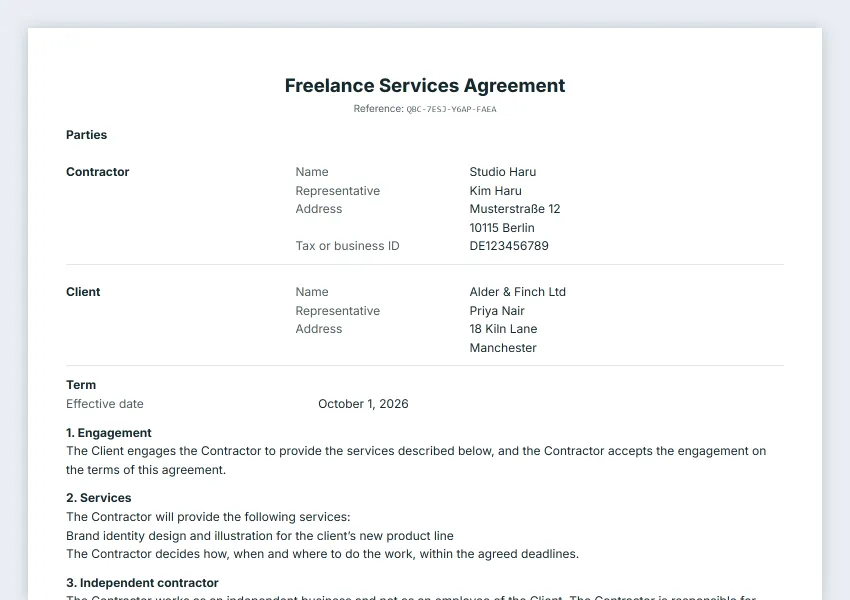
Freelance Services Agreement
Parties: Contractor · Client
1. Engagement
The Client engages the Contractor to provide the services described below, and the Contractor accepts the engagement on the terms of this agreement.
2. Services
The Contractor will provide the following services:
[[Describe the work, e.g. design, development or consulting]]
The Contractor decides how, when and where to do the work, within the agreed deadlines.
3. Independent contractor
The Contractor works as an independent business and not as an employee of the Client. The Contractor is responsible for their own taxes, social contributions, insurance and equipment, and may work for other clients.
4. Deliverables and schedule
The Contractor will deliver [[Deliverables]] according to this schedule: [[Dates or milestones]].
The Client will accept each delivery or ask for specific corrections within [[7]] days of receiving it.
5. Fees, invoicing and payment
The Client pays the fees shown in the price schedule of this contract. The Contractor invoices [[monthly, at each milestone or on completion]], and the Client pays each invoice on the payment terms stated in this contract.
6. Expenses
Expenses are reimbursed only if the Client approved them in advance and they are supported by receipts.
7. Intellectual property
When the Client has paid in full, the rights in the work made for the Client transfer to the Client or, where the applicable law does not allow a transfer, the Contractor grants the Client an exclusive, perpetual licence to use it. The Contractor may name the Client and show work that is not confidential in a portfolio unless the Client objects.
8. Confidentiality
The Contractor keeps the Client’s non-public information confidential and uses it only for the services, during this agreement and for [[2]] years after it ends.
9. Non-solicitation
[[Optional: keep or delete this clause]] During this agreement and for [[6]] months after it ends, neither party will actively encourage the other party’s staff who worked on the services to leave that party.
10. Term and termination
This agreement starts on the effective date and continues until the services are completed or the end date, whichever comes first. Either party may end it with [[14]] days’ notice in writing or in electronic form. The Client pays for the work done until the agreement ends.
11. Liability
Except for intent, gross negligence, personal injury or where the law does not allow a limitation, each party’s total liability is limited to the fees paid or payable under this agreement in the [[12]] months before the claim.
12. Governing law and disputes
This agreement is governed by the law stated under Governing law. The parties will first try to settle any dispute in good faith. Otherwise the courts stated under Jurisdiction decide, unless mandatory law provides otherwise.
Payment terms
Payment within [[14]] days of receiving an invoice, by bank transfer to the account stated on the invoice.
Governing law
[[Country or state whose law applies]]
Jurisdiction
[[Courts that decide disputes, e.g. the courts of your city]]
How to use it
Choose the template
Press the button to use this template. If you are not signed in, you first sign in or sign up for free and then come straight back to it.
Start a draft
The new-contract page opens with this template marked. Press its card to create a draft. Your company details fill in Party A, and you fill in the blanks, the other party and, where the template has one, the price schedule.
Send it for signature
You sign first, then send each signer a secure link and, by another route, an access code. Signers need no account.
They sign on any device
Each signer opens the link on a phone or a computer, enters the access code, reads the contract and signs. Once everyone has signed, you can print the contract or save it as a PDF with its signature certificate.
Next steps
Your client opens the link on any device and needs no account. See what the signing looks like on the E-Contracts page, and read which kind of electronic signature is enough for which document.
Already signed? Make the invoice from the signed contract: the parties and the price lines carry over, in full or for a deposit. The guide on turning a quotation into an invoice shows how to review the new draft, its dates and the PDF.
What it is, and what it is not
QuoteBill creates a simple electronic signature with an audit trail. In the EU, the UK, the US and Korea a signature is not denied legal effect only because it is electronic, and in Japan most contracts need no particular form at all. What a simple electronic signature proves in a dispute depends on the evidence behind it, and some documents need another form.
It is not a qualified or advanced electronic signature, and QuoteBill does not verify who the signers are. It records the use of the link and access code you delivered, so anyone who has both can sign. The signature certificate lists every link issued and, for each action by the sender or a signer, its IP address and browser where they could be read.
Some documents need another form. Wills, many real-estate transfers, guarantees and some employment documents must, in some countries, be handwritten, notarised or signed with a qualified signature. The templates are samples, not legal advice: review them with a lawyer.
Other contract templates
Service agreement
Services, deliverables, acceptance, fees and intellectual property.
Sales and supply agreement
Goods, orders, delivery, inspection, warranty and payment.
Non-disclosure agreement
Mutual confidentiality before or during a business discussion.
Simple general contract
What each party does, payment, term and termination.