Non-disclosure agreement (NDA) template
Mutual confidentiality before or during a business discussion. A sample contract you can read in full, edit in QuoteBill and sign online with a secure link.
Sample — review with a lawyer · Simple electronic signature with an audit trail
At a glance
- Between
- First PartySecond Party
- Contract
- 11 clauses · no payment
- To fill in
- 4 blanks · 1 of them already holds a figure
- Starts with
- Duration 3 years
- Signing
- You sign first; each signer gets a secure link and a separate access code, and needs no account.
Who it is for
For two businesses or people who are about to talk about a project, price or idea and will share private information, and who want each side to keep what it learns confidential.
When to use it
- Sharing confidential plans
- Talks before any deal
- Both sides share information
Common mistakes
- Purpose written too broadly
- Law and courts left blank
- Signing after sharing
What it covers
11 clauses, in this order. Each one is in the sample text below, and you can edit, remove or add clauses before you send.
1. Purpose
A blank for the project or cooperation the sides want to discuss, which is why they may share confidential information.
2. Confidential information
What counts as confidential: non-public business, technical or financial information shared for the purpose, if it is marked confidential or would reasonably be understood as confidential.
3. Exclusions
What is not covered: information that becomes public without a breach, was already known, comes lawfully from a third party or is developed independently.
4. Obligations
The receiving side keeps the information secret, protects it with reasonable care, uses it only for the purpose and shares it only with staff and advisers who need it and are bound by similar duties of confidence.
5. Compelled disclosure
If a law, court or authority requires disclosure, the receiving side may disclose what is required and, where lawful, tells the other side beforehand.
6. No licence
The information stays the property of the side that shared it. The only right given is to use it for the purpose.
7. Return or destruction
On request, and at the latest when the talks end, the information and its copies are returned or destroyed. Copies kept by law or in routine backups stay confidential.
8. Duration
The duty of confidence lasts for a set number of years after the last disclosure.
9. No obligation to proceed
Talking does not oblige either side to make any further agreement or deal.
10. Remedies
A side that breaks the agreement is liable for the damage it causes, and the other side may also ask a court to stop it where the law allows.
11. Governing law and disputes
The law you name applies. The sides first try to settle a dispute in good faith, and otherwise the courts you name decide.
There is no price schedule: this agreement involves no payment.
Figures the sample starts with
These are the numbers the sample text sets. You can change any of them before you send.
| Clause | Starts with |
|---|---|
| Duration | 3 years |
The sample text
[[10]] = a blank to fill in
How the blanks work
The whole sample, as QuoteBill starts it. Text in double square brackets, like [[10]], is a blank to fill in or check. A figure or time such as [[10]] that you leave as it is is used as shown when you send; a blank that needs your own words must be filled first. The clause text is written in English, Korean, Japanese and German; in other languages a contract starts in English for you to translate.
Read the sample text
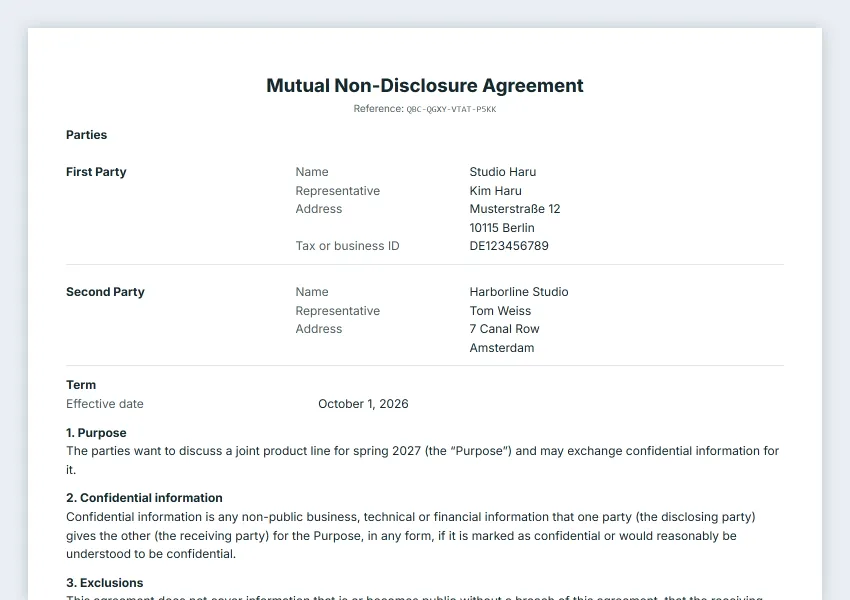
Mutual Non-Disclosure Agreement
Parties: First Party · Second Party
1. Purpose
The parties want to discuss [[Describe the project or possible cooperation]] (the “Purpose”) and may exchange confidential information for it.
2. Confidential information
Confidential information is any non-public business, technical or financial information that one party (the disclosing party) gives the other (the receiving party) for the Purpose, in any form, if it is marked as confidential or would reasonably be understood to be confidential.
3. Exclusions
This agreement does not cover information that is or becomes public without a breach of this agreement, that the receiving party already knew lawfully, that it receives lawfully from a third party without a duty of confidence, or that it develops independently.
4. Obligations
The receiving party keeps confidential information secret, protects it with at least reasonable care, uses it only for the Purpose, and shares it only with employees and advisers who need it for the Purpose and are bound by similar duties of confidence.
5. Compelled disclosure
If the law, a court or an authority requires disclosure, the receiving party may disclose what is required and, where lawful, tells the disclosing party in advance.
6. No licence
Confidential information remains the property of the disclosing party. No licence or other right is granted except the right to use it for the Purpose.
7. Return or destruction
On request, and at the latest when the discussions end, the receiving party returns or destroys the confidential information and its copies. Copies it must keep by law or that remain in routine backups stay confidential.
8. Duration
This agreement applies to information disclosed from the effective date. The duties of confidence last for [[3]] years after the last disclosure.
9. No obligation to proceed
This agreement does not oblige either party to enter into any further agreement or transaction.
10. Remedies
A party that breaches this agreement is liable for the resulting damage under the applicable law. The disclosing party may also seek an injunction or similar relief where the law allows it.
11. Governing law and disputes
This agreement is governed by the law stated under Governing law. The parties will first try to settle any dispute in good faith. Otherwise the courts stated under Jurisdiction decide, unless mandatory law provides otherwise.
Governing law
[[Country or state whose law applies]]
Jurisdiction
[[Courts that decide disputes, e.g. the courts of your city]]
How to use it
Choose the template
Press the button to use this template. If you are not signed in, you first sign in or sign up for free and then come straight back to it.
Start a draft
The new-contract page opens with this template marked. Press its card to create a draft. Your company details fill in Party A, and you fill in the blanks, the other party and, where the template has one, the price schedule.
Send it for signature
You sign first, then send each signer a secure link and, by another route, an access code. Signers need no account.
They sign on any device
Each signer opens the link on a phone or a computer, enters the access code, reads the contract and signs. Once everyone has signed, you can print the contract or save it as a PDF with its signature certificate.
Next steps
Your client opens the link on any device and needs no account. See what the signing looks like on the E-Contracts page, and read which kind of electronic signature is enough for which document.
Prefer a form to fill in and print rather than a contract to sign online?
What it is, and what it is not
QuoteBill creates a simple electronic signature with an audit trail. In the EU, the UK, the US and Korea a signature is not denied legal effect only because it is electronic, and in Japan most contracts need no particular form at all. What a simple electronic signature proves in a dispute depends on the evidence behind it, and some documents need another form.
It is not a qualified or advanced electronic signature, and QuoteBill does not verify who the signers are. It records the use of the link and access code you delivered, so anyone who has both can sign. The signature certificate lists every link issued and, for each action by the sender or a signer, its IP address and browser where they could be read.
Some documents need another form. Wills, many real-estate transfers, guarantees and some employment documents must, in some countries, be handwritten, notarised or signed with a qualified signature. The templates are samples, not legal advice: review them with a lawyer.
Other contract templates
One-way non-disclosure agreement
One side shares confidential information and the other keeps it secret and uses it only for the stated purpose.
Letter of intent
The deal the parties intend to negotiate, its main terms as intentions, and a plain list of the clauses that bind.
Memorandum of understanding
How two organisations intend to cooperate: purpose, areas, each side’s contribution, contacts and what does not bind.
Service agreement
Services, deliverables, acceptance, fees and intellectual property.