Tiler invoice template
Tiler invoice template: bill wall and floor tiling per square metre, strip-out and preparation on their own lines, and the grout and adhesive used.
Templates by industry
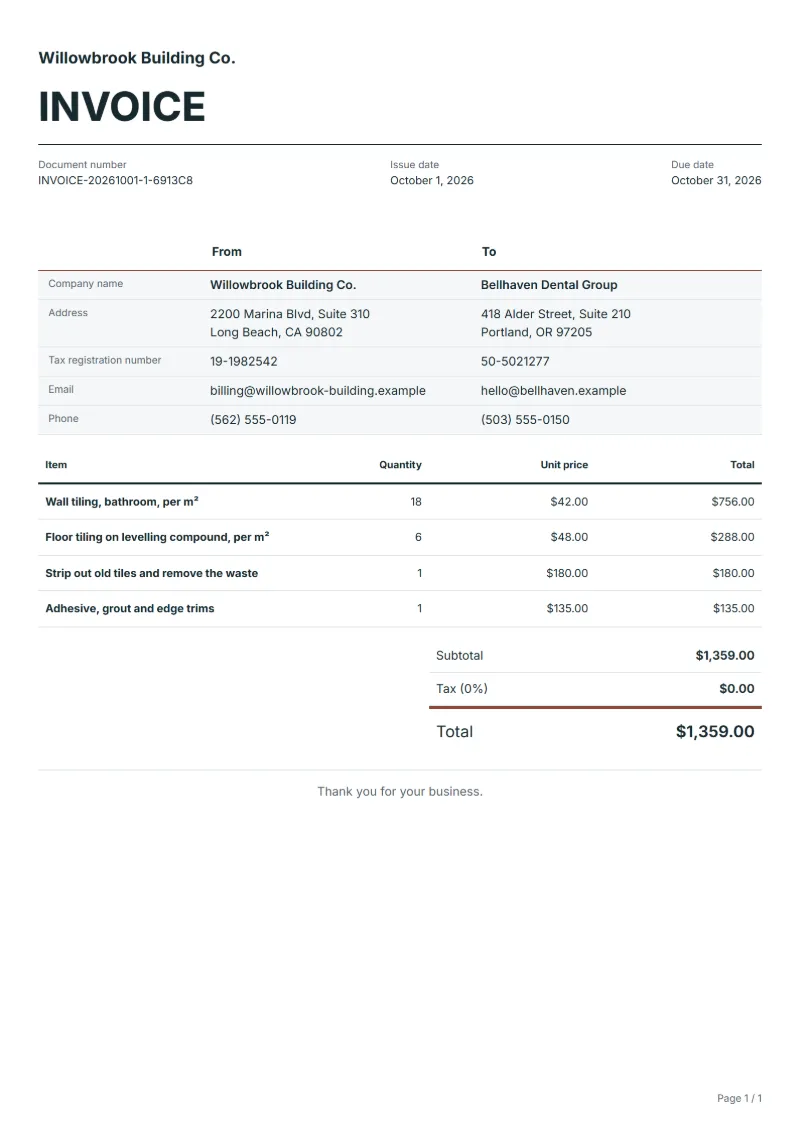
- Wall tiling, bathroom, per m²
- Floor tiling on levelling compound, per m²
- Strip out old tiles and remove the waste
- Adhesive, grout and edge trims
Preparation guide
Example workflow
Confirm scope and quantities
Example: reconcile the approval and work record for "Wall tiling, bathroom, per m²" to establish the quantity for this invoice.
Record delivery and acceptance
Check completion for every line, including "Adhesive, grout and edge trims". Confirm completed quantities, site photos, agreed test results and any remaining remedial work.
Send the billing record
Send the final charges, delivery reference and due date to the customer, then reconcile payment against the invoice number.
A tiling job is priced by area, but the hours often go into what happens before the first tile: stripping old tiles, levelling a floor, preparing a wall. This invoice gives walls and floors their own square-metre lines, puts strip-out and preparation on separate lines, and lists adhesive, grout and trims as materials. If the client bought the tiles, the invoice says so, which makes it plain that the tiles themselves are not in your price.
Fields to prepare
- Deliverables and line items
- Wall tiling, bathroom, per m², Floor tiling on levelling compound, per m², Strip out old tiles and remove the waste, Adhesive, grout and edge trims: record the quantities actually supplied and the service period.
- Wall tiling, bathroom, per m²
- Measure the tiled wall and deduct the window, the bath panel and the door; state the tile size, since small formats take longer.
- Floor tiling on levelling compound, per m²
- Give the floor area and the thickness of levelling compound used, because a thicker layer costs more and takes longer to cure.
- Strip out old tiles and remove the waste
- Price strip-out as one sum and mention if the plaster came away with the tiles, which is usually where extra work starts.
- Adhesive, grout and edge trims
- List adhesive and grout by bag or tub and the trims by length, and record which grout colour the client chose.
- Site and measured quantities
- Record the site, work zones, areas, lengths or counts, and access hours.
- Materials and work stages
- Specify materials, labor, removal, disposal and making-good allowances, and completion criteria for each stage.
- Scope to agree
- Bill tiled areas in square metres measured after the work, keep strip-out and preparation apart from laying, and say who supplied the tiles.
Before sending
- Does “Wall tiling, bathroom, per m²” show the quantity actually supplied, not the quantity first quoted?
- Is “Floor tiling on levelling compound, per m²” charged at the rate the customer agreed to, with any change approved?
- Is “Strip out old tiles and remove the waste” finished and accepted, or does it belong on a later invoice?
Show 4 more
- Does “Adhesive, grout and edge trims” show the quantity actually supplied, not the quantity first quoted?
- Agree how quantity changes following measurement or drawing revisions will be approved.
- Confirm client-supplied materials and work that other contractors must finish first.
- Match completed work to the order or approval record, and confirm the payment due date and amounts already received.
Worked example: retiling a family bathroom
The figures are an example, in dollars, with an example tax rate of 8%. A tiler strips the old tiles, covers 18 square metres of wall in 30 x 60 cm porcelain and lays 6 square metres of floor over levelling compound.
- Wall area: 22 m² of wall less the window, bath panel and door leaves 18 m².
- Floor: 6 m² at the floor rate, with the compound thickness noted.
- Strip-out and materials: one line each.
| Item | Quantity × unit price | Amount |
|---|---|---|
| Wall tiling, bathroom, per m² | 18 × $42.00 | $756.00 |
| Floor tiling on levelling compound, per m² | 6 × $48.00 | $288.00 |
| Strip out old tiles and remove the waste | 1 × $180.00 | $180.00 |
| Adhesive, grout and edge trims | 1 × $135.00 | $135.00 |
| Subtotal | $1,359.00 | |
| Sales tax (8%) | $108.72 | |
| Total | $1,467.72 | |
Four lines come to $1,359.00, tax at 8% adds $108.72, and the client is asked for $1,467.72. Spare tiles go in the notes, with where they were left for future repairs.
Where tiling invoices go wrong
- Charging the gross wall area without deducting the window and bath.
- Billing preparation work that was never agreed as an extra.
- Leaving out who supplied the tiles, so the client thinks they paid for them twice.
- Using one average rate for walls and floors, which hides the floor levelling.
What the document must show
These details make an invoice easier to approve and to file.
- Your business name, address and registration or tax number
- The customer's name and address
- Issue date and a document number you do not reuse
- Each line item with quantity, unit price and amount
- Tax shown separately from the net amount, and the total payable
- Payment terms: due date, bank details or accepted payment methods
The sales tax depends on where the work is supplied, so set the rate that applies to your customer before sending.
Official rate reference: US government: state and local taxes
Frequently asked questions
Do I bill the whole wall or only the tiled area?
Only the area you tiled. Deduct openings and anything left bare, and if your quotation priced cuts around a window separately, keep that line too.
The client bought the tiles: what goes on my invoice?
Your labour, adhesive, grout and trims, with a note that the tiles were supplied by the client. Ask them before you start to order spares, as a shortfall halts the job.
How do I charge more for mosaic or large-format tiles?
Use a separate square-metre rate for that area and name the format on the line. Blending two rates into one average makes the price impossible to check.
The wall needed boarding before I could tile: is that a new line?
Yes. Preparation the quotation did not include is an extra; bill it on its own line with the area, ideally after the client agreed to it on site.
How is tax calculated on this template?
The sales tax depends on where the work is supplied, so set the rate that applies to your customer before sending. The editor keeps the net amount, the tax and the total apart, and recalculates all three when you change a quantity, a unit price or the country setting.
Is this template free?
Yes. You can fill in this template and print it or save it as a PDF without an account, and there is no payment step and no watermark on the document. Saving it to your account and downloading Excel or Word files need a free account.
Read next
Reading for the Tiler invoice template: How to write an invoice: a step-by-step example and Credit note vs invoice (and credit memo): how to issue one. The VAT and GST calculator works out the tax line for you.