Tailoring invoice
Invoice template for tailors and dressmakers: garment pattern making, custom cutting and sewing, and fitting alterations. Download it as Excel or Word.
Templates by industry
- Garment pattern making
- Custom cutting and sewing
- Fitting alterations
Preparation guide
Example workflow
Confirm scope and quantities
Example: reconcile the approval and work record for "Garment pattern making" to establish the quantity for this invoice.
Record delivery and acceptance
Check completion for every line, including "Fitting alterations". Reconcile delivered quantities with approved specifications and hand over inspection and use or installation records.
Send the billing record
Send the final charges, delivery reference and due date to the customer, then reconcile payment against the invoice number.
A made-to-measure garment passes through several appointments before the client takes it home, and the bill is often settled at the last fitting or on collection, after a deposit taken when the cloth was chosen. This template puts the pattern, the cutting and sewing, and the adjustments after fittings on their own lines. Clients who bring their own cloth can see they are paying for the work alone, and a second garment from the same pattern can be billed without the pattern line.
Fields to prepare
- Deliverables and line items
- Garment pattern making, Custom cutting and sewing, Fitting alterations: record the quantities actually supplied and the service period.
- Garment pattern making
- Charge the pattern once per client and garment style; keep the measurements on file and leave this line off a repeat order cut from the same pattern.
- Custom cutting and sewing
- Say whose cloth was used and, if it was yours, bill the cloth and the metres on a separate line so the making price stays comparable.
- Fitting alterations
- List the fittings held and what changed, such as shortened sleeves or a taken-in waist; alterations after collection go on a new invoice.
- Specification and revision
- Record the approved drawing or file revision, material, dimensions, finish and agreed tolerances.
- Setup and production quantity
- Separate one-time setup from per-unit production and define inspection, packing and transport allowances.
- Scope to agree
- Record garment quantities, who supplies fabric, pattern work, fitting rounds and completed alterations.
Before sending
- Does “Garment pattern making” show the quantity actually supplied, not the quantity first quoted?
- Is “Custom cutting and sewing” charged at the rate the customer agreed to, with any change approved?
- Is “Fitting alterations” finished and accepted, or does it belong on a later invoice?
Show 3 more
- Define the sample or proof that must be approved before production and its approval deadline.
- Distinguish defect and rework handling from the cost of customer specification changes.
- Match completed work to the order or approval record, and confirm the payment due date and amounts already received.
Worked example with sample figures
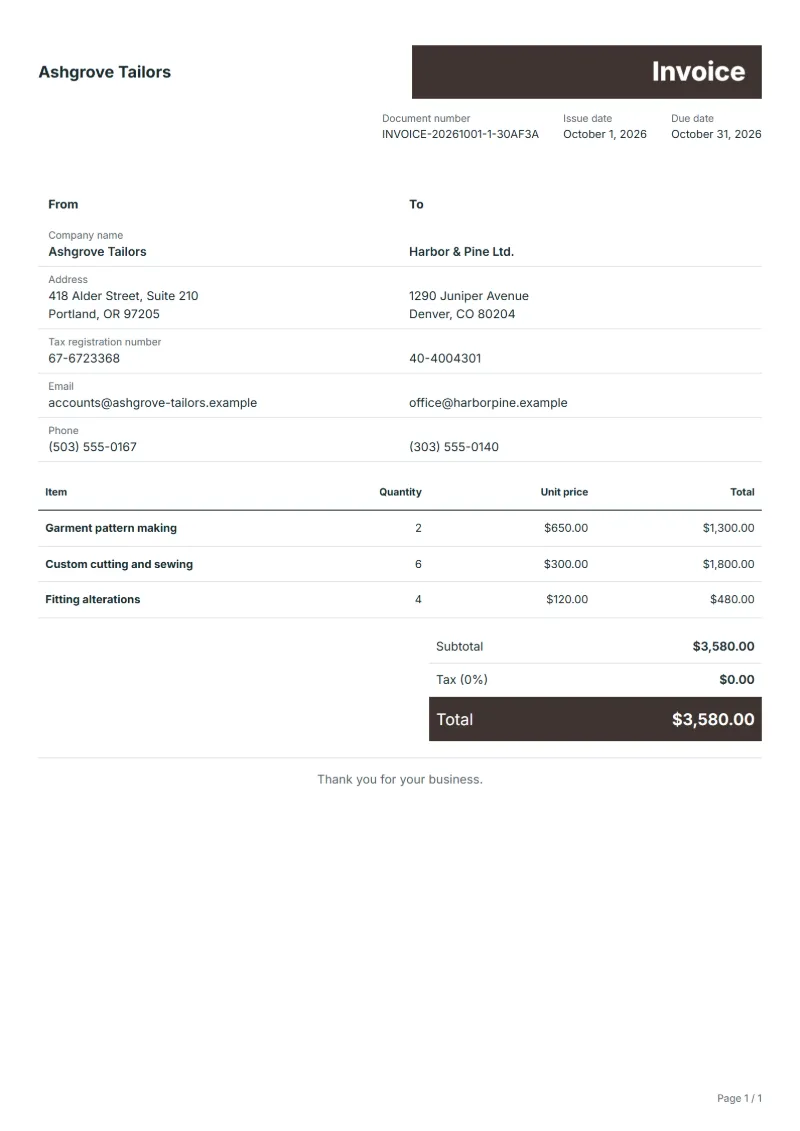
The figures below are invented to show how the template adds up: 3 lines in USD, with an example tax rate of 8%.
| Item | Quantity × unit price | Amount |
|---|---|---|
| Garment pattern making | 2 × $650.00 | $1,300.00 |
| Custom cutting and sewing | 6 × $300.00 | $1,800.00 |
| Fitting alterations | 4 × $120.00 | $480.00 |
| Subtotal | $3,580.00 | |
| Sales tax (8%) | $286.40 | |
| Total | $3,866.40 | |
Net amount $3,580.00, sales tax $286.40, total payable $3,866.40.
What the document must show
The details an invoice has to show, and why each one matters, are set out in the guide below.
The sales tax depends on where the work is supplied, so set the rate that applies to your customer before sending.
Official rate reference: US government: state and local taxes
Full requirements: How to write an invoice: a step-by-step example
Frequently asked questions
How do I show the deposit taken when the order was placed?
Keep the lines at their full price and record the deposit in the notes with its date and receipt number, then ask only for the balance. If the deposit is to cover the pattern and cloth already cut when an order is cancelled, put that in your order terms beforehand.
What should I note when a client brings a delicate or patterned cloth?
Record the length handed in and its condition at intake, and any extra work it needs, such as matching checks or stripes at the seams. Pattern matching takes more cloth and time, so show it as an addition rather than absorbing it in the sewing line.
How is the sales tax worked out on this invoice?
The worked example above uses an example rate of 8%: $286.40 on a net amount of $3,580.00, for a total of $3,866.40. The editor recalculates all three when you change a quantity, a price or the country.
Is this template free?
Yes. You can fill in this template and print it or save it as a PDF without an account, and there is no payment step and no watermark on the document. Saving it to your account and downloading Excel or Word files need a free account.
Can I email it to the customer?
Yes, from your own mail app. With a free account, the editor’s download menu offers Email this document, which opens your mail app with a message about the document already written. QuoteBill sends nothing itself, so save the PDF and attach it before you send.
Read next
Reading for the Tailoring invoice: How to write an invoice: a step-by-step example and Invoice payment terms: Net 15, Net 30, due dates. The VAT and GST calculator works out the tax line for you.