Retention release invoice template
Retention release invoice template for builders: claim money held back from progress payments at completion or after the defects period, variations apart.
Templates by industry
- Retention release at practical completion (50%)
- Retention held on variation 4
- Retention held on variation 6
Preparation guide
Example workflow
Confirm scope and quantities
Example: reconcile the approval and work record for "Retention release at practical completion (50%)" to establish the quantity for this invoice.
Record delivery and acceptance
Check completion for every line, including "Retention held on variation 6". Confirm completed quantities, site photos, agreed test results and any remaining remedial work.
Send the billing record
Send the final charges, delivery reference and due date to the customer, then reconcile payment against the invoice number.
On many building contracts the client keeps back a small percentage of every progress payment as security for defects. That money is released later, often half at completion and the rest when the defects period ends, but only if the contractor asks for it. This invoice is that request. It lists the retention held on the main contract and on each variation separately, so the client can tick it off against their payment records.
Fields to prepare
- Deliverables and line items
- Retention release at practical completion (50%), Retention held on variation 4, Retention held on variation 6: record the quantities actually supplied and the service period.
- Retention release at practical completion (50%)
- Quote the completion certificate or handover date that releases this half; without it the claim is usually returned unpaid.
- Retention held on variation 4
- Retention on variations is easily forgotten; take the amounts from the payment certificates that deducted them.
- Retention held on variation 6
- Give each variation its own line, so a disputed variation does not hold up the rest of the release.
- Site and measured quantities
- Record the site, work zones, areas, lengths or counts, and access hours.
- Materials and work stages
- Specify materials, labor, removal, disposal and making-good allowances, and completion criteria for each stage.
- Scope to agree
- Show the retention rate, the total held on the contract and on each variation, which release this is, and the completion or defects certificate that triggers it.
Before sending
- Does “Retention release at practical completion (50%)” show the quantity actually supplied, not the quantity first quoted?
- Is “Retention held on variation 4” charged at the rate the customer agreed to, with any change approved?
- Is “Retention held on variation 6” finished and accepted, or does it belong on a later invoice?
Show 3 more
- Agree how quantity changes following measurement or drawing revisions will be approved.
- Confirm client-supplied materials and work that other contractors must finish first.
- Match completed work to the order or approval record, and confirm the payment due date and amounts already received.
Worked example with sample figures
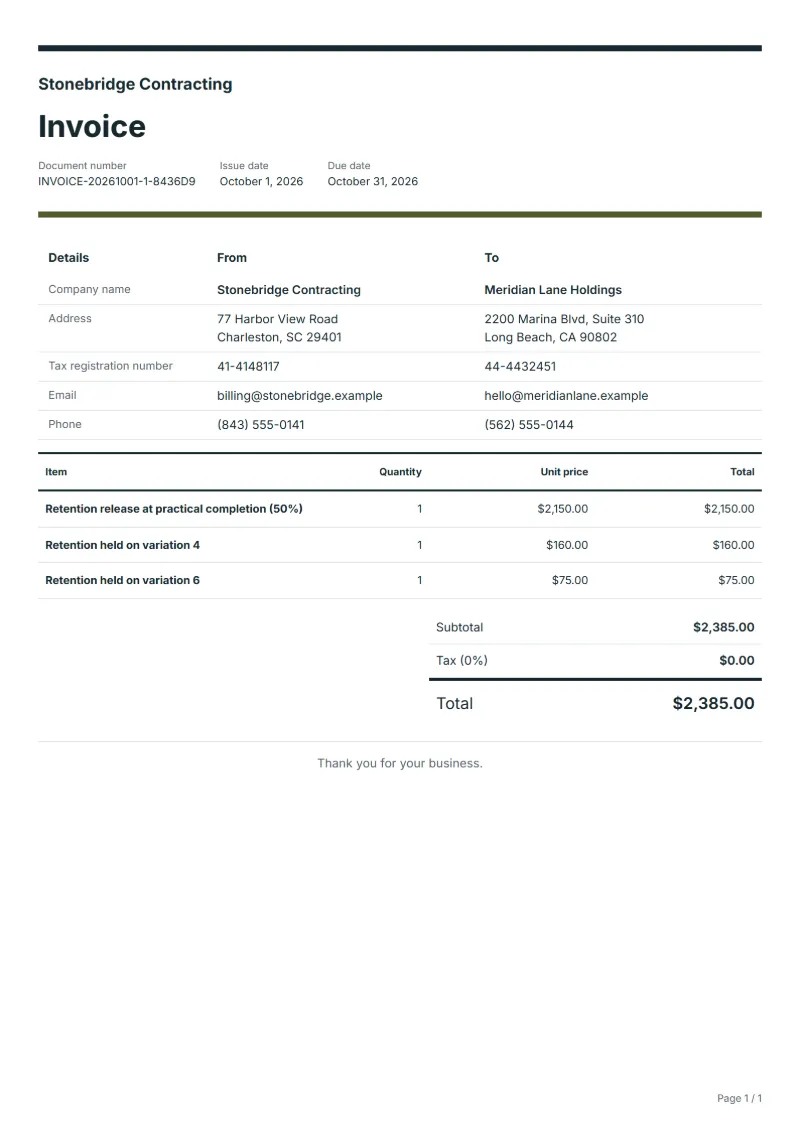
The figures below are invented to show how the template adds up: 3 lines in USD, with an example tax rate of 8%.
| Item | Quantity × unit price | Amount |
|---|---|---|
| Retention release at practical completion (50%) | 1 × $2,150.00 | $2,150.00 |
| Retention held on variation 4 | 1 × $160.00 | $160.00 |
| Retention held on variation 6 | 1 × $75.00 | $75.00 |
| Subtotal | $2,385.00 | |
| Sales tax (8%) | $190.80 | |
| Total | $2,575.80 | |
Net amount $2,385.00, sales tax $190.80, total payable $2,575.80.
What the document must show
The details an invoice has to show, and why each one matters, are set out in the guide below.
The sales tax depends on where the work is supplied, so set the rate that applies to your customer before sending.
Official rate reference: US government: state and local taxes
Full requirements: How to write an invoice: a step-by-step example
Frequently asked questions
When can I invoice the second half of the retention?
When the event your contract names has happened, usually the end of the defects period and the sign-off of any listed defects. Put the date in your diary at completion; retention that nobody asks for can stay unpaid for years.
Is tax charged when the retention is released?
It depends on your country and on how the earlier invoices were taxed. In some systems tax on retention becomes due only when it is paid or invoiced, in others it was due with the progress invoice. Check with your adviser before you set the rate.
How is the sales tax worked out on this invoice?
The worked example above uses an example rate of 8%: $190.80 on a net amount of $2,385.00, for a total of $2,575.80. The editor recalculates all three when you change a quantity, a price or the country.
Is this template free?
Yes. You can fill in this template and print it or save it as a PDF without an account, and there is no payment step and no watermark on the document. Saving it to your account and downloading Excel or Word files need a free account.
Can I email it to the customer?
Yes, from your own mail app. With a free account, the editor’s download menu offers Email this document, which opens your mail app with a message about the document already written. QuoteBill sends nothing itself, so save the PDF and attach it before you send.
Read next
Reading for the Retention release invoice template: How to write an invoice: a step-by-step example and Invoice payment terms: Net 15, Net 30, due dates. The VAT and GST calculator works out the tax line for you.