Physiotherapy invoice template
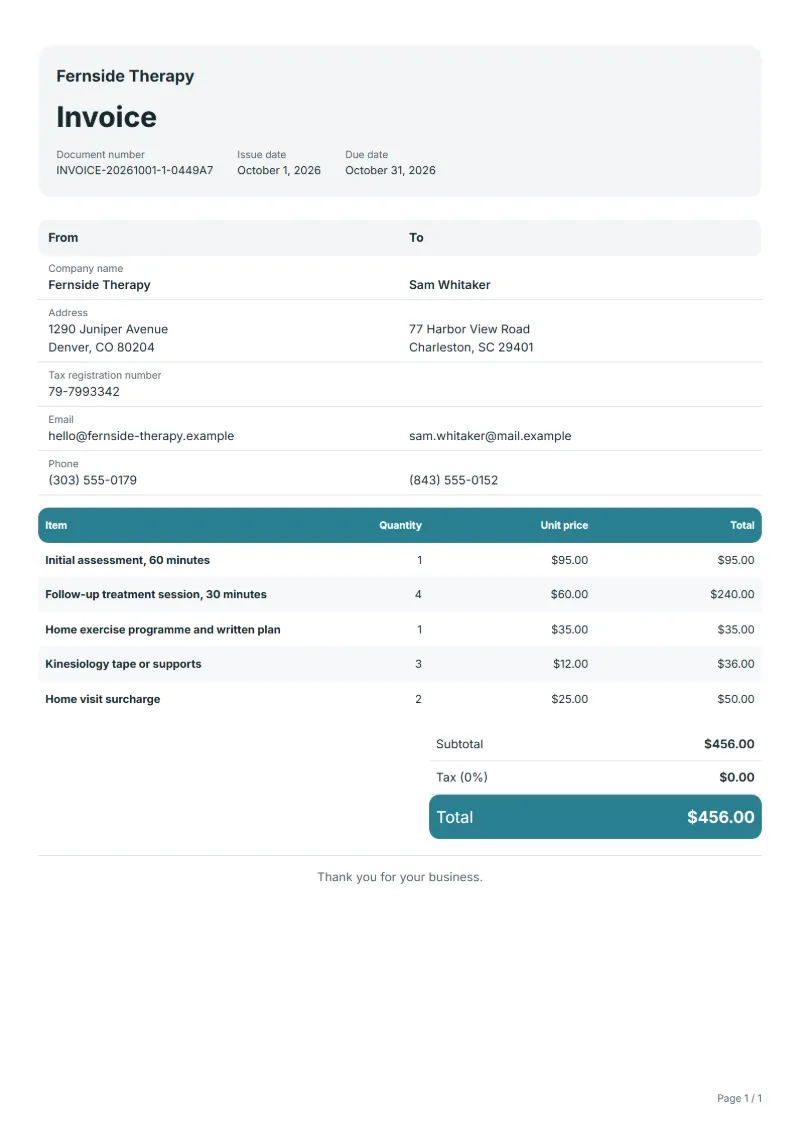
Physiotherapy invoice template: assessment, dated treatment sessions, exercise plan, supplies and home visits, with the details an insurance claim needs.
Templates by industry
- Initial assessment, 60 minutes
- Follow-up treatment session, 30 minutes
- Home exercise programme and written plan
- Kinesiology tape or supports
- Home visit surcharge
Preparation guide
Example workflow
Confirm scope and quantities
Example: reconcile the approval and work record for "Initial assessment, 60 minutes" to establish the quantity for this invoice.
Record delivery and acceptance
Check completion for every line, including "Home visit surcharge". Confirm completed services and quantities with the customer and retain the handover record.
Send the billing record
Send the final charges, delivery reference and due date to the customer, then reconcile payment against the invoice number.
A physiotherapy invoice is often read twice: first by the patient, then by an insurer or employer who repays part of it. Both want each appointment’s date and length, the kind of session and anything supplied, such as tape or a brace. This template separates the first assessment from follow-up treatment, lists the exercise plan and supplies, and keeps home visits as a surcharge, leaving the notes for the referral and the details a claim form asks for.
Fields to prepare
- Deliverables and line items
- Initial assessment, 60 minutes, Follow-up treatment session, 30 minutes, Home exercise programme and written plan, Kinesiology tape or supports, Home visit surcharge: record the quantities actually supplied and the service period.
- Initial assessment, 60 minutes
- The first assessment is usually longer and priced differently; give its date, length and the area assessed.
- Follow-up treatment session, 30 minutes
- List each follow-up date, or give the dates in the notes when several sessions share one line.
- Home exercise programme and written plan
- Describe the programme briefly and say how it was handed over, on paper or through an app.
- Kinesiology tape or supports
- Bill supplies item by item at the agreed price, so the patient can see them apart from treatment.
- Home visit surcharge
- Add the surcharge per home visit and say what it covers, such as travel time and carrying equipment.
- Intake and service
- Record the intake reference, service date, quantity and agreed service scope.
- Extras and handover
- Separate approved extras, supplied items and the completion or handover time.
- Scope to agree
- Give the date and length of every session, separate assessment from treatment and supplies, and add the details a patient needs to claim from an insurer.
Before sending
- Does “Initial assessment, 60 minutes” show the quantity actually supplied, not the quantity first quoted?
- Is “Follow-up treatment session, 30 minutes” charged at the rate the customer agreed to, with any change approved?
- Is “Home exercise programme and written plan” finished and accepted, or does it belong on a later invoice?
Show 5 more
- Does “Kinesiology tape or supports” show the quantity actually supplied, not the quantity first quoted?
- Is “Home visit surcharge” charged at the rate the customer agreed to, with any change approved?
- Reconcile the booked scope with any extra services actually supplied.
- Check that services included in a package have not also been billed separately.
- Match completed work to the order or approval record, and confirm the payment due date and amounts already received.
Worked example: a course of treatment for a knee injury
The figures are an example in dollars, with an example tax rate of 8%. A physiotherapist bills an assessment, four follow-up sessions, an exercise plan, three rolls of tape and two home visits.
| Item | Quantity × unit price | Amount |
|---|---|---|
| Initial assessment, 60 minutes | 1 × $95.00 | $95.00 |
| Follow-up treatment session, 30 minutes | 4 × $60.00 | $240.00 |
| Home exercise programme and written plan | 1 × $35.00 | $35.00 |
| Kinesiology tape or supports | 3 × $12.00 | $36.00 |
| Home visit surcharge | 2 × $25.00 | $50.00 |
| Subtotal | $456.00 | |
| Sales tax (8%) | $36.48 | |
| Total | $492.48 | |
The lines total $456.00; at an example rate of 8% the tax is $36.48 and the invoice comes to $492.48. Where your treatment is exempt from tax, set the rate to zero before sending.
Mistakes on a physiotherapy invoice
- Billing several sessions on one line without their dates, which an insurer may not accept.
- Mixing supplies into the treatment price.
- Leaving out your registration number when the patient needs to claim.
- Writing a diagnosis on the invoice without the patient’s consent.
- Charging a missed appointment that no cancellation policy covered.
What the document must show
These details make an invoice easier to approve and to file.
- Your business name, address and registration or tax number
- The customer's name and address
- Issue date and a document number you do not reuse
- Each line item with quantity, unit price and amount
- Tax shown separately from the net amount, and the total payable
- Payment terms: due date, bank details or accepted payment methods
The sales tax depends on where the work is supplied, so set the rate that applies to your customer before sending.
Official rate reference: US government: state and local taxes
Frequently asked questions
What does a patient need on the invoice to claim from an insurer?
Insurers differ, so ask the patient what their policy requires. Commonly it is your registration or membership number, the patient’s name, each session date and the type of treatment; add a diagnosis only with the patient’s consent.
Should I invoice after each session or once a month?
Either works if the patient knows in advance. Monthly invoices listing every session date suit longer courses of treatment; single invoices suit patients who pay at each visit and claim straight away.
How do I bill a missed appointment?
Charge it only under a cancellation policy the patient saw before booking, and put it on its own line marked as a missed appointment. The patient should not assume an insurer will cover it.
Does physiotherapy carry VAT or a similar tax?
Treatment by registered practitioners is exempt in some countries, under conditions that differ from place to place. Check yours and set the tax rate accordingly; supplies such as braces may be treated differently from treatment.
How is tax calculated on this template?
The sales tax depends on where the work is supplied, so set the rate that applies to your customer before sending. The editor keeps the net amount, the tax and the total apart, and recalculates all three when you change a quantity, a unit price or the country setting.
Is this template free?
Yes. You can fill in this template and print it or save it as a PDF without an account, and there is no payment step and no watermark on the document. Saving it to your account and downloading Excel or Word files need a free account.
Read next
Reading for the Physiotherapy invoice template: How to write an invoice: a step-by-step example and Credit note vs invoice (and credit memo): how to issue one. The VAT and GST calculator works out the tax line for you.