Late payment fee invoice template
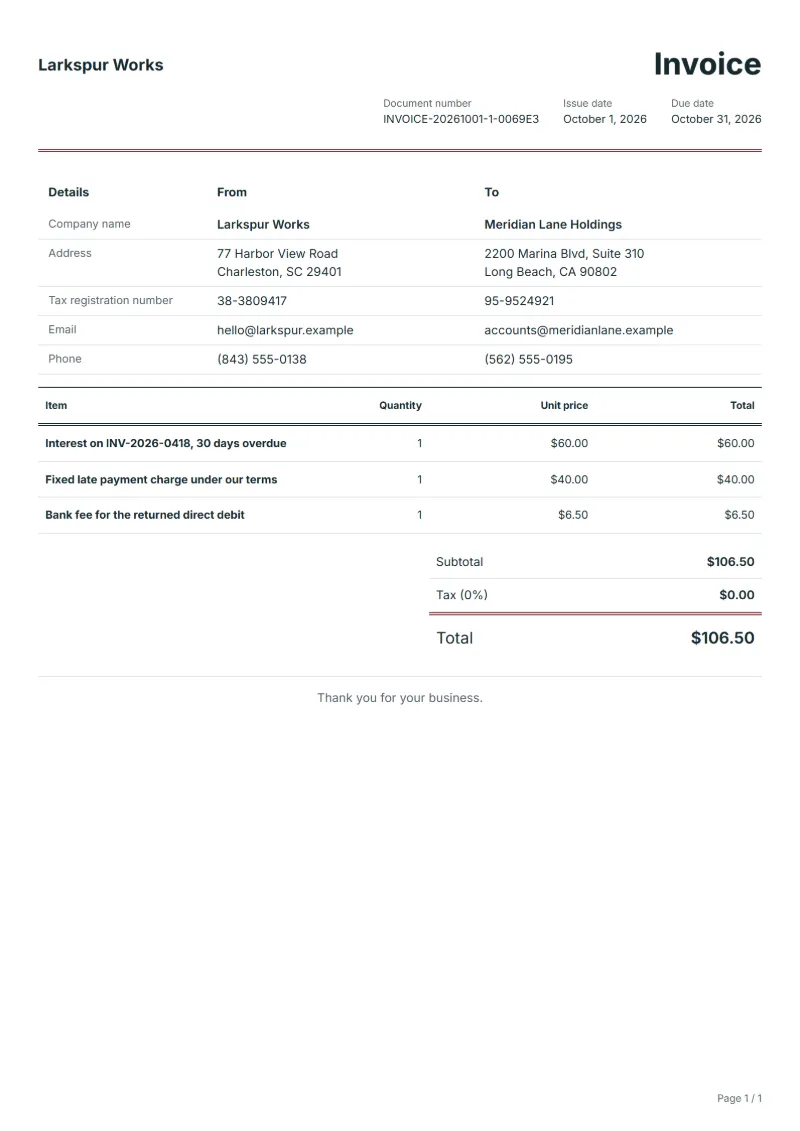
Late payment fee invoice template: interest on an overdue invoice with rate and days shown, a fixed charge under your terms, and returned-payment costs.
Templates by industry
- Interest on INV-2026-0418, 30 days overdue
- Fixed late payment charge under our terms
- Bank fee for the returned direct debit
Preparation guide
Example workflow
Confirm scope and quantities
Example: reconcile the approval and work record for "Interest on INV-2026-0418, 30 days overdue" to establish the quantity for this invoice.
Record delivery and acceptance
Check completion for every line, including "Bank fee for the returned direct debit". Match the delivery record to approved quantities and record who accepted the work.
Send the billing record
Send the final charges, delivery reference and due date to the customer, then reconcile payment against the invoice number.
When an invoice is paid weeks after its due date, the cost of waiting can be passed back to the customer, provided your terms or the law allow it. This template bills those costs on their own instead of adding them to the next order. Each line names the late invoice; the interest line shows the rate and the number of days, so anyone can redo the sum. It starts at a tax rate of 0%, which you can change.
Fields to prepare
- Deliverables and line items
- Interest on INV-2026-0418, 30 days overdue, Fixed late payment charge under our terms, Bank fee for the returned direct debit: record the quantities actually supplied and the service period.
- Interest on INV-2026-0418, 30 days overdue
- Count the days from the due date, not the invoice date, to the day the money arrived, and write the rate and the days in the description.
- Fixed late payment charge under our terms
- Charge a fixed sum only if your terms or the law provide one, and quote which in the notes.
- Bank fee for the returned direct debit
- Pass on a bank fee for a failed payment at the amount the bank actually took, with its statement line.
- Quantity and billing unit
- Use the agreed unit, such as hours, units or a fixed project, and record both quantity and rate.
- Reference and dates
- Add the purchase reference, service period and delivery date to distinguish this work from other orders.
- Scope to agree
- Name the late invoice, its due date and the date it was paid, show the rate and the days behind the interest, and keep each fee on a line of its own.
Before sending
- Does “Interest on INV-2026-0418, 30 days overdue” show the quantity actually supplied, not the quantity first quoted?
- Is “Fixed late payment charge under our terms” charged at the rate the customer agreed to, with any change approved?
- Is “Bank fee for the returned direct debit” finished and accepted, or does it belong on a later invoice?
Show 3 more
- Separate additional work from the original scope and check its approval record.
- Distinguish included expenses from separately billed expenses and reconcile supporting records.
- Match completed work to the order or approval record, and confirm the payment due date and amounts already received.
Worked example: interest and charges on an invoice paid 30 days late
The figures are an example. Invoice INV-2026-0418 for $7,300 was paid 30 days after its due date. The supplier’s terms set interest at 10% a year and a fixed late charge of $40, and the customer’s direct debit had bounced once before the payment arrived.
- Interest: $7,300 × 10% × 30 ÷ 365 = $60.00.
- Fixed charge: $40, with the clause of the terms in the notes.
- Bank fee: the $6.50 the bank charged for the returned debit.
| Item | Quantity × unit price | Amount |
|---|---|---|
| Interest on INV-2026-0418, 30 days overdue | 1 × $60.00 | $60.00 |
| Fixed late payment charge under our terms | 1 × $40.00 | $40.00 |
| Bank fee for the returned direct debit | 1 × $6.50 | $6.50 |
| Total | $106.50 | |
The lines add up to $106.50. No tax is added at the starting rate of 0%, so the customer is asked for $106.50.
Common mistakes when billing a late payment
- Counting the days from the invoice date instead of the due date.
- Writing a lump sum with no rate or days, so the figure cannot be checked.
- Adding VAT to interest out of habit.
- Charging a fee that neither your terms nor the law provide for.
- Using a rate taken from another country’s rules.
What the document must show
These details make an invoice easier to approve and to file.
- Your business name, address and registration or tax number
- The customer's name and address
- Issue date and a document number you do not reuse
- Each line item with quantity, unit price and amount
- Tax shown separately from the net amount, and the total payable
- Payment terms: due date, bank details or accepted payment methods
The sales tax depends on where the work is supplied, so set the rate that applies to your customer before sending.
Official rate reference: US government: state and local taxes
Frequently asked questions
Can I charge interest if my terms never mentioned it?
In some countries the law gives a business a right to interest on late payments between businesses even without a clause; elsewhere only an agreed rate can be claimed. Check the rules that apply to the contract, and add a clear clause to your terms for next time.
Separate invoice or a line on the next invoice?
A separate invoice keeps the original clean, makes the fee easy to discuss or waive, and stops a dispute about the fee from holding up payment for new work. Quote the late invoice number on every line.
How is the interest worked out?
Unpaid amount × yearly rate × days late ÷ 365 is the usual simple-interest formula; some contracts use 360 days. Put the inputs in the description, so the customer can check the figure in a minute.
Is tax charged on late payment interest?
In many tax systems interest and fixed compensation for late payment are not payment for a supply and carry no VAT, which is why this template starts at 0%. Confirm with your adviser before you change the rate.
The customer paid part of the invoice on time. What then?
Charge interest only on the part that was late, for the days it stayed unpaid. If the balance came in several steps, give each period its own line.
How is tax calculated on this template?
The sales tax depends on where the work is supplied, so set the rate that applies to your customer before sending. The editor keeps the net amount, the tax and the total apart, and recalculates all three when you change a quantity, a unit price or the country setting.
Can I change the layout and colour?
Yes. The editor offers other layouts and a document colour for the printed page. Changing them moves no figure: the lines and totals stay as they are, and the PDF, Word and Excel files follow the layout you pick.
Read next
Reading for the Late payment fee invoice template: How to write an invoice: a step-by-step example and Credit note vs invoice (and credit memo): how to issue one. The VAT and GST calculator works out the tax line for you.