Intercompany recharge invoice template
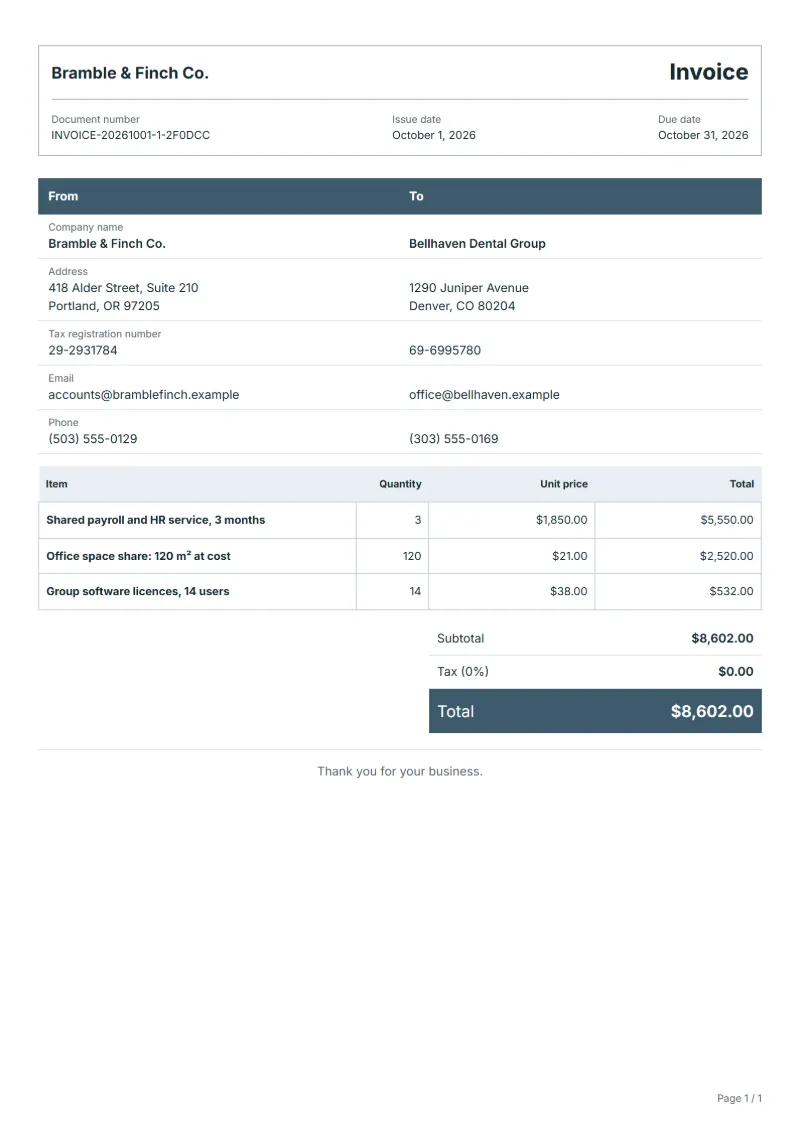
Intercompany recharge invoice template: bill a sister company for shared staff, office space or software, with the allocation key and any mark-up shown.
Templates by industry
- Shared payroll and HR service, 3 months
- Office space share: 120 m² at cost
- Group software licences, 14 users
Preparation guide
Example workflow
Confirm scope and quantities
Example: reconcile the approval and work record for "Shared payroll and HR service, 3 months" to establish the quantity for this invoice.
Record delivery and acceptance
Check completion for every line, including "Group software licences, 14 users". Match the delivery record to approved quantities and record who accepted the work.
Send the billing record
Send the final charges, delivery reference and due date to the customer, then reconcile payment against the invoice number.
In a group of companies one entity often employs the shared staff, signs the office lease or buys the software, and the others use them. An intercompany recharge invoice moves that cost to the company that benefits, so each set of accounts shows what it really consumed. Because the two parties are related, the invoice has to explain itself: which agreement it follows, how each cost was divided, and whether a mark-up was added.
Fields to prepare
- Deliverables and line items
- Shared payroll and HR service, 3 months, Office space share: 120 m² at cost, Group software licences, 14 users: record the quantities actually supplied and the service period.
- Shared payroll and HR service, 3 months
- Bill the shared service by month as the service agreement sets it, and say whether the monthly figure includes a mark-up.
- Office space share: 120 m² at cost
- Divide rent by floor area or headcount, name the key and the figures behind it, and keep the lease reference at hand.
- Group software licences, 14 users
- Charge licences per user from the licence list at the end of the period; a seat count no one can check invites questions in an audit.
- Quantity and billing unit
- Use the agreed unit, such as hours, units or a fixed project, and record both quantity and rate.
- Reference and dates
- Add the purchase reference, service period and delivery date to distinguish this work from other orders.
- Scope to agree
- Name both group companies and the agreement behind the charge, show the allocation key for each cost, and say whether a mark-up is added or the cost is passed on as it is.
Before sending
- Does “Shared payroll and HR service, 3 months” show the quantity actually supplied, not the quantity first quoted?
- Is “Office space share: 120 m² at cost” charged at the rate the customer agreed to, with any change approved?
- Is “Group software licences, 14 users” finished and accepted, or does it belong on a later invoice?
Show 3 more
- Separate additional work from the original scope and check its approval record.
- Distinguish included expenses from separately billed expenses and reconcile supporting records.
- Match completed work to the order or approval record, and confirm the payment due date and amounts already received.
Worked example: a quarter of shared costs passed to a sister company
The figures are an example, with an example tax rate of 8%. The parent company runs payroll and HR for its trading subsidiary at $1,850 a month under a service agreement, rents an office of which the subsidiary uses 120 m² at $21 per m² for the quarter, and holds the software licences for its 14 users at $38 each.
- Shared service: 3 months at $1,850, as the agreement fixes it.
- Space: 120 m² of the floor plan at the quarter’s cost per m².
- Licences: 14 users from the licence list at the end of the quarter.
| Item | Quantity × unit price | Amount |
|---|---|---|
| Shared payroll and HR service, 3 months | 3 × $1,850.00 | $5,550.00 |
| Office space share: 120 m² at cost | 120 × $21.00 | $2,520.00 |
| Group software licences, 14 users | 14 × $38.00 | $532.00 |
| Subtotal | $8,602.00 | |
| Sales tax (8%) | $688.16 | |
| Total | $9,290.16 | |
The lines add up to $8,602.00; with tax of $688.16 at 8%, the subsidiary owes $9,290.16. The notes name the agreement and say that space and licences are passed on at cost, while the service fee includes the agreed mark-up.
Common mistakes on an intercompany invoice
- Issuing the recharge without a written agreement behind it.
- Using an allocation key nobody can reproduce from the figures.
- Adding a mark-up to costs that should pass through at cost, or leaving it off services.
- Leaving out VAT between group companies that are not registered as one VAT group.
- Booking the charge in one company and never sending the invoice to the other, so the two sets of accounts disagree.
What the document must show
These details make an invoice easier to approve and to file.
- Your business name, address and registration or tax number
- The customer's name and address
- Issue date and a document number you do not reuse
- Each line item with quantity, unit price and amount
- Tax shown separately from the net amount, and the total payable
- Payment terms: due date, bank details or accepted payment methods
The sales tax depends on where the work is supplied, so set the rate that applies to your customer before sending.
Official rate reference: US government: state and local taxes
Frequently asked questions
Do I need a mark-up on intercompany recharges?
Many tax authorities expect prices between related companies to match what independent parties would agree, which can mean a mark-up on services and none on costs passed straight through. The rules differ by country and by type of cost, so take advice and record the method in the agreement.
Is VAT charged between companies in the same group?
Often yes, because each company is a separate taxable person, unless the companies are registered together as one VAT group or the supply is exempt. Check how your group is registered and set the rate on the invoice to match.
How often should recharges be invoiced?
As often as the agreement says, commonly monthly or quarterly. Regular invoices keep each company’s results realistic during the year, instead of one large correction at year-end.
What documents should support the invoice?
The intercompany agreement, the calculation of each allocation key and the underlying costs, such as the payroll summary, the lease and the licence invoice. Keep them with the invoice; auditors and tax inspectors usually ask for them together.
The other company disputes the allocation. What then?
Agree a corrected key in writing, then issue a credit note for the difference rather than editing the invoice, so both sets of books keep the same history.
How is tax calculated on this template?
The sales tax depends on where the work is supplied, so set the rate that applies to your customer before sending. The editor keeps the net amount, the tax and the total apart, and recalculates all three when you change a quantity, a unit price or the country setting.
Is this template free?
Yes. You can fill in this template and print it or save it as a PDF without an account, and there is no payment step and no watermark on the document. Saving it to your account and downloading Excel or Word files need a free account.
Read next
Reading for the Intercompany recharge invoice template: How to write an invoice: a step-by-step example and Invoice payment terms: Net 15, Net 30, due dates. The VAT and GST calculator works out the tax line for you.