Store house account statement template
Store house account statement template for shops that let regulars buy on account: purchases by signed slip, payments in store, the limit and the date due.
Templates by industry
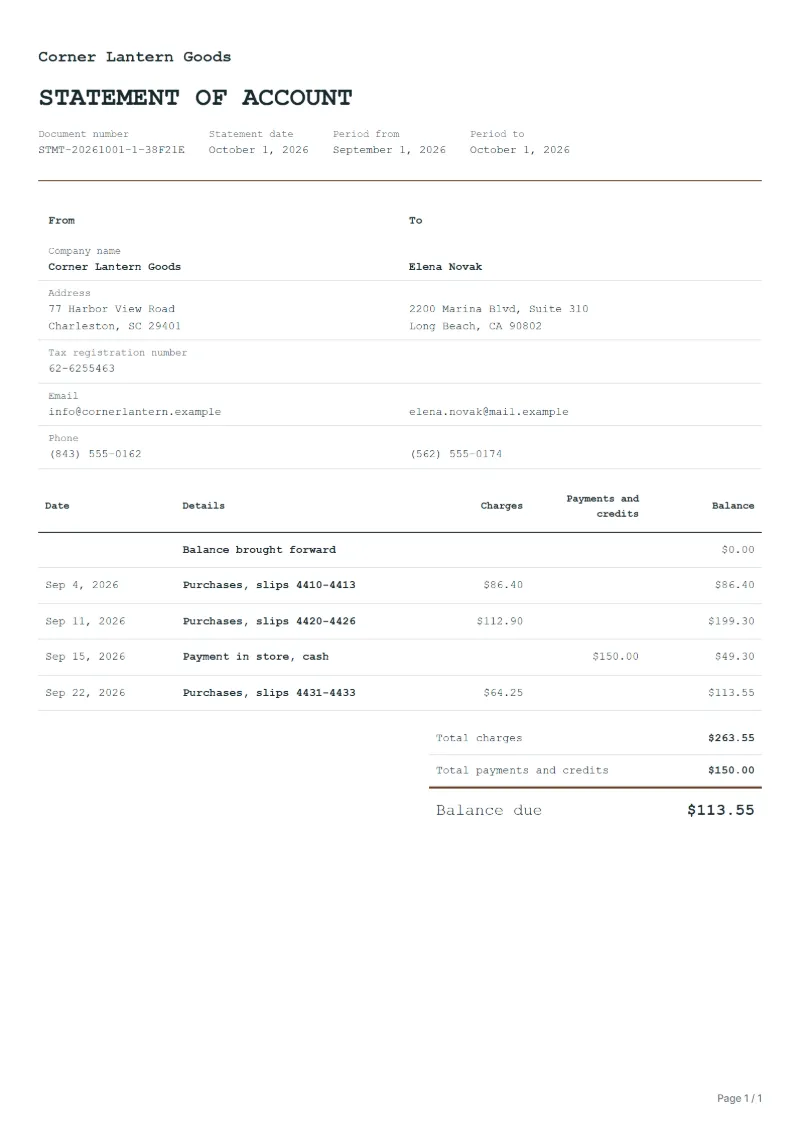
- Purchases, slips 4410-4413
- Purchases, slips 4420-4426
- Payment in store, cash
- Purchases, slips 4431-4433
Preparation guide
Example workflow
Collect the period's documents
Example: list "Purchases, slips 4410-4413" and every other invoice, receipt and credit note for the customer in the period, oldest first.
Check the running balance
Confirm the balance after each line, including "Purchases, slips 4431-4433", matches your accounts for this customer.
Send and follow up
Send the statement with the balance due and payment terms, then follow up on invoices past due.
A hardware store, a farm shop, a pharmacy or a village grocer may still let trusted customers take goods now and pay at the end of the month. Each visit leaves a signed slip; the monthly statement turns the pile of slips into one balance. Grouping purchases by slip number lets the household or the small business check every visit, and showing payments taken at the till keeps cash and account sales apart in the shop’s own books.
Fields to prepare
- Deliverables and line items
- Purchases, slips 4410-4413, Purchases, slips 4420-4426, Payment in store, cash, Purchases, slips 4431-4433: list each invoice, payment and credit by date, with its document number.
- Purchases, slips 4410-4413
- Give the slip numbers and the dates of the visits they cover; a customer checks the slips, not the total.
- Purchases, slips 4420-4426
- Keep one line per week or per batch of slips rather than one per item; the slips carry the item detail.
- Payment in store, cash
- A cash payment at the till goes on the statement as received, with the receipt number the shop gave.
- Purchases, slips 4431-4433
- Purchases after the last payment start the next month’s balance; show them, but say they are not yet due.
- Period and balance brought forward
- Give the statement date and the period it covers, and carry over the balance from the previous statement.
- Charges and payments
- Enter each invoice under charges and each payment or credit note under payments and credits, at the amount on the document itself. "Add from my documents" copies those amounts from your saved documents for this customer.
- Scope to agree
- Group purchases by the signed slips they came from, show each payment taken in the shop, and state the account limit and when the balance is due.
Before sending
- Does “Purchases, slips 4410-4413” carry the number and amount of the document it comes from?
- Has every payment for “Purchases, slips 4420-4426” been entered on the day it arrived?
- Would the customer find “Payment in store, cash” in their own ledger at the same amount?
Show 4 more
- Does “Purchases, slips 4431-4433” carry the number and amount of the document it comes from?
- Check the statement period, the balance brought forward and that every payment received is listed.
- List each invoice once, at the total it was issued for, and each credit note with the payments.
- Say how the customer can pay the balance due, and quote the numbers of any invoices past due.
Worked example with sample figures
The entries below are invented to show how the balance runs: 4 entries in USD over a period of 30 days.
- 27 days before the statement date: Purchases, slips 4410-4413, charged $86.40; balance $86.40
- 20 days before the statement date: Purchases, slips 4420-4426, charged $112.90; balance $199.30
- 16 days before the statement date: Payment in store, cash, paid $150.00; balance $49.30
- 9 days before the statement date: Purchases, slips 4431-4433, charged $64.25; balance $113.55
Balance due at the end of the period: $113.55.
What the document must show
These details make a statement of account easier to approve and to file.
- Your company name and address
- The customer's name
- Statement date and period
- Balance brought forward
- Each invoice, payment and credit with date and number
- Running balance and balance due
A statement adds no tax of its own: each line carries an invoice, a payment or a credit at the amount on that document, and the balance runs on from the balance brought forward.
Frequently asked questions
Who may buy on the account?
Agree in writing who may sign slips, such as family members or named employees, and print the names on the statement. A slip signed by someone not on the list is the commonest dispute on a house account.
What if the customer goes over the limit?
Say so on the statement and decide whether new purchases wait until a payment arrives. A limit that is never enforced is not a limit, and the statement is the natural place to remind the customer of it.
How is the balance on this statement worked out?
A statement adds no tax of its own: each line carries an invoice, a payment or a credit at the amount on that document, and the balance runs on from the balance brought forward. In the worked example above the entries end at a balance of $113.55.
What is the difference between a statement and an invoice?
An invoice asks for payment for one sale. A statement lists invoices, payments and credits over a period and shows what is still owed; it does not replace the invoices.
Can I add my logo and signature?
Yes. The From section of the editor has a place for your company logo and for a signature or seal image. Uploading a picture needs a free account, and a member can keep both in settings so that every new document starts with them.
Read next
Reading for the Store house account statement template: Unpaid invoice: follow-ups, part payments and statements and Payment reminder email: three templates and timing. For an account that is overdue, the Payment reminder template is the next step.