Early payment discount credit note template
Early payment discount credit note template: credit the settlement discount a customer earned by paying within the terms, invoice by invoice and tier by tier.
Templates by industry
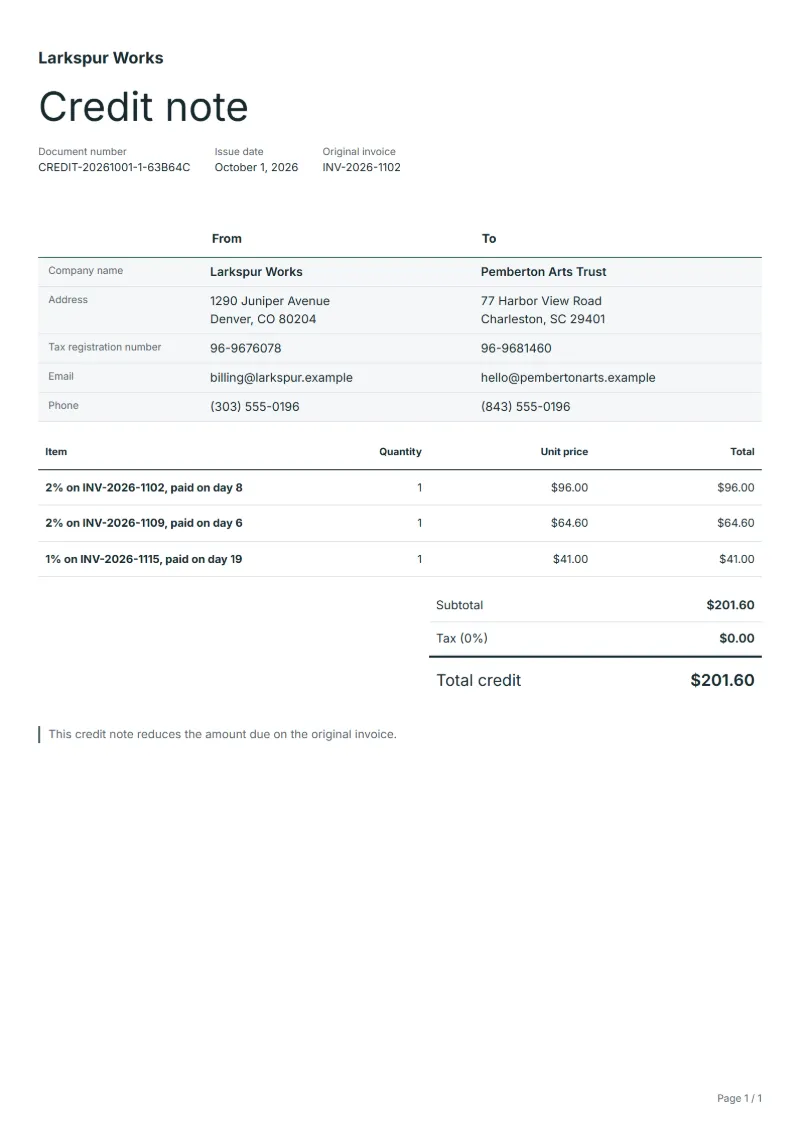
- 2% on INV-2026-1102, paid on day 8
- 2% on INV-2026-1109, paid on day 6
- 1% on INV-2026-1115, paid on day 19
Preparation guide
Example workflow
Identify the invoice and the reason
Example: for "2% on INV-2026-1102, paid on day 8", find the original invoice, note its number and date, and record the reason: a return, a price reduction or a cancellation.
Credit the affected lines
Enter the quantity or amount credited for each affected line, down to "1% on INV-2026-1115, paid on day 19", so the tax on it is reversed in proportion.
Send and settle the credit
Send the credit note to the customer, then refund the amount or set it off against the next invoice, and keep both documents together.
Terms such as “2% if paid within 10 days, 1% within 20, net 30” reward a customer for paying early, but the invoice was issued at the full price. When the customer takes the discount, a credit note brings the price, and where your rules require it the tax, down to what was actually paid. This template collects a month of such discounts in one document, one line per invoice, with the payment day showing which tier applied.
Fields to prepare
- Deliverables and line items
- 2% on INV-2026-1102, paid on day 8, 2% on INV-2026-1109, paid on day 6, 1% on INV-2026-1115, paid on day 19: only the lines being reduced or cancelled, with the quantity or amount credited.
- 2% on INV-2026-1102, paid on day 8
- Count the days from the invoice date as your terms do, and give the day the money arrived, not the day it was sent.
- 2% on INV-2026-1109, paid on day 6
- Each invoice keeps its own line, so the customer can match the discount to the payment that earned it.
- 1% on INV-2026-1115, paid on day 19
- A payment on day 19 earns only the lower tier; if the customer deducted the higher one, ask for the difference rather than crediting it.
- Original invoice
- Quote the number and date of the invoice being corrected, and the reason: a return, a price reduction or a cancellation.
- Settlement
- Say how the credit is settled: refunded to the customer or set off against the next invoice.
- Scope to agree
- Quote each invoice the discount applies to, the day it was paid and the discount tier it earned, and reduce the tax with the price where your tax rules require it.
Before sending
- Is “2% on INV-2026-1102, paid on day 8” one of the lines being corrected, at the price on the original invoice?
- Is the quantity or amount credited for “2% on INV-2026-1109, paid on day 6” no more than was invoiced?
- Does the customer know why “1% on INV-2026-1115, paid on day 19” is credited: a return, a price change or a cancellation?
Show 3 more
- Credit only the affected lines, and reverse the tax on them at the rate the original invoice used.
- Give the credit note a number of its own rather than reusing or changing the original invoice number.
- Agree with the customer whether the credit is refunded or set off before you send it.
Worked example with sample figures
The figures below are invented to show how the template adds up: 3 lines in USD, with an example tax rate of 8%.
| Item | Quantity × unit price | Amount |
|---|---|---|
| 2% on INV-2026-1102, paid on day 8 | 1 × $96.00 | $96.00 |
| 2% on INV-2026-1109, paid on day 6 | 1 × $64.60 | $64.60 |
| 1% on INV-2026-1115, paid on day 19 | 1 × $41.00 | $41.00 |
| Subtotal | $201.60 | |
| Sales tax (8%) | $16.13 | |
| Total | $217.73 | |
Credit before tax $201.60, sales tax reversed $16.13, total credited $217.73.
- The credit corrects invoice INV-2026-1102.
What the document must show
The details a credit note has to show, and why each one matters, are set out in the guide below.
The sales tax depends on where the work is supplied, so set the rate that applies to your customer before sending.
Official rate reference: US government: state and local taxes
Full requirements: Credit note vs invoice (and credit memo): how to issue one
Frequently asked questions
Do I need a credit note at all for an early payment discount?
It depends on your tax rules. Some countries expect the tax to follow the reduced price and accept either a credit note or wording on the original invoice; others let the discount be booked without a document. Check which applies before you choose this route.
The customer took the discount but paid late. What now?
The discount was not earned. Write to the customer, show the payment date against the terms and ask for the amount deducted; do not issue a credit note for it.
How is the sales tax worked out on this credit note?
The worked example above uses an example rate of 8%: $16.13 on a net amount of $201.60, for a total of $217.73. The editor recalculates all three when you change a quantity, a price or the country.
Why issue a credit note instead of editing the invoice?
An invoice you have sent is part of both parties' records. A credit note with its own number, the original invoice number and the reason reduces or cancels it, so both sets of books stay traceable.
How is the document numbered?
QuoteBill gives each new document a unique number of its own. A member can switch to numbers in sequence in settings, such as CN-2026-0001: one sequence for each kind of document, starting again every calendar year. A number you type yourself is kept as it is.
Read next
Reading for the Early payment discount credit note template: Credit note vs invoice (and credit memo): how to issue one and Quote, proforma, invoice, receipt, credit note: which to use. The VAT and GST calculator helps you credit the tax that went with the goods.