Carpenter invoice template
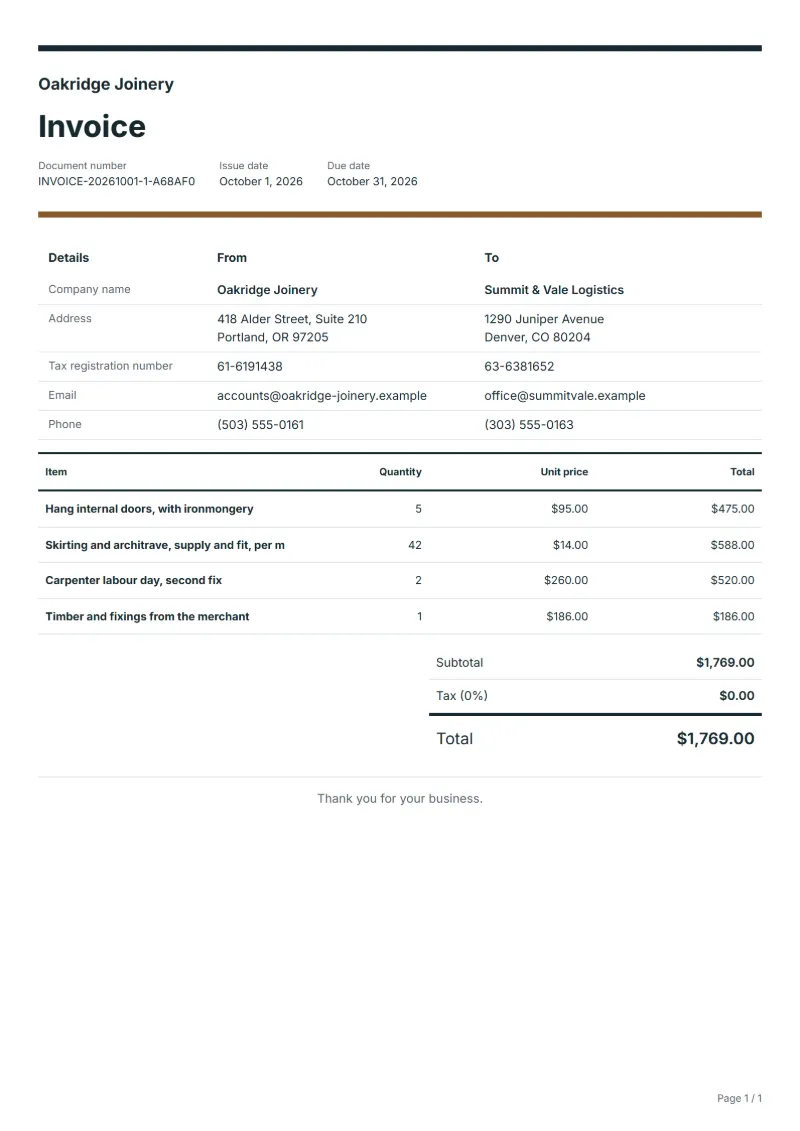
Carpenter invoice template: bill doors hung, skirting by the metre, labour days and the timber bought for the job on separate lines, then save it as a PDF.
Templates by industry
- Hang internal doors, with ironmongery
- Skirting and architrave, supply and fit, per m
- Carpenter labour day, second fix
- Timber and fixings from the merchant
Preparation guide
Example workflow
Confirm scope and quantities
Example: reconcile the approval and work record for "Hang internal doors, with ironmongery" to establish the quantity for this invoice.
Record delivery and acceptance
Check completion for every line, including "Timber and fixings from the merchant". Confirm completed quantities, site photos, agreed test results and any remaining remedial work.
Send the billing record
Send the final charges, delivery reference and due date to the customer, then reconcile payment against the invoice number.
Carpenters often finish a job with a mix of piece work, measured work and days on site, and a single lump sum hides which is which. This invoice keeps them apart: doors are counted, skirting and architrave are measured in metres, labour days cover work that cannot be priced by the piece, and timber and fixings bought from the merchant sit on a line of their own. A client comparing it with your quotation can see exactly where an extra day came from.
Fields to prepare
- Deliverables and line items
- Hang internal doors, with ironmongery, Skirting and architrave, supply and fit, per m, Carpenter labour day, second fix, Timber and fixings from the merchant: record the quantities actually supplied and the service period.
- Hang internal doors, with ironmongery
- Price each door as hung and fitted with its handle, latch and hinges; a door that needed planing or rehanging belongs on its own line.
- Skirting and architrave, supply and fit, per m
- Measure skirting and architrave along the wall after fitting, not from the length of boards bought, and round to the metre.
- Carpenter labour day, second fix
- Use day rates only for work you could not price per piece, and name what was done that day, such as boxing in pipes.
- Timber and fixings from the merchant
- Copy totals from the merchant receipts and say whether a handling margin is added, so the client can check it if asked.
- Site and measured quantities
- Record the site, work zones, areas, lengths or counts, and access hours.
- Materials and work stages
- Specify materials, labor, removal, disposal and making-good allowances, and completion criteria for each stage.
- Scope to agree
- Count doors and fittings per item, give skirting and architrave in running metres, and keep timber you bought for the job apart from your labour days.
Before sending
- Does “Hang internal doors, with ironmongery” show the quantity actually supplied, not the quantity first quoted?
- Is “Skirting and architrave, supply and fit, per m” charged at the rate the customer agreed to, with any change approved?
- Is “Carpenter labour day, second fix” finished and accepted, or does it belong on a later invoice?
Show 4 more
- Does “Timber and fixings from the merchant” show the quantity actually supplied, not the quantity first quoted?
- Agree how quantity changes following measurement or drawing revisions will be approved.
- Confirm client-supplied materials and work that other contractors must finish first.
- Match completed work to the order or approval record, and confirm the payment due date and amounts already received.
Worked example: finishing a loft conversion
The figures are an example, in dollars, with an example tax rate of 8%. A carpenter hangs five doors, fits 42 metres of skirting and architrave, spends two days boxing in pipes and building a cupboard, and passes on the timber bill.
- Doors: five at the fitted price; a door the client bought is marked as supplied by them.
- Skirting: the measured 42 metres, not the 48 metres bought.
- Days: two labour days, each with the work named.
| Item | Quantity × unit price | Amount |
|---|---|---|
| Hang internal doors, with ironmongery | 5 × $95.00 | $475.00 |
| Skirting and architrave, supply and fit, per m | 42 × $14.00 | $588.00 |
| Carpenter labour day, second fix | 2 × $260.00 | $520.00 |
| Timber and fixings from the merchant | 1 × $186.00 | $186.00 |
| Subtotal | $1,769.00 | |
| Sales tax (8%) | $141.52 | |
| Total | $1,910.52 | |
The lines add up to $1,769.00; tax at 8% is $141.52, so the invoice asks for $1,910.52. Whether offcuts stay on site follows from who paid for the timber.
Mistakes carpenters make on an invoice
- Billing the length of skirting bought instead of the length fitted.
- Folding timber costs into the day rate, so neither can be checked.
- Charging a client-supplied door at a fitted price that includes the door.
- Listing days without saying what was built on them.
What the document must show
These details make an invoice easier to approve and to file.
- Your business name, address and registration or tax number
- The customer's name and address
- Issue date and a document number you do not reuse
- Each line item with quantity, unit price and amount
- Tax shown separately from the net amount, and the total payable
- Payment terms: due date, bank details or accepted payment methods
The sales tax depends on where the work is supplied, so set the rate that applies to your customer before sending.
Official rate reference: US government: state and local taxes
Frequently asked questions
Should I charge for hanging a door the client bought?
Yes, but only for fitting it. Write that the door was supplied by the client, so the line covers hanging and ironmongery and not the door itself.
How do I bill a day lost waiting for other trades?
Only if your quotation said waiting time is chargeable. Then list it as a separate labour line with the date and the reason, never inside a fitting price.
Can I add a margin to the timber I bought?
You can if you told the client in advance, for example in the quotation terms. State the margin in the notes rather than hiding it in the line price.
What if I fitted more skirting than I quoted?
Bill the measured length and say so in the notes, with the quoted length beside it. Clients accept a difference more easily when the measuring method is written down.
How is tax calculated on this template?
The sales tax depends on where the work is supplied, so set the rate that applies to your customer before sending. The editor keeps the net amount, the tax and the total apart, and recalculates all three when you change a quantity, a unit price or the country setting.
Can I download it as Excel, Word or PDF?
Yes. A PDF needs no account: fill in the template and use Print / PDF. The Excel and Word files download from this page with a free account, and the spreadsheet keeps its formulas, so changing a quantity updates the tax and the total.
Read next
Reading for the Carpenter invoice template: How to write an invoice: a step-by-step example and Credit note vs invoice (and credit memo): how to issue one. The VAT and GST calculator works out the tax line for you.