Volunteer agreement (unpaid help for an organisation) template
A volunteer helps an organisation without pay: duties, time, expenses, safety, safeguarding and ending at any time. A sample contract you can read in full, edit in QuoteBill and sign online with a secure link.
Sample — review with a lawyer · Simple electronic signature with an audit trail
Who it is for
For a charity, club, school or community group and a volunteer who want the role, time, expenses, safety rules and safeguarding checks written down, with no pay and no promise of a job.
Whether a helper counts as a volunteer or as a worker depends on local law and the facts: regular duties, set hours or benefits can change this, and rules on working with children or vulnerable people may apply.
What it covers
14 clauses, in this order. Each one is in the sample text below, and you can edit, remove or add clauses before you send.
1. Purpose
What the agreement is for: the Volunteer gives unpaid help to the Organisation by choice, and both record what they expect of each other.
2. Role and duties
Blanks for the role, the main duties, the place and the contact person who guides the Volunteer. Duties change only with the Volunteer’s agreement, and nobody has to do what is unsafe or unlawful.
3. Time commitment
Blanks for the expected hours, the start and the end. Times are agreed with the contact person. The Volunteer may reduce their time or stop at any time, and the Organisation may change its need for help on reasonable notice.
4. Unpaid help and expenses
No pay or fee. A blank lists the expenses the Organisation repays against receipts and another any meals or benefits it gives. No paid job or other benefit is promised.
5. Voluntary relationship
This is meant as voluntary help and, as far as the law allows, not employment. Rights the law gives the Volunteer stay, and if the law sees the arrangement differently, that law applies.
6. Health, safety and insurance
The Organisation gives induction, instructions, protective equipment and a safe place. The Volunteer follows safety rules and reports hazards and accidents. A blank states any insurance that covers the Volunteer.
7. Conduct and rules
Everyone is treated with respect, free of harassment and discrimination. The Volunteer follows the Organisation’s policies, takes part sober and speaks for the Organisation only if it agrees.
8. Safeguarding
A blank lists the checks and policies the law or the Organisation requires for work with children or vulnerable people. The Volunteer completes the checks first, follows the policy and reports concerns at once.
9. Confidentiality and personal data
The Volunteer keeps private the personal information of the people helped and the Organisation’s non-public information. The Organisation handles the Volunteer’s data only as needed and as the law requires.
10. Photos, publicity and work created
Photos, videos or the Volunteer’s name are used for promotion only with separate permission, noted in a blank. Work made for the Organisation may be used by it, and earlier or outside work stays the Volunteer’s.
11. Ending the volunteering
Either side may end it at any time, with notice as a blank states. The Organisation may end it at once for a serious breach or safety. The Volunteer returns keys and materials and may get a short written confirmation.
12. Liability
Each side answers for harm it causes. The Organisation is responsible for running its activities safely. Liability the law does not allow to be limited is not limited, and other loss is capped at an amount you set.
13. Changes and notices
This agreement is the whole agreement. Changes need both sides’ agreement in writing or in electronic form, and notices go to the stated contact details.
14. Governing law and disputes
The law you name applies. The sides first try to settle a dispute in good faith, and otherwise the courts you name decide.
There is no price schedule: this agreement involves no payment.
The sample text
The whole sample, as QuoteBill starts it. Text in double square brackets, like [[10]], is a blank to fill in or check. A figure or time such as [[10]] that you leave as it is is used as shown when you send; a blank that needs your own words must be filled first. The clause text is written in English, Korean, Japanese and German; in other languages a contract starts in English for you to translate.
Read the sample text
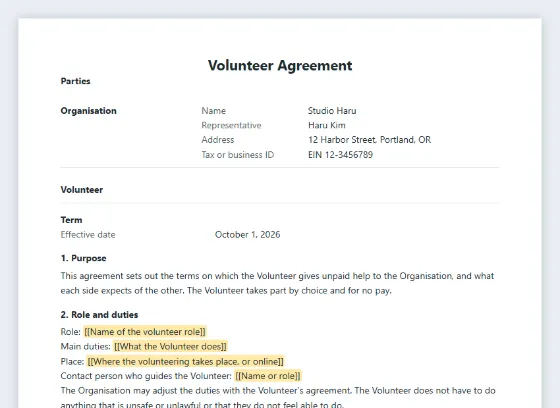
Volunteer Agreement
Parties: Organisation · Volunteer
1. Purpose
This agreement sets out the terms on which the Volunteer gives unpaid help to the Organisation, and what each side expects of the other. The Volunteer takes part by choice and for no pay.
2. Role and duties
Role: [[Name of the volunteer role]]
Main duties: [[What the Volunteer does]]
Place: [[Where the volunteering takes place, or online]]
Contact person who guides the Volunteer: [[Name or role]]
The Organisation may adjust the duties with the Volunteer’s agreement. The Volunteer does not have to do anything that is unsafe or unlawful or that they do not feel able to do.
3. Time commitment
The Volunteer expects to help for about [[4]] hours per [[week]], from [[Start date]] until [[End date, or until either side ends it]]. The Volunteer agrees the times with the contact person and tells them as early as possible if they cannot come. The Volunteer may reduce their time or stop at any time, and the Organisation may change how much help it needs with reasonable notice.
4. Unpaid help and expenses
The Volunteer receives no pay or fee for the help. The Organisation repays expenses that it approved in advance and that receipts show: [[none / which expenses and up to what amount]]
Meals, refreshments or other benefits that the Organisation gives its volunteers: [[none / what is given]]
The Organisation does not promise the Volunteer a paid job or any other benefit for the help, other than what is written here.
5. Voluntary relationship
The parties intend this to be voluntary help and not paid work, and, as far as the law allows, this agreement does not create an employment relationship. Neither side is obliged to continue, and the Volunteer is free to stop.
Nothing in this agreement takes away a right that the law gives the Volunteer. If the law treats the arrangement differently, for example because of regular duties, set hours or the benefits given, that law applies and the parties adjust this agreement to it.
6. Health, safety and insurance
The Organisation gives the Volunteer the induction, instructions and protective equipment needed for the role and a safe place to work. The Volunteer follows the safety instructions, reports hazards and accidents to the contact person without delay and, if they wish, tells the Organisation of any health condition that could affect their safety or that of others.
Insurance that covers the Volunteer, such as accident or liability cover: [[none / the cover the Organisation provides]] The Organisation tells the Volunteer what is and is not covered.
7. Conduct and rules
The Volunteer treats everyone with respect, follows the Organisation’s policies and reasonable instructions, does not take part under the influence of alcohol or drugs, and does not speak for the Organisation in public or on social media unless it has agreed. The Organisation treats the Volunteer with respect, free of harassment and discrimination, and listens to concerns and complaints.
8. Safeguarding
Checks and policies that the law or the Organisation requires for work with children, older people or other vulnerable persons: [[none / the checks and the policy that apply]]
The Volunteer completes the checks before starting this work, follows the safeguarding policy, reports any concern to [[Name or role]] without delay and works with vulnerable persons only as the policy allows.
9. Confidentiality and personal data
The Volunteer keeps confidential the personal information of the people the Organisation serves and the Organisation’s information that is not public, uses it only for the volunteering and handles it as the law that applies requires. The Organisation handles the Volunteer’s personal information only as needed to manage the volunteering and as the law requires. These duties continue after the volunteering ends.
10. Photos, publicity and work created
The Organisation uses photos or videos that show the Volunteer, or the Volunteer’s name, to promote its work only with the Volunteer’s separate permission: [[no permission given / the permission given, with its purpose and duration]]
Work that the Volunteer creates for the Organisation as part of the volunteering, such as texts, designs or photos, may be used by the Organisation for its purposes, as far as the law allows. The Volunteer keeps the rights in work created before the volunteering or outside it.
11. Ending the volunteering
Either side may end the volunteering at any time by telling the other, with [[no notice / 7 days’ notice]]. The Organisation may end it at once if the Volunteer seriously breaks the rules or if safety requires it. When it ends, the Volunteer returns the Organisation’s keys, equipment and materials, and the Organisation gives the Volunteer, on request, a short written confirmation of the help given.
12. Liability
Each party is liable for harm it causes, as the law provides. The Organisation is responsible for running its activities safely and for what it asks the Volunteer to do. The Volunteer takes reasonable care and follows the instructions given. Neither party limits liability that the law does not allow to be limited, such as for intent, gross negligence or personal injury. Subject to that, each party’s liability for other loss is limited to [[Amount, or the limit of the insurance that applies]].
13. Changes and notices
This agreement is the entire agreement on the volunteering. Changes are valid only if both parties agree to them in writing or in electronic form. Notices go to the contact details given for the parties, or to another address a party has notified.
14. Governing law and disputes
This agreement is governed by the law stated under Governing law. The parties will first try to settle any dispute in good faith. Otherwise the courts stated under Jurisdiction decide, unless mandatory law provides otherwise.
Governing law
[[Country or state whose law applies]]
Jurisdiction
[[Courts that decide disputes, e.g. the courts of your city]]
How to use it
Choose the template
Press the button to use this template. If you are not signed in, you first sign in or sign up for free and then come straight back to it.
Start a draft
The new-contract page opens with this template marked. Press its card to create a draft. Your company details fill in Party A, and you fill in the blanks, the other party and, where the template has one, the price schedule.
Send it for signature
You sign first, then send each signer a secure link and, by another route, an access code. Signers need no account.
Next steps
Your client opens the link on any device and needs no account. See what the signing looks like on the E-Contracts page, and read which kind of electronic signature is enough for which document.
What it is, and what it is not
QuoteBill creates a simple electronic signature with an audit trail. In the EU, the UK, the US and Korea a signature is not denied legal effect only because it is electronic, and in Japan most contracts need no particular form at all. What a simple electronic signature proves in a dispute depends on the evidence behind it, and some documents need another form.
It is not a qualified or advanced electronic signature, and QuoteBill does not verify who the signers are. It records the use of the link and access code you delivered, so anyone who has both can sign. The signature certificate lists every link issued and, for each action by the sender or a signer, its IP address and browser where they could be read.
Some documents need another form. Wills, many real-estate transfers, guarantees and some employment documents must, in some countries, be handwritten, notarised or signed with a qualified signature. The templates are samples, not legal advice: review them with a lawyer.
Other contract templates
Childcare or nanny agreement
A family engages a nanny or babysitter to care for its children at home: hours, pay, safety, health and ending.
Home care and caregiver agreement
A household engages a caregiver for an older or ill person at home: care plan, hours, pay, medicines, safety and ending.
Pet sitting and boarding agreement
A sitter or boarder cares for an animal: care instructions, vet authority, fees, cancellation and liability.
Private tutoring agreement
Lessons, schedule, cancellation and fees for a private tutor, with a parent or guardian signing for a minor student.