Home care and caregiver agreement template
A household engages a caregiver for an older or ill person at home: care plan, hours, pay, medicines, safety and ending. A sample contract you can read in full, edit in QuoteBill and sign online with a secure link.
Sample — review with a lawyer · Simple electronic signature with an audit trail
Who it is for
For a person or family hiring a caregiver to look after an older or ill person at home, who want the care plan, hours, pay, medicine rules and ending written down; local law sets the employment rules.
Household employment and the care of older or ill people are regulated and differ by country: employment law is mandatory, and rules on qualifications, medicines, pay and insurance vary. Get local advice first.
What it covers
16 clauses, in this order. Each one is in the sample text below, and you can edit, remove or add clauses before you send.
1. Purpose
What the agreement is for: a household engages a caregiver to look after an older or ill person at home. The law of the country where the work is done decides how this work is treated, and it goes first.
2. The person and the care plan
Blanks for the person cared for, their needs, the tasks and a care plan. The care follows written instructions from health professionals, and nothing beyond this is taken on without agreement.
3. Medicines and health tasks
Help with medicines only as a health professional prescribed or instructed and as the law allows, with a record of doses. No medical or nursing procedures without the qualification the law requires.
4. Start, term and place
The care starts on the effective date and is open-ended or fixed-term (you choose). Blanks for the home’s address, living in the home and a trial period, which applies only where the law allows it.
5. Hours, nights and rest
Blanks for the weekly hours, night care, on-call time and cover. The law decides whether on-call and overnight time counts as work; rest, maximum hours and overtime follow it.
6. Pay and expenses
Pay comes from the price schedule or a blank. Tax, social contributions, insurance and registration are as the law requires, with a blank for who handles them. Approved shopping and transport costs are repaid against receipts.
7. Leave and absence
Leave, sick leave and public holidays are as the law requires. A blank sets pay if the person is in hospital or the care is cancelled, never less than the law requires. Absences are reported early so cover can be found.
8. Dignity, privacy and safety
The Caregiver treats the person with dignity, respects their choices and privacy, uses no force, threats, restraint or neglect and helps them move safely. Nothing is posted about them; cameras are disclosed and kept out of private places.
9. Health information and emergencies
The Household gives written health details, wishes about care and emergency contacts. The Caregiver keeps a short log and calls the emergency services first, then the emergency contact.
10. Money, property and gifts
The Caregiver does not take, borrow or keep the person’s money or valuables or sign for them, except as agreed in writing and as the law allows. No gifts of real value, loans or a place in a will.
11. Checks, references and personal data
The Caregiver gives true information and documents. Checks are asked for only where the law allows or requires. The person’s health information stays confidential; the Caregiver’s data is handled as the law requires.
12. Insurance and liability
Home insurance, accident cover and liability cover are as the law requires, with a blank naming them. Each side answers for the loss it causes within the legal limits; a blank sets the Caregiver’s limit.
13. Ending the agreement
Either side may end the engagement only as the law of the country where the work is done allows. It also ends when care is no longer needed. Immediate ending only where the law allows, for example serious risk to the person.
14. Mandatory law and written terms
The local law gives the Caregiver rights this agreement cannot reduce, and may set rules for care. Where the law asks for written terms, this agreement and an attachment supply them in the form required.
15. Changes and notices
This contract is the whole agreement apart from rights the law gives. Changes need both sides’ written or electronic agreement where the law allows that form, and notices go to the addresses stated.
16. Governing law and disputes
The law you name applies. The sides first try to settle a dispute in good faith, and otherwise the courts you name decide.
A price schedule is optional: add one if you want the amounts in a table, or write the agreed amount into the payment clause.
The sample text
The whole sample, as QuoteBill starts it. Text in double square brackets, like [[10]], is a blank to fill in or check. A figure or time such as [[10]] that you leave as it is is used as shown when you send; a blank that needs your own words must be filled first. The clause text is written in English, Korean, Japanese and German; in other languages a contract starts in English for you to translate.
Read the sample text
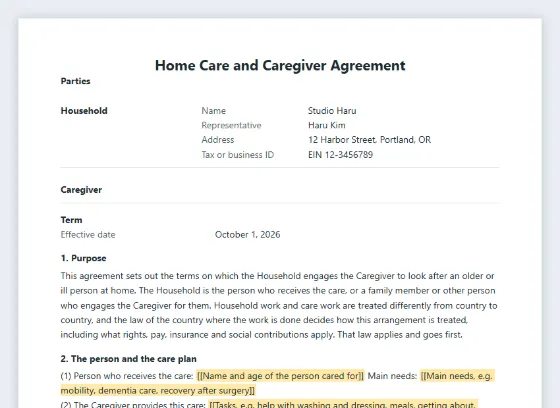
Home Care and Caregiver Agreement
Parties: Household · Caregiver
1. Purpose
This agreement sets out the terms on which the Household engages the Caregiver to look after an older or ill person at home. The Household is the person who receives the care, or a family member or other person who engages the Caregiver for them. Household work and care work are treated differently from country to country, and the law of the country where the work is done decides how this arrangement is treated, including what rights, pay, insurance and social contributions apply. That law applies and goes first.
2. The person and the care plan
(1) Person who receives the care: [[Name and age of the person cared for]] Main needs: [[Main needs, e.g. mobility, dementia care, recovery after surgery]]
(2) The Caregiver provides this care: [[Tasks, e.g. help with washing and dressing, meals, getting about, company, light housekeeping, going to appointments]]
(3) The care follows the written instructions of the person’s doctor or other health professionals, where there are any, and this care plan: [[Care plan, or none]]
The Caregiver does not take on work beyond this without agreement.
3. Medicines and health tasks
(1) The Caregiver helps with medicines only as a health professional has prescribed or instructed in writing, and as the law allows. Medicines the Caregiver may give or remind about: [[none / the medicines and times, or a list attached]] The Caregiver keeps a short record of each dose given.
(2) The Caregiver does not carry out medical or nursing procedures, such as injections, wound care or tube feeding, unless the Caregiver holds the qualification the law requires for them and the law allows it here. Qualifications held: [[none / the qualifications]]
(3) If the person’s health changes or the Caregiver is unsure what to do, the Caregiver tells the Household and, where needed, a health professional.
4. Start, term and place
(1) The care starts on the effective date and is [[open-ended / for a fixed term ending on the end date]]. Where the law restricts fixed-term work, this applies only as far as the law allows.
(2) The Caregiver works in the home of the person cared for at [[Address of the home]] and goes with the person to appointments and outings as agreed. Living in the home: [[no / yes, with the arrangement for room and meals]]
(3) A trial period applies only where the law allows it: [[none / the length of the trial period]]
5. Hours, nights and rest
(1) Usual hours: [[Hours per week]] per week, as follows: [[Days and times]]
(2) Night care and being on call: [[none / the arrangement]] Whether time on call, or overnight in the home, counts as working time and how it is paid is decided by the law of the country where the work is done.
(3) Rest breaks, daily and weekly rest, the maximum working time and the pay for overtime, night and weekend work are as required by that law.
(4) Cover when the Caregiver is off or cannot work: [[Who covers, e.g. a family member or a relief caregiver]]
6. Pay and expenses
(1) The Household pays the Caregiver the pay shown in the price schedule of this contract or, if there is none, [[Pay amount, currency and period, e.g. per hour or per month before tax]], on the payment terms stated in this contract. Other pay, such as holiday pay, a bonus or an allowance: [[none / the arrangement]]
(2) Tax, social contributions, insurance and registration for household staff, and who pays what, are as required by the law of the country where the work is done. Who handles them: [[Who handles them, e.g. the Household or a payroll service]]
(3) Reasonable costs of shopping, transport and other items that the Household approved in advance are reimbursed against receipts or paid from an advance, and the Caregiver keeps the receipts: [[none / the arrangement]]
7. Leave and absence
(1) Annual leave, public holidays, sick leave, family leave and other leave are as required by law, and are worked out in proportion to the hours worked where the law provides for that. Additional leave: [[none / the additional leave]]
(2) If the person is in hospital or away, or the care is cancelled at short notice, the Caregiver is paid as follows, and in any case not less than the law requires: [[full pay / the arrangement]]
(3) When the Caregiver cannot work, they tell the Household as early as possible, by [[How to report, e.g. a call or message in the morning]], so that cover can be arranged, and give the evidence that the law or the Household’s reasonable rules require.
8. Dignity, privacy and safety
(1) The Caregiver treats the person with dignity and respect, listens to their wishes, lets them make their own choices as far as they can and respects their privacy and belongings. The Caregiver does not use force, threats, restraint, neglect or any treatment that humiliates or harms the person.
(2) The Caregiver helps the person to move and lift safely, using the aids and training that the Household provides as the law requires: [[Equipment and training provided, or none]] The Caregiver tells the Household at once about hazards in the home and about any fall, injury or concern.
(3) The Caregiver does not publish photos, videos or information about the person, online or elsewhere, without the permission of the person or their legal representative. The Household tells the Caregiver before the engagement starts about any camera or recording device in the home and uses it only as the law allows. None is placed in bathrooms, in a room used by the Caregiver or in other private places.
9. Health information and emergencies
(1) The Household gives the Caregiver written details of the person’s health conditions, allergies, medicines, doctor and emergency contacts, and of any written wishes the person has made about their care: [[Details, or attached sheet]] The Household keeps them up to date.
(2) The Caregiver keeps a short log of the care given and of anything unusual: [[none / what is recorded and how it is kept]]
(3) In an emergency the Caregiver calls the emergency services and then the emergency contact: [[Name and phone number]]
10. Money, property and gifts
(1) The Caregiver does not take, borrow or keep the person’s money, cards, valuables or documents, and does not sign for the person, except as agreed in writing and as the law allows: [[none / the arrangement, e.g. a shopping float with receipts]]
(2) The Caregiver does not ask for or accept gifts of real value, loans, or a place in the person’s will or other documents. Small gifts of no real value may be accepted.
11. Checks, references and personal data
(1) The Caregiver gives true information about their identity, experience, qualifications and right to work, and gives the documents the law requires. References: [[none / the references given]]
(2) Background checks, certificates or health information about the Caregiver are asked for only where the law allows or requires it, and with the Caregiver’s consent where the law requires that: [[none / the checks]]
(3) The Caregiver keeps the person’s health and private information confidential, during and after the engagement, except where the law requires or allows disclosure, including to protect the person.
(4) The Household handles the Caregiver’s personal data to manage the engagement and as the law requires, and tells the Caregiver how it does so.
12. Insurance and liability
Insurance for the home, accident cover for the Caregiver and liability cover for the care are as the law requires: [[Insurance or scheme that applies, or as required by law]] Each party is responsible for loss or damage it causes, within the limits the law sets. Limit on the Caregiver’s liability for damage to the person’s property: [[as the law provides / the limit agreed, where the law allows it]]
13. Ending the agreement
(1) Either party may end the engagement only as the law of the country where the work is done allows, including its rules on notice periods, form, reasons and protection against dismissal. Notice period: [[as required by law / the longer period agreed, where the law allows it]]
(2) The engagement also ends when the care is no longer needed, for example if the person dies or moves to a care home. The Household tells the Caregiver as soon as possible, and what is due is settled as the law requires: [[none beyond the law / the arrangement]]
(3) Either party may end it at once only where the law allows this, for example because of a serious risk to the person’s safety.
(4) When it ends, the Caregiver returns keys, cards and the Household’s property, and the Household pays what is due as the law requires and gives the Caregiver a reference on request.
14. Mandatory law and written terms
The law of the country where the work is done gives the Caregiver rights that this agreement cannot reduce, and may also set rules for the care of older or ill people. If anything in this agreement gives the Caregiver less than that law requires, that law applies instead. Where that law requires a written contract or written information on the main terms, such as hours, pay and leave, this agreement and the document attached here supply it: [[Attachment, or none]] The parties add whatever is still missing. Where that law requires a particular form for the contract or the written terms, the parties also meet that form.
15. Changes and notices
This contract, including its price schedule, is the entire agreement on the care, apart from the rights the law gives. Changes are valid only if both parties agree to them in writing or in electronic form, where the law allows that form. Notices are given to the addresses stated for the parties, or to another address a party has notified.
16. Governing law and disputes
This agreement is governed by the law stated under Governing law. The parties will first try to settle any dispute in good faith. Otherwise the courts stated under Jurisdiction decide, unless mandatory law provides otherwise.
Payment terms
The pay is paid [[monthly in arrears / weekly]] into the bank account the Caregiver names, after the deductions the law requires, and a pay record is given where the law requires one.
Governing law
[[Country or state whose law applies]]
Jurisdiction
[[Courts that decide disputes, e.g. the courts of your city]]
How to use it
Choose the template
Press the button to use this template. If you are not signed in, you first sign in or sign up for free and then come straight back to it.
Start a draft
The new-contract page opens with this template marked. Press its card to create a draft. Your company details fill in Party A, and you fill in the blanks, the other party and, where the template has one, the price schedule.
Send it for signature
You sign first, then send each signer a secure link and, by another route, an access code. Signers need no account.
Next steps
Your client opens the link on any device and needs no account. See what the signing looks like on the E-Contracts page, and read which kind of electronic signature is enough for which document.
Already signed? Make the invoice from the signed contract: the parties and the price lines carry over, in full or for a deposit. The guide on turning a quotation into an invoice shows how to review the new draft, its dates and the PDF.
What it is, and what it is not
QuoteBill creates a simple electronic signature with an audit trail. In the EU, the UK, the US and Korea a signature is not denied legal effect only because it is electronic, and in Japan most contracts need no particular form at all. What a simple electronic signature proves in a dispute depends on the evidence behind it, and some documents need another form.
It is not a qualified or advanced electronic signature, and QuoteBill does not verify who the signers are. It records the use of the link and access code you delivered, so anyone who has both can sign. The signature certificate lists every link issued and, for each action by the sender or a signer, its IP address and browser where they could be read.
Some documents need another form. Wills, many real-estate transfers, guarantees and some employment documents must, in some countries, be handwritten, notarised or signed with a qualified signature. The templates are samples, not legal advice: review them with a lawyer.
Other contract templates
Childcare or nanny agreement
A family engages a nanny or babysitter to care for its children at home: hours, pay, safety, health and ending.
Pet sitting and boarding agreement
A sitter or boarder cares for an animal: care instructions, vet authority, fees, cancellation and liability.
Private tutoring agreement
Lessons, schedule, cancellation and fees for a private tutor, with a parent or guardian signing for a minor student.
Course enrolment agreement
A school or academy and a student: the course, fees, attendance, refunds as a blank, changes and certificates.