Pet sitting and boarding agreement template
A sitter or boarder cares for an animal: care instructions, vet authority, fees, cancellation and liability. A sample contract you can read in full, edit in QuoteBill and sign online with a secure link.
Sample — review with a lawyer · Simple electronic signature with an audit trail
Who it is for
For a pet sitter, dog walker or home boarder, and the owner, who want the animal’s needs, vet authority, fees, cancellation and late collection agreed in writing before the animal is handed over.
Care of animals is regulated differently by country and city: licences for boarding, vaccination, animal welfare and liability rules vary, so check what applies where the animal is cared for.
What it covers
14 clauses, in this order. Each one is in the sample text below, and you can edit, remove or add clauses before you send.
1. Purpose
What the agreement is for: the Carer looks after the Owner’s animal for a set period at the Owner’s home, the Carer’s home or another place. It covers daily care only and does not change who owns the animal.
2. The animal
Blanks for the name, species, breed and age, identification, health and medication, and behaviour. The Owner confirms ownership or authority, that the information is true, and that vaccinations are up to date as required.
3. Place and period of care
Blanks for the place and for visits or full-day boarding, with start and end times. A longer stay needs both sides’ agreement, and the animal is not handed to anyone else except a vet or a named substitute.
4. Care instructions
Blanks for food, walks, toilet routine, medication and what the animal must not have. The Carer keeps it safe, does not leave it alone beyond a set number of hours and does not breed, sell or give it away.
5. Handover and return
The Owner brings the animal with its food, medication and papers and collects it at the agreed time. Both note its condition at handover and return, and the Carer reports any illness, injury or incident.
6. Health, vet and emergencies
Blanks for the vet, emergency contacts and the amount of treatment the Carer may approve alone. Above it the Carer asks first if the Owner can be reached. The Owner pays the vet’s costs.
7. Fees and payment
The Carer’s fee comes from the price schedule. Extras such as medication, extra walks or holiday care are charged only if the schedule says so or the Owner agreed. Food and vet costs the Carer pays are repaid at cost.
8. Cancellation and late collection
Early cancellation returns payments less a set share, late cancellation leaves part payable, and late collection is paid per day. If the Owner cannot be reached, the Carer arranges care elsewhere and never leaves the animal alone.
9. Licences and the law
The Carer holds any licence, registration or training the law requires for the care it offers, as a blank states. The Owner meets the legal duties of an owner, such as registration or vaccination, and both follow animal welfare rules.
10. Keys, access and privacy
If the Carer enters the Owner’s home, keys and codes are used only for the care, kept safe, not copied and returned. A blank sets how photos and updates are sent. Public posting needs the Owner’s permission.
11. Risks and liability
Animals can fall ill or be hurt even with good care. The Carer is liable for failing to take reasonable care, the Owner for harm the animal causes. Other loss is capped at an amount you set, with the usual exceptions.
12. Ending the care early
Either side may end the care early if the animal’s health, behaviour or safety requires it or after a serious unremedied breach. The Owner collects the animal without delay and pays for the care given.
13. Changes and notices
This contract, with its price schedule, is the whole agreement. Changes need both sides’ agreement in writing or in electronic form, and notices go to the stated contact details.
14. Governing law and disputes
The law you name applies. The sides first try to settle a dispute in good faith, and otherwise the courts you name decide.
A price schedule (items, quantities and prices) is part of this contract. It starts empty, in your currency, and the clauses on fees and payment point to it.
The sample text
The whole sample, as QuoteBill starts it. Text in double square brackets, like [[10]], is a blank to fill in or check. A figure or time such as [[10]] that you leave as it is is used as shown when you send; a blank that needs your own words must be filled first. The clause text is written in English, Korean, Japanese and German; in other languages a contract starts in English for you to translate.
Read the sample text
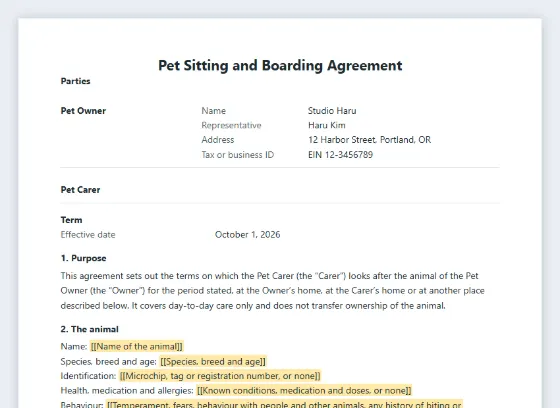
Pet Sitting and Boarding Agreement
Parties: Pet Owner · Pet Carer
1. Purpose
This agreement sets out the terms on which the Pet Carer (the “Carer”) looks after the animal of the Pet Owner (the “Owner”) for the period stated, at the Owner’s home, at the Carer’s home or at another place described below. It covers day-to-day care only and does not transfer ownership of the animal.
2. The animal
Name: [[Name of the animal]]
Species, breed and age: [[Species, breed and age]]
Identification: [[Microchip, tag or registration number, or none]]
Health, medication and allergies: [[Known conditions, medication and doses, or none]]
Behaviour: [[Temperament, fears, behaviour with people and other animals, any history of biting or escaping, or none]]
The Owner confirms that the animal is theirs or that they may arrange its care, that the information above is complete and true as far as they know, and that its vaccinations and parasite treatment are up to date as far as the law or the Carer’s reasonable rules require.
3. Place and period of care
Place of care: [[At the Owner’s home / at the Carer’s home / another place, with its address]]
Visits or boarding: [[Number and length of visits per day, or full-day boarding]]
The care starts on [[Date and time]] and ends on [[Date and time]]. A longer period needs the agreement of both parties, which may be given by message. The Carer keeps the animal at the stated place and does not hand it to anyone else, except to a vet or to a substitute the Owner names: [[none / name of the substitute]]
4. Care instructions
The Carer looks after the animal with the attention that a careful keeper would give.
Feeding, water, exercise and toilet routine: [[Food, amounts, times, walks, litter or cage care]]
Medication or treatment: [[none / what is given, when and how]]
What the animal must not do or have: [[Forbidden foods, places or other animals, off-lead walks, or none]]
The Carer keeps the animal safe and secure, uses a lead or an enclosure where needed, does not leave it alone for longer than [[4]] hours unless the Owner agrees, and keeps it apart from other animals unless the Owner agrees. The Carer does not breed, sell, give away or let anyone else take the animal.
5. Handover and return
At the start the Owner brings the animal with its food, medication, lead, bedding, toys and papers. At the end the Owner collects it at the agreed place and time, and the Carer hands back what is left of the supplies. The parties note the animal’s health and condition at handover and at return, and the Carer reports how the animal has been, including any illness, injury, incident or change in behaviour.
6. Health, vet and emergencies
Regular vet: [[Name, address and phone number of the vet]]
The Owner’s emergency contact: [[Name and phone number]]; a second contact: [[Name and phone number, or none]]
If the animal becomes ill or is hurt, the Carer calls a vet and the Owner without delay. The Carer may approve treatment without asking first up to [[Amount]]. Above that, the Carer asks the Owner first where the Owner can be reached in time. If the Owner cannot be reached and the vet advises that treatment cannot wait, the Carer may allow the treatment needed to save the animal’s life or relieve its suffering. The Owner’s further instructions on treatment: [[none / the instructions]]
The Owner pays the vet’s costs, including those under this clause, and repays the Carer what the Carer has paid for them.
7. Fees and payment
The Owner pays the Carer’s fee shown in the price schedule of this contract, on the payment terms stated in this contract. Extra services, such as giving medication, extra walks, grooming, collection and delivery or care on public holidays, are charged only as the price schedule says or if the Owner has agreed to them. Food and supplies that the Carer has to buy for the animal, and vet costs that the Carer pays, are repaid at cost against receipts.
8. Cancellation and late collection
If the Owner cancels at least [[7]] days before the care starts, the Carer returns what has been paid, less [[a stated share of the fee / nothing]]. If the Owner cancels later or shortens the stay, [[a stated share of the fee]] stays payable. If the Owner does not collect the animal on the agreed day, the Owner pays for the extra days at the rate in the price schedule. If the Owner has not collected the animal and cannot be reached [[7]] days after the end of the period, the Carer may arrange suitable care elsewhere at the Owner’s cost, contacts the Owner’s emergency contacts and, where the law requires it, the authority responsible for animals. The Carer never leaves the animal without care.
9. Licences and the law
Sitting, boarding and keeping animals may be regulated where the care takes place. The Carer holds the licence, registration, permit or training that the law requires for the care it offers, and keeps it for the whole period: [[none required / details of the licence or registration]]
The Owner meets the duties that the law gives to the owner of an animal, such as registration, microchipping, vaccination, licensing and insurance, where it requires them. Each party follows the animal welfare rules that apply.
10. Keys, access and privacy
Where the Carer enters the Owner’s home, the Owner gives the Carer the keys, codes and instructions needed. The Carer uses them only for the care, keeps them safe, does not copy them or let anyone else in, and returns them at the end. The Carer treats the home and belongings with care. Photos and updates about the animal are sent as follows: [[none / how often and by what means]] The Carer shares photos of the animal or the home in public only with the Owner’s permission.
11. Risks and liability
Animals can fall ill, be hurt or become stressed even with good care, and the Owner knows this. The Carer takes reasonable care and is liable for harm that results from failing to do so. As between the parties and as far as the law allows, the Owner is liable for damage or injury that the animal causes to people, other animals or property, unless the Carer caused it by not following the Owner’s instructions or the care this agreement requires. The Owner tells the Carer of any behaviour that could be dangerous. Insurance the Carer holds for animals in its care: [[none / details]]
Except for intent, gross negligence, personal injury or where the law does not allow a limitation, each party’s liability for other loss is limited to [[Amount, e.g. the total fee]].
12. Ending the care early
Either party may end the care early if the animal’s health, behaviour or safety makes this necessary, or if the other party seriously breaches this agreement and does not remedy the breach within a reasonable time after being asked to. When the care ends early, the Owner collects the animal without delay, or the Carer takes it to a place the Owner names, and the Owner pays the fee for the care given until then.
13. Changes and notices
This contract, including its price schedule, is the entire agreement on the care. Changes are valid only if both parties agree to them in writing or in electronic form. Notices go to the contact details given for the parties, or to another address a party has notified.
14. Governing law and disputes
This agreement is governed by the law stated under Governing law. The parties will first try to settle any dispute in good faith. Otherwise the courts stated under Jurisdiction decide, unless mandatory law provides otherwise.
Payment terms
The fee is payable [[in advance, before the care starts / on return of the animal]] by bank transfer or the other means stated on the invoice or in this contract.
Governing law
[[Country or state whose law applies]]
Jurisdiction
[[Courts that decide disputes, e.g. the courts of your city]]
How to use it
Choose the template
Press the button to use this template. If you are not signed in, you first sign in or sign up for free and then come straight back to it.
Start a draft
The new-contract page opens with this template marked. Press its card to create a draft. Your company details fill in Party A, and you fill in the blanks, the other party and, where the template has one, the price schedule.
Send it for signature
You sign first, then send each signer a secure link and, by another route, an access code. Signers need no account.
Next steps
Your client opens the link on any device and needs no account. See what the signing looks like on the E-Contracts page, and read which kind of electronic signature is enough for which document.
Already signed? Make the invoice from the signed contract: the parties and the price lines carry over, in full or for a deposit. The guide on turning a quotation into an invoice shows how to review the new draft, its dates and the PDF.
What it is, and what it is not
QuoteBill creates a simple electronic signature with an audit trail. In the EU, the UK, the US and Korea a signature is not denied legal effect only because it is electronic, and in Japan most contracts need no particular form at all. What a simple electronic signature proves in a dispute depends on the evidence behind it, and some documents need another form.
It is not a qualified or advanced electronic signature, and QuoteBill does not verify who the signers are. It records the use of the link and access code you delivered, so anyone who has both can sign. The signature certificate lists every link issued and, for each action by the sender or a signer, its IP address and browser where they could be read.
Some documents need another form. Wills, many real-estate transfers, guarantees and some employment documents must, in some countries, be handwritten, notarised or signed with a qualified signature. The templates are samples, not legal advice: review them with a lawyer.
Other contract templates
Childcare or nanny agreement
A family engages a nanny or babysitter to care for its children at home: hours, pay, safety, health and ending.
Home care and caregiver agreement
A household engages a caregiver for an older or ill person at home: care plan, hours, pay, medicines, safety and ending.
Private tutoring agreement
Lessons, schedule, cancellation and fees for a private tutor, with a parent or guardian signing for a minor student.
Course enrolment agreement
A school or academy and a student: the course, fees, attendance, refunds as a blank, changes and certificates.