Course enrolment agreement template
A school or academy and a student: the course, fees, attendance, refunds as a blank, changes and certificates. A sample contract you can read in full, edit in QuoteBill and sign online with a secure link.
Sample — review with a lawyer · Simple electronic signature with an audit trail
Who it is for
For a school, academy, training centre or independent teacher who enrols students and wants fees, attendance, refunds, changes and certificates written down, with a guardian signing for a minor.
Schools and academies may need a licence or registration, and a student’s refund and cancellation rights come from consumer and education law that differs by country. A guardian signs for a minor.
What it covers
15 clauses, in this order. Each one is in the sample text below, and you can edit, remove or add clauses before you send.
1. Purpose
What the agreement is for: the School enrols the Student in a course and the Student takes part. For a minor, a parent or legal guardian signs as a further party.
2. The course
Blanks for the course name and level, content, dates, schedule, venue or online platform, language and class size.
3. Enrolment and start
Enrolment takes effect on signing and the first payment, and the place is held until a date in a blank. A blank lists entry requirements; a student who turns out not to meet one gets another course or a refund.
4. Fees and payment
Fees come from the price schedule, in full or by instalments, and the schedule says what they include. Extras are charged only if listed. After a late payment the School may suspend attendance, but the fee stays due.
5. Attendance and conduct
The Student attends on time, takes part and follows the rules given before signing. The School may send out a disruptive student and, after a warning, end the enrolment. A blank for the attendance a certificate needs.
6. Missed classes and make-ups
A blank for the make-up policy. A class the School cancels or shortens is made up or refunded.
7. Cancellation, withdrawal and refunds
The Student or payer may withdraw by notice; a blank states the refund policy and a set number of days for paying it. A consumer’s legal rights to cancel or to a refund stay, and a course the School cancels is refunded.
8. Changes by the School
The School may change teacher, room, platform or, for good reasons, times. A substantial change lets the Student withdraw with a refund; a cancelled course means a refund or another course.
9. Course materials and recordings
Course materials stay the School’s and are for the Student’s own learning. No recording without the teacher’s permission. The Student’s own work stays theirs and is shown only with permission.
10. Assessment and certificates
The School explains how progress is assessed; blanks give the conditions for a certificate and any qualification. It does not promise a pass, a job or admission elsewhere.
11. Minors and guardians
Under a set age, or too young to sign alone where they live, a parent or legal guardian signs as a further party, is named in a blank, pays the fees and gets progress information. The School reports an absence or accident.
12. Health, safety and personal data
The Student tells the School what matters for safety; a blank for an emergency contact. Data is used only to run the course, shared only as needed and handled as the law requires. Photos only with separate permission.
13. Term and ending
Runs until the course ends. The School may end it for a serious breach or unpaid fees after a reminder, then refunds the part not given less what the refund policy lets it keep. The Student’s rights to withdraw and a refund stay.
14. Liability
Each side is liable under the law. Where allowed, the School’s liability for ordinary negligence is capped at an amount in a blank, never for intent, gross negligence, personal injury or unwaivable consumer rights.
15. Governing law and disputes
The law you name applies. The sides first try to settle a dispute in good faith, and otherwise the courts you name decide.
A price schedule (items, quantities and prices) is part of this contract. It starts empty, in your currency, and the clauses on fees and payment point to it.
The sample text
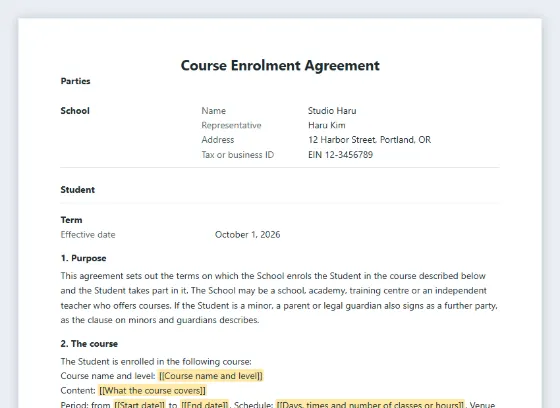
The whole sample, as QuoteBill starts it. Text in double square brackets, like [[10]], is a blank to fill in or check. A figure or time such as [[10]] that you leave as it is is used as shown when you send; a blank that needs your own words must be filled first. The clause text is written in English, Korean, Japanese and German; in other languages a contract starts in English for you to translate.
Read the sample text
Course Enrolment Agreement
Parties: School · Student
1. Purpose
This agreement sets out the terms on which the School enrols the Student in the course described below and the Student takes part in it. The School may be a school, academy, training centre or an independent teacher who offers courses. If the Student is a minor, a parent or legal guardian also signs as a further party, as the clause on minors and guardians describes.
2. The course
The Student is enrolled in the following course:
Course name and level: [[Course name and level]]
Content: [[What the course covers]]
Period: from [[Start date]] to [[End date]]. Schedule: [[Days, times and number of classes or hours]]. Venue or online platform: [[Venue or online platform]]. Language of instruction: [[Language]]. Class size: up to [[20]] students.
3. Enrolment and start
The enrolment takes effect when both parties have signed and the first payment under the clause on fees and payment has been received. The School keeps the Student’s place until [[Date]]. Entry requirements: [[Entry requirements, e.g. a level test or earlier courses, or none]]
The School confirms the enrolment in writing or in electronic form.
If it turns out that the Student does not meet an entry requirement that was stated before they signed, the School tells the Student promptly, and the parties agree a suitable course or the fees paid are refunded.
4. Fees and payment
The Student, or the parent or guardian who signs (the payer), pays the course fees and other fees shown in the price schedule of this contract, [[in full before the start / in instalments]], on the payment terms stated in it. Fees for materials, exams, registration or equipment are payable only if the price schedule lists them. The price schedule states what the course fee includes.
If a payment is more than [[7]] days late, the School may suspend the Student’s attendance after telling the payer; the fee stays due.
Where taxes apply, they are added to the fees.
5. Attendance and conduct
The Student attends classes on time, takes part, does the work set and follows the School’s rules, which the School gave the Student before they signed. Where the rules can be read: [[Where the rules can be read]]
The Student treats teachers and other students with respect, does not disrupt classes and takes care of the School’s premises and equipment.
The School may send a Student out of a class that they disrupt and, where the conduct is serious and continues after a warning, may end the enrolment as the clause on term and ending says.
Where a certificate depends on attendance, attendance at least [[80]]% of the classes is expected.
6. Missed classes and make-ups
If the Student misses a class, the School handles it as follows: [[Make-up policy, e.g. a recording, a make-up class within a set time, or none]]
A class that the School cancels or shortens is made up or refunded as the clause on changes by the School says.
7. Cancellation, withdrawal and refunds
The Student or the payer may withdraw from the course by notice to the School in writing or in electronic form. Refunds: [[Refund policy, e.g. a full refund before the start, a share of the fees after it begins, or none]]
The refund is paid within [[14]] days after the School accepts the notice, to the person who paid.
This clause does not limit any right that the law gives the Student as a consumer, such as a right to cancel a contract made at a distance or away from business premises, or a right to a refund if the School does not provide what was agreed. Those rights apply as the law that applies provides.
If the School cancels the course, it refunds the fees paid for the part not given, as the clause on changes by the School says.
8. Changes by the School
The School may change the teacher, the room or the platform and, for good reasons, the times of the classes, and tells the Student as early as it can. If a change is substantial and the Student cannot reasonably accept it, the Student may withdraw and receives a refund of the fees for the part of the course not yet given.
If the School cancels the course, for example because too few students enrolled, it tells the payer at least [[7]] days before the start where practicable and either refunds all fees paid for the part not given or offers another course that the payer accepts.
If the School has to cancel or shorten a class, for example because of illness, it makes the class up or refunds its share of the fee.
9. Course materials and recordings
Course materials, such as books, notes, slides and recordings, remain the School’s or its licensors’. The Student may use them for their own learning only and does not copy, sell or publish them.
The Student does not record classes without the teacher’s permission.
Work that the Student produces remains the Student’s; the School may display it only with the Student’s permission.
10. Assessment and certificates
The School tells the Student how progress is assessed. A certificate or confirmation of attendance is issued if the Student meets the stated conditions: [[Conditions for a certificate]]
Qualification or accreditation that the course leads to: [[none / the qualification and who awards it]]
The School does not promise that the Student will pass an exam, find a job or be admitted to another school; the result depends on the Student’s own effort and on the decisions of the awarding body.
11. Minors and guardians
If the Student is under [[18]] years old, or under the age at which they can sign for themselves where they live, a parent or legal guardian also signs this agreement as a further party. The parent or guardian confirms that they have the authority to sign for the Student, is responsible for paying the fees and receives information about attendance and progress. Parent or guardian: [[Name of the parent or guardian and relationship]]
The School tells the parent or guardian without delay of an absence, an accident or a serious conduct problem, using: [[Phone or email of the parent or guardian]]
12. Health, safety and personal data
The Student tells the School about a health condition or need that matters for their safety or for the class, as far as they are willing to, and the School takes reasonable care of the Student’s safety during classes. Emergency contact: [[Name and phone number]]
The School uses the Student’s contact, payment, attendance, progress and health information only to run the course and for safety, shares it only with people who need it for that purpose, keeps it only as long as needed and handles it as the law that applies to it requires.
Photos or recordings of the Student are used for promotion only with separate permission. Permission given: [[none / the permission given]]
13. Term and ending
This agreement starts on the effective date and ends when the course ends.
The School may end it by notice [[after a written warning / at once in serious cases]] if the Student seriously breaches the rules or this agreement, or does not pay after a reminder. It then refunds the fees for the part of the course not given, less any amount that the refund policy allows it to keep.
The Student’s rights under the clause on cancellation, withdrawal and refunds stay.
14. Liability
Each party is liable under the law that applies. Where the law allows a limitation, the School’s liability for ordinary negligence is limited to [[the fees paid for the course]]. This never limits liability for intent, gross negligence or injury to life, body or health, or any right that the law gives a consumer and that cannot be waived.
The School is not liable for the loss of belongings that the Student brings, unless it caused the loss by intent or gross negligence.
15. Governing law and disputes
This agreement is governed by the law stated under Governing law. The parties will first try to settle any dispute in good faith. Otherwise the courts stated under Jurisdiction decide, unless mandatory law provides otherwise.
Payment terms
The course fees are paid [[in full before the start / in instalments on the dates stated in the price schedule]], within [[7]] days of receiving the invoice, by [[bank transfer / card / cash against a receipt]].
Governing law
[[Country or state whose law applies]]
Jurisdiction
[[Courts that decide disputes, e.g. the courts of your city]]
How to use it
Choose the template
Press the button to use this template. If you are not signed in, you first sign in or sign up for free and then come straight back to it.
Start a draft
The new-contract page opens with this template marked. Press its card to create a draft. Your company details fill in Party A, and you fill in the blanks, the other party and, where the template has one, the price schedule.
Send it for signature
You sign first, then send each signer a secure link and, by another route, an access code. Signers need no account.
Next steps
Your client opens the link on any device and needs no account. See what the signing looks like on the E-Contracts page, and read which kind of electronic signature is enough for which document.
Already signed? Make the invoice from the signed contract: the parties and the price lines carry over, in full or for a deposit. The guide on turning a quotation into an invoice shows how to review the new draft, its dates and the PDF.
What it is, and what it is not
QuoteBill creates a simple electronic signature with an audit trail. In the EU, the UK, the US and Korea a signature is not denied legal effect only because it is electronic, and in Japan most contracts need no particular form at all. What a simple electronic signature proves in a dispute depends on the evidence behind it, and some documents need another form.
It is not a qualified or advanced electronic signature, and QuoteBill does not verify who the signers are. It records the use of the link and access code you delivered, so anyone who has both can sign. The signature certificate lists every link issued and, for each action by the sender or a signer, its IP address and browser where they could be read.
Some documents need another form. Wills, many real-estate transfers, guarantees and some employment documents must, in some countries, be handwritten, notarised or signed with a qualified signature. The templates are samples, not legal advice: review them with a lawyer.
Other contract templates
Childcare or nanny agreement
A family engages a nanny or babysitter to care for its children at home: hours, pay, safety, health and ending.
Home care and caregiver agreement
A household engages a caregiver for an older or ill person at home: care plan, hours, pay, medicines, safety and ending.
Pet sitting and boarding agreement
A sitter or boarder cares for an animal: care instructions, vet authority, fees, cancellation and liability.
Private tutoring agreement
Lessons, schedule, cancellation and fees for a private tutor, with a parent or guardian signing for a minor student.