Short-term holiday rental agreement template
Stay and price, deposit, check-in, guests and house rules, damage, host duties, cancellation, safety and registration. A sample contract you can read in full, edit in QuoteBill and sign online with a secure link.
Sample — review with a lawyer · Simple electronic signature with an audit trail
Who it is for
For the owner or manager of a holiday home, apartment or similar and a guest who want the stay, price, deposit, house rules, cancellation and safety terms agreed in writing before arrival.
Short-term letting is licensed, registered, taxed or limited in many places, and guest-stay and consumer rules differ by country; the Host must follow the permits and rules that apply to the accommodation.
What it covers
14 clauses, in this order. Each one is in the sample text below, and you can edit, remove or add clauses before you send.
1. Purpose
What the agreement is for: the Host lets holiday accommodation to the Guest for a short stay. It is not a tenancy of a home.
2. Property and stay
Blanks for the accommodation, arrival and departure, the number and names of guests and what is included, such as linen, internet or parking.
3. Booking and payment
The price comes from the price schedule for the whole stay. A choice says whether local tourist taxes are included or added. Part is paid on booking and the balance before arrival, set in blanks.
4. Security deposit
A set amount paid before arrival or at check-in and returned within a set number of days after departure, less documented damage and what was owed, with the deductions explained.
5. Check-in and check-out
Check-in and check-out times are blanks. The Host hands over keys and explains the accommodation, a late check-out needs agreement, and the Guest leaves it tidy and returns the keys.
6. Guests and use
Only for holiday stays by the named guests, not as a residence, party or business. The lead guest is at least a set age and answers for the others, day visitors need consent and there is no subletting.
7. House rules
A blank for the house rules, such as quiet hours, smoking, pets and parking. The Guest respects the building and neighbours, and the Host may end the stay after a serious breach, as far as the law allows.
8. Care of the property and damage
The Guest takes care of the accommodation, reports damage at once and pays for damage beyond normal wear. A choice says whether final cleaning is in the price or done by the Guest.
9. Host’s obligations
The Host provides a clean, safe, as-described accommodation, answers within a set time and confirms it may let it short-term with the permit, registration, insurance and safety measures the law requires.
10. Problems and unavailability
If the accommodation is unavailable or differs materially, the Host offers an equal one or refunds the days affected. The price drops for loss of use the Host could have fixed, and force majeure follows a blank policy.
11. Cancellation and changes
A blank sets the Guest’s cancellation policy, and if the Host cancels, everything is refunded plus a choice of compensation. Changes need the Host’s agreement. Legal cancellation rights stay.
12. Safety, registration and data
The Guest gives the guest details the law requires and follows the safety instructions. The Host uses personal data only for the stay and legal duties and shares it only where needed.
13. Liability
The Host answers for its fault and defects, and for belongings only if at fault. The Guest answers for guests’ safety and special features such as a pool. Liability is capped, with the usual exceptions.
14. Governing law and disputes
The law you name applies. The sides first try to settle a dispute in good faith, and otherwise the courts you name decide.
A price schedule (items, quantities and prices) is part of this contract. It starts empty, in your currency, and the clauses on fees and payment point to it.
The sample text
The whole sample, as QuoteBill starts it. Text in double square brackets, like [[10]], is a blank to fill in or check. A figure or time such as [[10]] that you leave as it is is used as shown when you send; a blank that needs your own words must be filled first. The clause text is written in English, Korean, Japanese and German; in other languages a contract starts in English for you to translate.
Read the sample text
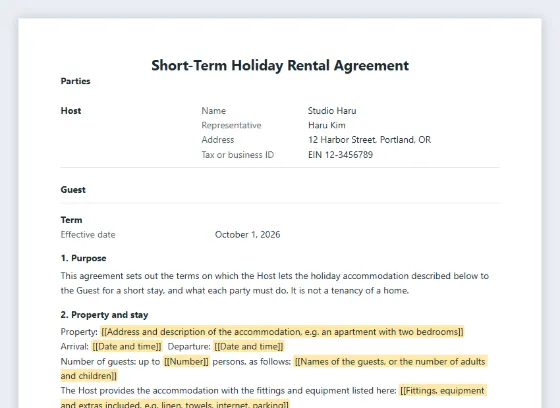
Short-Term Holiday Rental Agreement
Parties: Host · Guest
1. Purpose
This agreement sets out the terms on which the Host lets the holiday accommodation described below to the Guest for a short stay, and what each party must do. It is not a tenancy of a home.
2. Property and stay
Property: [[Address and description of the accommodation, e.g. an apartment with two bedrooms]]
Arrival: [[Date and time]] Departure: [[Date and time]]
Number of guests: up to [[Number]] persons, as follows: [[Names of the guests, or the number of adults and children]]
The Host provides the accommodation with the fittings and equipment listed here: [[Fittings, equipment and extras included, e.g. linen, towels, internet, parking]]
3. Booking and payment
The Guest pays the price shown in the price schedule of this contract for the whole stay. The price includes [[Cleaning fee and other included charges, or none]].
Local tourist, accommodation or similar taxes and charges that the law that applies requires are [[included in the price / added and paid by the Guest, as shown in the price schedule]].
The Guest pays [[30]]% on booking and the balance [[14]] days before arrival, or the whole price on booking if the stay starts within that time.
4. Security deposit
The Guest pays a security deposit of [[Amount]] [[before arrival / at check-in]]. The Host returns it within [[7]] days after departure, less the documented cost of damage, missing items and other amounts the Guest owes under this agreement, and tells the Guest in writing or in electronic form what was deducted and why.
No interest is paid on the deposit unless the law requires it. The deposit does not limit the Guest’s liability for damage above its amount.
5. Check-in and check-out
Check-in is from [[Time]] and check-out is by [[Time]]. The Host gives the Guest the keys or the access code and explains how the accommodation works, in person or in writing. A late check-out needs the Host’s agreement and may be charged at [[Late check-out charge, or none]].
On departure the Guest leaves the accommodation tidy, closes windows and doors, switches off appliances and returns the keys or access devices.
6. Guests and use
Unless the Host agrees otherwise in writing or in electronic form, the accommodation is used only for holiday stays by the guests named in this agreement, and not as a permanent residence, for a party or event or for any business purpose.
The lead guest, who signs this agreement, is at least [[18]] years old, stays throughout and is responsible for the other guests, including minors. Day visitors need the Host’s consent. The Guest may not sublet the accommodation or pass it on to anyone else.
7. House rules
The Guest follows these house rules: [[House rules, e.g. quiet hours, smoking, pets, parking, waste, use of the pool or terrace]]
The Guest follows the rules of the building and the neighbourhood, causes no nuisance and treats the neighbours with consideration. If a guest seriously breaks the rules or endangers people or the property, the Host may end the stay and ask the guests to leave, after a warning where that is reasonable, as far as the law that applies allows.
8. Care of the property and damage
The Guest treats the accommodation, its furnishings and its equipment with care and keeps it reasonably clean. The Guest tells the Host without delay of any damage or defect and pays for damage caused by the guests beyond normal wear and tear.
The condition on arrival is as described and, if there are photographs or an inventory, as they show. Final cleaning is [[included in the price / done by the Guest]].
9. Host’s obligations
The Host provides the accommodation clean, safe and in the condition described, with working equipment and the services listed, and answers the Guest’s questions and reports of problems within [[24]] hours or, for urgent problems, as soon as possible.
The Host confirms that it is entitled to let the accommodation for short stays, that it holds the permit, registration and insurance that the law that applies requires for this: [[Registration or permit number, or none required]] and that the accommodation meets the safety requirements that apply to it, such as smoke alarms and safe exits.
10. Problems and unavailability
If the accommodation is not available, or differs from the description in a way that matters, the Host offers equivalent accommodation of at least the same standard or, if it cannot, refunds the amount paid for the days affected.
The Guest tells the Host of a problem as soon as it is noticed so that it can be put right. The price is reduced in proportion to any loss of use that the Host could have remedied but did not.
Where an event outside the control of both parties, such as extreme weather or a failure of public services, makes the stay impossible, the money paid for the days that cannot be used is [[refunded / handled as stated here: policy]].
11. Cancellation and changes
If the Guest cancels, the following applies: [[Cancellation policy, e.g. full refund up to 30 days before arrival, half up to 7 days before, none after]]
A change of dates or of the number of guests needs the Host’s agreement. If the Host cancels, it refunds everything paid at once and pays [[Compensation for the Guest, or none]].
Rights that the law that applies gives the Guest to cancel or withdraw are not limited by this clause.
12. Safety, registration and data
The Guest gives the Host the information about the guests that the law that applies requires for registration or reporting, and follows the safety instructions for the accommodation, including those on fire, gas and water.
The Host uses the guests’ personal data only to carry out the stay and to meet legal duties, shares it only with those who need it for that purpose, such as cleaners or the authorities where the law requires it, keeps it only as long as needed and handles it as the law that applies requires.
13. Liability
The Host is liable, as the law provides, for damage that its fault or a defect of the accommodation causes to the Guest, but not for the loss of the guests’ belongings unless the Host’s fault caused it. The Guest is responsible for the safety of the guests, including children, and for the use of any pool, hot tub or other special feature: [[Special risks, e.g. pool, hot tub, steep stairs, or none]]
The Guest is advised to take out travel insurance that also covers belongings. Except for intent, gross negligence, personal injury or where the law does not allow a limitation, each party’s total liability for other loss under this agreement is limited to [[the total price / Amount]].
14. Governing law and disputes
This agreement is governed by the law stated under Governing law. The parties will first try to settle any dispute in good faith. Otherwise the courts stated under Jurisdiction decide, unless mandatory law provides otherwise.
Payment terms
The price is payable as stated under Booking and payment, by bank transfer to the account stated in the booking confirmation or by [[card / other payment method]]. The security deposit is payable as stated under Security deposit.
Governing law
[[Country or state whose law applies]]
Jurisdiction
[[Courts that decide disputes, e.g. the courts of your city]]
How to use it
Choose the template
Press the button to use this template. If you are not signed in, you first sign in or sign up for free and then come straight back to it.
Start a draft
The new-contract page opens with this template marked. Press its card to create a draft. Your company details fill in Party A, and you fill in the blanks, the other party and, where the template has one, the price schedule.
Send it for signature
You sign first, then send each signer a secure link and, by another route, an access code. Signers need no account.
Next steps
Your client opens the link on any device and needs no account. See what the signing looks like on the E-Contracts page, and read which kind of electronic signature is enough for which document.
Already signed? Make the invoice from the signed contract: the parties and the price lines carry over, in full or for a deposit. The guide on turning a quotation into an invoice shows how to review the new draft, its dates and the PDF.
What it is, and what it is not
QuoteBill creates a simple electronic signature with an audit trail. In the EU, the UK, the US and Korea a signature is not denied legal effect only because it is electronic, and in Japan most contracts need no particular form at all. What a simple electronic signature proves in a dispute depends on the evidence behind it, and some documents need another form.
It is not a qualified or advanced electronic signature, and QuoteBill does not verify who the signers are. It records the use of the link and access code you delivered, so anyone who has both can sign. The signature certificate lists every link issued and, for each action by the sender or a signer, its IP address and browser where they could be read.
Some documents need another form. Wills, many real-estate transfers, guarantees and some employment documents must, in some countries, be handwritten, notarised or signed with a qualified signature. The templates are samples, not legal advice: review them with a lawyer.
Other contract templates
Building and construction works contract
Works and plans, permits, programme, price and stages, variations, handover, defects warranty and insurance.
Home or office renovation contract (interior works)
Scope and materials, access, permits, schedule, payment plan, hidden conditions, acceptance and guarantee.
Repair and maintenance work contract
Work and price, extra work found on site, regulated trades, completion, guarantee and cancellation.
Architectural or interior design services agreement
Project stages, client brief, fees, permits, cost estimates, site visits, and who owns and may use the designs.