Event venue hire agreement (hall, studio, garden) template
Hire of a hall, studio or garden for one event: hours, capacity, deposits, damage, insurance and cancellation. A sample contract you can read in full, edit in QuoteBill and sign online with a secure link.
Sample — review with a lawyer · Simple electronic signature with an audit trail
Who it is for
For the owner of a hall, studio, garden or similar space who wants hours, capacity, deposits, house rules, damage and cancellation agreed in writing with a hirer for an event.
Rules on safety, capacity, noise, alcohol, music and food at events differ by place; check which permits and limits apply to your venue and event before you use this.
What it covers
14 clauses, in this order. Each one is in the sample text below, and you can edit, remove or add clauses before you send.
1. Purpose
What the agreement is for: the Owner lets a venue to the Hirer for one event and for stated hours. It covers the use of the space only, not a lease and not a home.
2. Venue and event
Blanks for the venue and its address, the spaces included, the kind of event, the expected number of guests and the fittings and equipment that come with it.
3. Hire period and access
When the Hirer may come in to set up, the date and the start and end times of the event, and the time the venue must be empty. A blank sets the charge for extra time. Keys or codes are handed over and returned.
4. Capacity and permitted use
The venue is used only for the described event and for no more than a set number of people. No subletting, nothing unlawful or disturbing, music ends at a set time, and the Owner may refuse entry to anyone dangerous.
5. Permits and licences
The Owner says the venue may be used for such events and passes on any condition. The Hirer gets and pays for the permits the law requires for its own event, such as alcohol or music. A blank lists them.
6. Hire fee and extras
The hire fee and the prices of extras, such as equipment, staff or cleaning, come from the price schedule, with tax added where the law requires it. Extras are charged only if the Hirer asked for or approved them.
7. Deposits
A booking deposit counts towards the fee, and a damage deposit is held as security. It is returned within a set number of days after the final walk-through, less amounts owed that the Owner can show in a list.
8. House rules and safety
The Hirer follows the house rules and the staff’s safety instructions, keeps exits clear and uses no flames or gas without agreement. A named person is present throughout, and the Owner may stop a dangerous event.
9. Suppliers and staff
The Hirer may bring caterers, musicians and others and is responsible for them. They are named in advance and hold the permits and insurance the law requires. A blank lists suppliers the Hirer must use.
10. Condition, damage and cleaning
Both walk through the venue before and after and record its condition. The Hirer returns it as found apart from normal wear and pays for damage it, its guests and suppliers cause. A blank decides who cleans.
11. Insurance and liability
The Hirer insures its event and its liability, as a blank states, and the Owner insures the building. Each answers for harm it causes. Other loss is capped at an amount you set, with the usual exceptions.
12. Cancellation and changes
A Hirer who cancels early gets money back less a set share, and later cancellation leaves part of the fee payable. The date can be moved once. If the Owner cannot provide the venue, all payments are returned.
13. Changes and notices
This contract, with its price schedule and any house rules, is the whole agreement. Changes need both sides’ agreement in writing or in electronic form, and notices go to the stated addresses.
14. Governing law and disputes
The law you name applies. The sides first try to settle a dispute in good faith, and otherwise the courts you name decide.
A price schedule (items, quantities and prices) is part of this contract. It starts empty, in your currency, and the clauses on fees and payment point to it.
The sample text
The whole sample, as QuoteBill starts it. Text in double square brackets, like [[10]], is a blank to fill in or check. A figure or time such as [[10]] that you leave as it is is used as shown when you send; a blank that needs your own words must be filled first. The clause text is written in English, Korean, Japanese and German; in other languages a contract starts in English for you to translate.
Read the sample text
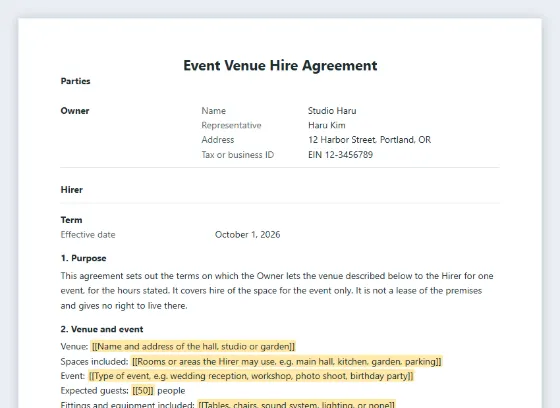
Event Venue Hire Agreement
Parties: Owner · Hirer
1. Purpose
This agreement sets out the terms on which the Owner lets the venue described below to the Hirer for one event, for the hours stated. It covers hire of the space for the event only. It is not a lease of the premises and gives no right to live there.
2. Venue and event
Venue: [[Name and address of the hall, studio or garden]]
Spaces included: [[Rooms or areas the Hirer may use, e.g. main hall, kitchen, garden, parking]]
Event: [[Type of event, e.g. wedding reception, workshop, photo shoot, birthday party]]
Expected guests: [[50]] people
Fittings and equipment included: [[Tables, chairs, sound system, lighting, or none]]
3. Hire period and access
The Hirer may enter the venue from [[Date and time access begins]] to set up. The event takes place on [[Date]] from [[Start time]] to [[End time]], and the Hirer has cleared the venue and left by [[Time]]. If the Hirer stays longer, it pays [[Charge for extra time, e.g. per hour or part of an hour]]. The Owner hands over the keys or entry codes at the start of the hire and takes them back at its end.
4. Capacity and permitted use
The venue is used only for the event described above and for no more than [[100]] people at any one time, counting guests, staff and suppliers. The Hirer does not sublet the venue, hand the event over to someone else or use the venue for anything unlawful, dangerous or likely to disturb others. Music and amplified sound end at [[Time]], or earlier where the law or local rules require it. The Owner may refuse entry to anyone who endangers others or breaks the house rules.
5. Permits and licences
The Owner confirms that the venue may be used for events of this kind and tells the Hirer of any condition attached to that use, such as limits on numbers, noise or hours. The Hirer obtains and pays for the licences, permits and notices that the law requires for its own event, for example for alcohol, food, music, entertainment or a temporary structure, and shows them to the Owner on request. Permits needed and who obtains each: [[none / list of permits]]
6. Hire fee and extras
The Hirer pays the hire fee and the prices of extras, such as equipment, staff, cleaning, parking or extra time, shown in the price schedule of this contract, on the payment terms stated in this contract. Where the law requires tax on the hire, it is added. Extras are charged only if the Hirer asks for them before the event or approves them in writing or in electronic form.
7. Deposits
On signing, the Hirer pays a booking deposit of [[Amount or share of the hire fee]], which counts towards the hire fee. The Hirer also pays a damage deposit of [[Amount]] by [[Date]]. The Owner keeps it as security for damage, missing items, extra cleaning and unpaid charges, and returns it within [[14]] days after the event and the final walk-through, less the amounts that are owed and that the Owner can show in a written list.
8. House rules and safety
The Hirer follows the house rules, [[the rules attached here / none]], and the instructions of the Owner’s staff on safety. The Hirer keeps fire exits and escape routes clear, does not use open flames, smoke machines, gas or heaters unless the Owner agreed in advance, does not fix anything to walls, ceilings or plants without the Owner’s consent and does not exceed the capacity. A person who is present for the whole event and responsible for it: [[Name and phone number]]
The Owner may stop the event at once if it endangers people or breaks the law.
9. Suppliers and staff
The Hirer may bring caterers, musicians, decorators and other suppliers and is responsible for them and their staff as for its own guests. The Hirer names them to the Owner by [[Date]] and makes sure they hold the permits, insurance and certificates that the law requires for their work. Suppliers the Hirer must use: [[none / the Owner’s own caterer or equipment]] Suppliers load and unload at the times and places the Owner states.
10. Condition, damage and cleaning
Before and after the event the parties walk through the venue and record its condition in a list or in photographs. The Hirer returns the venue in the same condition, apart from normal wear, and is responsible for damage or loss caused by it, its guests and its suppliers. Cleaning after the event: [[included in the hire fee / done by the Hirer to the standard described here / charged as in the price schedule]] The Hirer removes its rubbish, decorations and belongings; what remains after [[7]] days the Owner may dispose of at the Hirer’s cost, as the law allows.
11. Insurance and liability
The Hirer insures its event and its liability for damage and injury to the venue, guests and others as follows: [[Insurance cover required]] and shows proof on request. The Owner insures the building and its own equipment and is not liable for belongings or equipment left at the venue unless it caused the loss. Each party is liable for harm it causes, as the law provides. Except for intent, gross negligence, personal injury or where the law does not allow a limitation, each party’s liability for other loss is limited to [[Amount, e.g. the total hire fee]].
12. Cancellation and changes
If the Hirer cancels at least [[60]] days before the event, the Owner returns what it has been paid, less [[the booking deposit / a stated share of the hire fee]]. If the Hirer cancels later, [[a stated share of the hire fee]] stays payable. The Hirer may move the date once if the Owner has the new date free and is asked at least [[30]] days before the first date. If the Owner cannot provide the venue, for example because of damage or a closure ordered by an authority, it returns all payments at once and, where it can, offers another date or a similar venue.
13. Changes and notices
This contract, including its price schedule and any house rules attached to it, is the entire agreement on the hire. Changes are valid only if both parties agree to them in writing or in electronic form. Notices are given to the addresses stated for the parties, or to another address a party has notified.
14. Governing law and disputes
This agreement is governed by the law stated under Governing law. The parties will first try to settle any dispute in good faith. Otherwise the courts stated under Jurisdiction decide, unless mandatory law provides otherwise.
Payment terms
The booking deposit is due on signing and the balance [[14]] days before the event, by bank transfer to the account stated on the invoice or in this contract.
Governing law
[[Country or state whose law applies]]
Jurisdiction
[[Courts that decide disputes, e.g. the courts of your city]]
How to use it
Choose the template
Press the button to use this template. If you are not signed in, you first sign in or sign up for free and then come straight back to it.
Start a draft
The new-contract page opens with this template marked. Press its card to create a draft. Your company details fill in Party A, and you fill in the blanks, the other party and, where the template has one, the price schedule.
Send it for signature
You sign first, then send each signer a secure link and, by another route, an access code. Signers need no account.
Next steps
Your client opens the link on any device and needs no account. See what the signing looks like on the E-Contracts page, and read which kind of electronic signature is enough for which document.
Already signed? Make the invoice from the signed contract: the parties and the price lines carry over, in full or for a deposit. The guide on turning a quotation into an invoice shows how to review the new draft, its dates and the PDF.
What it is, and what it is not
QuoteBill creates a simple electronic signature with an audit trail. In the EU, the UK, the US and Korea a signature is not denied legal effect only because it is electronic, and in Japan most contracts need no particular form at all. What a simple electronic signature proves in a dispute depends on the evidence behind it, and some documents need another form.
It is not a qualified or advanced electronic signature, and QuoteBill does not verify who the signers are. It records the use of the link and access code you delivered, so anyone who has both can sign. The signature certificate lists every link issued and, for each action by the sender or a signer, its IP address and browser where they could be read.
Some documents need another form. Wills, many real-estate transfers, guarantees and some employment documents must, in some countries, be handwritten, notarised or signed with a qualified signature. The templates are samples, not legal advice: review them with a lawyer.
Other contract templates
Building and construction works contract
Works and plans, permits, programme, price and stages, variations, handover, defects warranty and insurance.
Home or office renovation contract (interior works)
Scope and materials, access, permits, schedule, payment plan, hidden conditions, acceptance and guarantee.
Repair and maintenance work contract
Work and price, extra work found on site, regulated trades, completion, guarantee and cancellation.
Architectural or interior design services agreement
Project stages, client brief, fees, permits, cost estimates, site visits, and who owns and may use the designs.