Building and construction works contract template
Works and plans, permits, programme, price and stages, variations, handover, defects warranty and insurance. A sample contract you can read in full, edit in QuoteBill and sign online with a secure link.
Sample — review with a lawyer · Simple electronic signature with an audit trail
Who it is for
For a builder or construction firm and a client who want the works, plans, permits, schedule, payment stages, variations, handover and defects settled in writing before building starts.
Building work is regulated by licensing, permit, safety and consumer rules that differ by country; the contractor’s licence and any statutory warranty follow the law that applies, not this sample.
What it covers
14 clauses, in this order. Each one is in the sample text below, and you can edit, remove or add clauses before you send.
1. Purpose
What the contract is for: the Contractor carries out the building works described below for the Client, and each side does its part.
2. Works and documents
Blanks for the works and the site address, and a list of the plans and specifications. Work that is not in them is outside the contract unless both sides agree it as a variation.
3. Licences, permits and approvals
The Contractor confirms the licences the law requires and keeps them in force. A choice says who obtains and pays for the building permission, and work starts only once the required permits are in place.
4. Site, access and safety
The Client gives access, water and electricity and shares what it knows about the site. The Contractor answers for safe working, protects neighbours, tidies up and reports accidents.
5. Programme and delays
Start and completion dates. A needed extension is reported within a set number of days, and delays that are not the Contractor’s fault extend the time. A choice sets any compensation for its own delay, as far as the law allows.
6. Price and payment
The price comes from the price schedule, fixed or estimated. Stage payments and an optional hold-back are set in blanks. If payment is late, the Contractor may pause work after notice.
7. Variations and hidden conditions
Changes are priced and approved in writing or electronically before work starts. Unforeseeable conditions are reported at once with a proposal, and urgent safety steps may be taken first.
8. Materials and subcontractors
New materials of the described quality and the work of a skilled contractor. Subcontractors may be used, but the Contractor stays responsible and makes sure they hold the required licences.
9. Completion and handover
A joint inspection within a set number of days, a list of minor defects, then acceptance. The Client receives keys, as-built drawings, manuals and required certificates, and the risk passes at handover.
10. Defects and warranty
Defects caused by the Contractor’s work are fixed free for a set number of months, or longer where the law requires. Statutory warranties are not limited, and wear, misuse and others’ work are excluded.
11. Insurance
The Contractor insures the works and its liability up to a stated amount and shows a certificate. The Client keeps its own insurance for the existing building and its contents.
12. Termination
Either side can end the contract after a serious breach that is not put right in time. The Client can also end it on notice, paying for work done and reasonable wind-down costs, as far as the law allows.
13. Liability
Each side answers for the damage it causes. The Contractor’s total liability is capped at a stated amount and indirect loss is excluded, with the usual exceptions such as intent and personal injury.
14. Governing law and disputes
The law you name applies. The sides first try to settle a dispute in good faith, and otherwise the courts you name decide.
A price schedule (items, quantities and prices) is part of this contract. It starts empty, in your currency, and the clauses on fees and payment point to it.
The sample text
The whole sample, as QuoteBill starts it. Text in double square brackets, like [[10]], is a blank to fill in or check. A figure or time such as [[10]] that you leave as it is is used as shown when you send; a blank that needs your own words must be filled first. The clause text is written in English, Korean, Japanese and German; in other languages a contract starts in English for you to translate.
Read the sample text
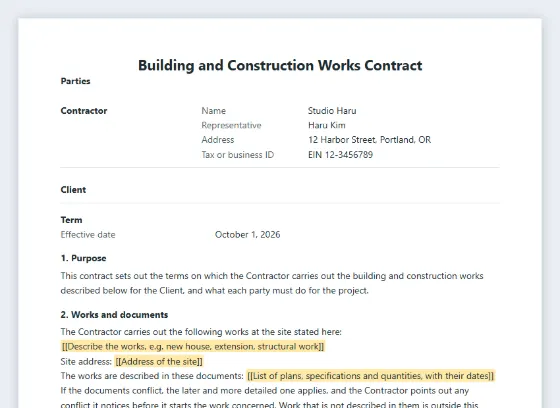
Building and Construction Works Contract
Parties: Contractor · Client
1. Purpose
This contract sets out the terms on which the Contractor carries out the building and construction works described below for the Client, and what each party must do for the project.
2. Works and documents
The Contractor carries out the following works at the site stated here:
[[Describe the works, e.g. new house, extension, structural work]]
Site address: [[Address of the site]]
The works are described in these documents: [[List of plans, specifications and quantities, with their dates]]
If the documents conflict, the later and more detailed one applies, and the Contractor points out any conflict it notices before it starts the work concerned. Work that is not described in them is outside this contract unless the parties agree it as a variation.
3. Licences, permits and approvals
The Contractor confirms that it holds the licences, registrations and qualifications that the law that applies requires for these works: [[Licence or registration details, or none required]] It keeps them in force until handover.
The building permission and the other approvals needed for the works are obtained by [[the Client / the Contractor]] and paid for by [[the Client / the Contractor]]. The works start only when the permits that the law requires before starting are in place, and the parties give each other the documents the authorities ask for without delay.
4. Site, access and safety
The Client gives the Contractor access to the site from the start date and provides water and electricity as follows: [[Utilities available on site and who pays for them]] The Client also tells the Contractor what it knows about the ground, existing structures, pipes, cables and other conditions on the site.
The Contractor is responsible for the way it carries out the works, for the safety of its staff and subcontractors on the site and for protecting neighbours and passers-by, as the safety rules that apply require. It keeps the site secure and reasonably tidy, removes its waste lawfully and reports any accident on the site to the Client without delay.
5. Programme and delays
The Contractor starts the works on [[Start date]] and completes them by [[Completion date]]. It tells the Client within [[7]] days of becoming aware that the time needs to be extended, and why.
The time is extended by the length of a delay caused by the Client, by late permits or decisions, by variations, by weather that prevents the work or by other causes outside the Contractor’s control. If the Contractor is late for other reasons, [[no compensation for delay / the Client may deduct the amount stated here per day or week: Amount]], as far as the law that applies allows.
6. Price and payment
The Client pays the price shown in the price schedule of this contract. The price is [[a fixed price / an estimate that is settled on the work actually measured]] and excludes tax unless the price schedule says otherwise.
Payment is made in these stages: [[Payment stages, e.g. 20% on signing, stage payments on completed milestones, balance on handover]]
The Client may hold back [[Percentage held back, or none]] of the price until [[the end of the defects period / handover]]. If a payment is more than [[14]] days late, the Contractor may stop work after notifying the Client until it is paid, as far as the law that applies allows.
7. Variations and hidden conditions
Either party may ask for a change to the works. The Contractor tells the Client in writing or in electronic form what the change costs and how it affects the time, and carries it out only when the Client has approved it in the same way.
If the Contractor finds conditions that could not reasonably have been foreseen, such as unexpected ground conditions or hidden defects in an existing structure, it stops the affected work, tells the Client at once and proposes how to deal with them, at what cost and with what delay. Where it is necessary to keep people safe or to prevent damage, the Contractor may act at once without approval and tells the Client afterwards.
8. Materials and subcontractors
The Contractor uses new materials and fittings of the quality described in the documents, or equal ones, and carries out the works with the care and skill expected of a competent contractor and in line with the rules and standards that apply to them.
The Contractor may use subcontractors. It remains responsible to the Client for their work, makes sure they hold the licences the law requires for their part and pays them on time.
9. Completion and handover
The Contractor tells the Client when the works are complete. The parties then inspect them together within [[7]] days and record minor defects in a list. The Client accepts the works or states in writing or in electronic form the defects that prevent acceptance, and the Contractor corrects them without delay.
At handover the Contractor gives the Client the keys, the drawings of the work as built, the instructions for the installed equipment and the certificates that the law requires. The risk of damage to the works passes to the Client at handover. The Client may not refuse to accept the works because of minor defects that do not affect their use.
10. Defects and warranty
The Contractor corrects, free of charge and within a reasonable time, defects that are caused by its work or its materials and that the Client reports within the defects period of [[12]] months from handover, or any longer period that the law that applies requires.
The Contractor’s obligations for defects under the law that applies, including any statutory warranty for building work, remain as that law requires and are not limited by this contract. Damage caused by wear and tear, misuse, lack of maintenance or the work of others is not covered.
11. Insurance
The Contractor holds insurance for the works and for its liability for damage to people and property caused by the works, with cover of at least [[Amount]] per claim, and gives the Client a certificate before starting. The Client keeps its own insurance for the existing building and its contents and tells its insurer about the works. Each party tells the other without delay of any claim or event that could affect the cover.
12. Termination
Either party may terminate this contract by notice in writing or in electronic form if the other party seriously breaches it and does not remedy the breach within [[14]] days of being asked to.
The Client may also end the contract at any time on [[30]] days’ notice. In that case it pays for the work done and the materials ordered up to the end date, plus the reasonable costs of winding down, as far as the law that applies allows.
On termination the Contractor makes the site safe, hands over the work done and the documents for it, and the parties settle the account.
13. Liability
Each party is liable for damage it causes, as the law provides. Except for intent, gross negligence, personal injury or where the law does not allow a limitation, the Contractor’s total liability under this contract is limited to [[the contract price / Amount]], and neither party is liable for indirect loss such as lost profit or loss of use.
14. Governing law and disputes
This agreement is governed by the law stated under Governing law. The parties will first try to settle any dispute in good faith. Otherwise the courts stated under Jurisdiction decide, unless mandatory law provides otherwise.
Payment terms
Invoices for each stage are payable within [[14]] days of receipt, by bank transfer to the account stated on the invoice. Invoices for variations are payable on the same terms.
Governing law
[[Country or state whose law applies]]
Jurisdiction
[[Courts that decide disputes, e.g. the courts of your city]]
How to use it
Choose the template
Press the button to use this template. If you are not signed in, you first sign in or sign up for free and then come straight back to it.
Start a draft
The new-contract page opens with this template marked. Press its card to create a draft. Your company details fill in Party A, and you fill in the blanks, the other party and, where the template has one, the price schedule.
Send it for signature
You sign first, then send each signer a secure link and, by another route, an access code. Signers need no account.
Next steps
Your client opens the link on any device and needs no account. See what the signing looks like on the E-Contracts page, and read which kind of electronic signature is enough for which document.
Already signed? Make the invoice from the signed contract: the parties and the price lines carry over, in full or for a deposit. The guide on turning a quotation into an invoice shows how to review the new draft, its dates and the PDF.
What it is, and what it is not
QuoteBill creates a simple electronic signature with an audit trail. In the EU, the UK, the US and Korea a signature is not denied legal effect only because it is electronic, and in Japan most contracts need no particular form at all. What a simple electronic signature proves in a dispute depends on the evidence behind it, and some documents need another form.
It is not a qualified or advanced electronic signature, and QuoteBill does not verify who the signers are. It records the use of the link and access code you delivered, so anyone who has both can sign. The signature certificate lists every link issued and, for each action by the sender or a signer, its IP address and browser where they could be read.
Some documents need another form. Wills, many real-estate transfers, guarantees and some employment documents must, in some countries, be handwritten, notarised or signed with a qualified signature. The templates are samples, not legal advice: review them with a lawyer.
Other contract templates
Home or office renovation contract (interior works)
Scope and materials, access, permits, schedule, payment plan, hidden conditions, acceptance and guarantee.
Repair and maintenance work contract
Work and price, extra work found on site, regulated trades, completion, guarantee and cancellation.
Architectural or interior design services agreement
Project stages, client brief, fees, permits, cost estimates, site visits, and who owns and may use the designs.
Property management agreement (owner and manager)
Appointment and spending limit, letting, rent and deposits, repairs, compliance, fees, reports and ending the agreement.