Architectural or interior design services agreement template
Project stages, client brief, fees, permits, cost estimates, site visits, and who owns and may use the designs. A sample contract you can read in full, edit in QuoteBill and sign online with a secure link.
Sample — review with a lawyer · Simple electronic signature with an audit trail
Who it is for
For an architect, interior designer or design studio and a client who want the stages, brief, fees, permits, site visits and rights in the designs agreed in writing before the design work starts.
Architects and designers are licensed or title-protected in many places, and fee, permit and liability rules differ by country; the Designer’s registration and any mandatory form follow the law that applies.
What it covers
14 clauses, in this order. Each one is in the sample text below, and you can edit, remove or add clauses before you send.
1. Purpose
What the agreement is for: the Designer provides architectural or interior design services for the project described below, and each side does its part.
2. Project and services
Blanks for the project, the site and the services. Surveys, models and visualisations are outside the agreement unless both sides agree them in writing or electronically.
3. Stages
A blank lists the stages included. The Client approves each stage, or asks for changes, within a set number of business days before the next one starts. The schedule depends on timely information and decisions.
4. Client’s brief and decisions
The Client gives the brief, the budget and the site documents, confirms they are correct and decides within a set number of business days. The Designer keeps the Client’s information confidential.
5. Fees and payment
The fee comes from the price schedule: lump sum, percentage or hourly, paid in instalments set in a blank. Expenses are paid at cost, with an optional mark-up and approval above a set amount.
6. Changes and additional services
A change to the brief or an approved stage is priced and approved in writing or electronically before it starts, and extra work is charged at an hourly rate in a blank.
7. Consultants and third parties
A choice says who engages structural, services or other specialists. The Designer coordinates them but is not responsible for consultants it did not engage or for contractors’ work.
8. Permits and authorities
The Designer prepares the drawings for permit applications; the authorities decide and no outcome is promised. The Designer confirms any registration or licence the law requires.
9. Cost estimates and budget
Estimates are professional opinions, not a guarantee of building cost. The Client owns its budget, and the Designer warns it if the design looks set to exceed it.
10. Site visits and supervision
A set number of site visits for a general check. Full supervision is a choice. Contractors stay responsible for methods, safety and quality on site.
11. Copyright and use of the designs
The Designer keeps the rights. After payment the Client may build the project once on the site and use and alter the building. Reuse needs consent, and another designer may take over on a choice.
12. Professional care, insurance and liability
The Designer works with a competent professional’s care and holds professional insurance for a stated amount. Liability is capped at a stated amount, indirect loss is excluded, with the usual exceptions.
13. Term and termination
The agreement ends when the services are delivered and paid for. Either side can end it after a serious breach that is not put right in time, and the Client can end it on notice, paying for work done.
14. Governing law and disputes
The law you name applies. The sides first try to settle a dispute in good faith, and otherwise the courts you name decide.
A price schedule (items, quantities and prices) is part of this contract. It starts empty, in your currency, and the clauses on fees and payment point to it.
The sample text
The whole sample, as QuoteBill starts it. Text in double square brackets, like [[10]], is a blank to fill in or check. A figure or time such as [[10]] that you leave as it is is used as shown when you send; a blank that needs your own words must be filled first. The clause text is written in English, Korean, Japanese and German; in other languages a contract starts in English for you to translate.
Read the sample text
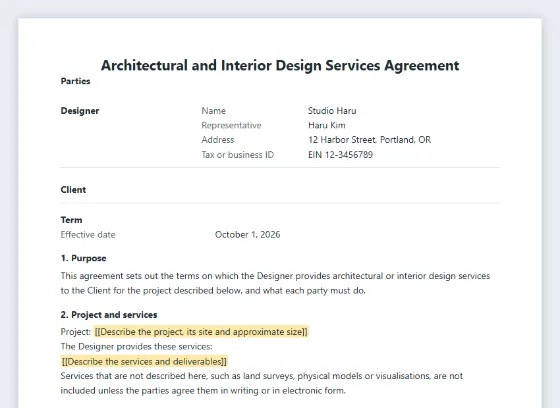
Architectural and Interior Design Services Agreement
Parties: Designer · Client
1. Purpose
This agreement sets out the terms on which the Designer provides architectural or interior design services to the Client for the project described below, and what each party must do.
2. Project and services
Project: [[Describe the project, its site and approximate size]]
The Designer provides these services:
[[Describe the services and deliverables]]
Services that are not described here, such as land surveys, physical models or visualisations, are not included unless the parties agree them in writing or in electronic form.
3. Stages
The services are carried out in these stages: [[Stages included, e.g. brief and concept design, developed design, technical drawings, tender documents, site visits]]
The Designer finishes each stage and presents the result to the Client. Within [[10]] business days the Client approves it in writing or in electronic form, or states what must be changed, and the Designer starts the next stage only after approval.
The schedule is: [[Schedule or target dates]] It depends on the Client giving the information and decisions in time.
4. Client’s brief and decisions
The Client gives the Designer a brief that describes its needs and its budget, and the information about the site and the building that the Designer needs, such as surveys, existing drawings and the documents on the ownership and use of the property. The Client confirms that this information is correct and that it is entitled to give it.
The Client makes its decisions within [[10]] business days of being asked; a delay by the Client extends the schedule by the same time. The Designer keeps the Client’s information and non-public business information confidential and uses it only for the project.
5. Fees and payment
The Client pays the fee shown in the price schedule of this contract. The fee is [[a lump sum / a percentage of the building cost / an hourly rate]] and is paid in these instalments: [[Instalments, e.g. 20% on signing and the rest on completion of each stage]]
Expenses such as printing, models, travel and fees of authorities are paid by the Client at cost [[with / without]] a mark-up of [[Percentage, or none]]; the Client approves in advance any expense above [[Amount]]. Fees exclude tax unless the price schedule says otherwise.
If a payment is more than [[14]] days late, the Designer may pause the work after notifying the Client, as far as the law that applies allows.
6. Changes and additional services
If the Client changes the brief or an approved stage, or asks for services that are not included, the Designer tells the Client what the change costs and how it affects the schedule, and carries it out only after the Client has approved it in writing or in electronic form. Additional work is charged at [[Hourly rate]] unless the parties agree a different fee for it.
7. Consultants and third parties
Specialists such as structural, building services, energy, fire safety or surveying consultants are engaged [[by the Client / by the Designer on the Client’s behalf]] and paid by the Client. The Designer coordinates their input with its own design, but is not responsible for the work of consultants it did not engage, or for the work and materials of contractors and suppliers.
Where the law that applies reserves certain calculations or certifications to registered specialists, the Client engages them.
8. Permits and authorities
The Designer prepares the drawings and documents needed for the permit applications for the project and helps the Client answer the authorities’ questions. The Client signs and submits the applications [[itself / through the Designer]] and pays the authorities’ fees.
The decision on a permit is made by the authorities, and the Designer does not promise that a permit will be granted or how long the procedure will take.
The Designer confirms that it holds the registration, licence or professional title that the law that applies requires for the services it provides: [[Registration or licence details, or none required]] If the law reserves a part of the services to a person with a particular qualification, that part is carried out or signed by such a person.
9. Cost estimates and budget
Any cost estimate that the Designer gives is a professional opinion based on the information available at the time and on market conditions, and not a guarantee of the price of the building work. The Client is responsible for its budget and for the contracts it makes with contractors. The Designer tells the Client without delay if it sees that the design is likely to exceed the budget stated in the brief, and proposes ways of reducing the cost.
10. Site visits and supervision
The services include [[Number]] visits to the site during the building work, to check in general that the work follows the design. Full supervision of the building work is [[included as described here / not included / agreed separately]].
The contractors are responsible for their methods, for safety on the site and for the quality of their work, unless the parties agree otherwise in writing or in electronic form. The Designer’s visits do not relieve the contractors of these duties.
11. Copyright and use of the designs
The rights in the designs, drawings and other documents that the Designer creates stay with the Designer. When the fees due have been paid, the Client receives a non-exclusive, perpetual right to use the designs to build the project once at the site described above, and to use, maintain, repair and alter the finished building.
Using the designs for another project, or for a repeat of this one, needs the Designer’s consent and may be charged. The Client may have another designer change or complete the design only [[with the Designer’s consent / after paying all fees due]]. Rights that the law gives the Designer and that cannot be waived remain.
The Designer may photograph the finished project and show it in its portfolio, naming the Client, unless the Client objects in writing or in electronic form.
12. Professional care, insurance and liability
The Designer provides the services with the care and skill expected of a competent professional in its field and holds professional indemnity insurance with cover of at least [[Amount]], and shows a certificate on request.
Except for intent, gross negligence, personal injury or where the law does not allow a limitation, the Designer’s total liability under this agreement is limited to [[the fees / Amount]], and neither party is liable for indirect loss such as lost profit.
13. Term and termination
This agreement starts on the effective date and ends when the services have been provided and paid for. Either party may terminate it by notice in writing or in electronic form if the other party seriously breaches it and does not remedy the breach within [[14]] days of being asked to. The Client may also end it at any time on [[14]] days’ notice.
On termination the Client pays for the services provided until then and for the reasonable costs of winding down, and receives the work done so far, which it may use under the clause on copyright and use of the designs once it has paid.
14. Governing law and disputes
This agreement is governed by the law stated under Governing law. The parties will first try to settle any dispute in good faith. Otherwise the courts stated under Jurisdiction decide, unless mandatory law provides otherwise.
Payment terms
Each instalment is payable within [[14]] days of receiving the invoice, by bank transfer to the account stated on the invoice. Expenses are invoiced with the instalment that follows them.
Governing law
[[Country or state whose law applies]]
Jurisdiction
[[Courts that decide disputes, e.g. the courts of your city]]
How to use it
Choose the template
Press the button to use this template. If you are not signed in, you first sign in or sign up for free and then come straight back to it.
Start a draft
The new-contract page opens with this template marked. Press its card to create a draft. Your company details fill in Party A, and you fill in the blanks, the other party and, where the template has one, the price schedule.
Send it for signature
You sign first, then send each signer a secure link and, by another route, an access code. Signers need no account.
Next steps
Your client opens the link on any device and needs no account. See what the signing looks like on the E-Contracts page, and read which kind of electronic signature is enough for which document.
Already signed? Make the invoice from the signed contract: the parties and the price lines carry over, in full or for a deposit. The guide on turning a quotation into an invoice shows how to review the new draft, its dates and the PDF.
What it is, and what it is not
QuoteBill creates a simple electronic signature with an audit trail. In the EU, the UK, the US and Korea a signature is not denied legal effect only because it is electronic, and in Japan most contracts need no particular form at all. What a simple electronic signature proves in a dispute depends on the evidence behind it, and some documents need another form.
It is not a qualified or advanced electronic signature, and QuoteBill does not verify who the signers are. It records the use of the link and access code you delivered, so anyone who has both can sign. The signature certificate lists every link issued and, for each action by the sender or a signer, its IP address and browser where they could be read.
Some documents need another form. Wills, many real-estate transfers, guarantees and some employment documents must, in some countries, be handwritten, notarised or signed with a qualified signature. The templates are samples, not legal advice: review them with a lawyer.
Other contract templates
Building and construction works contract
Works and plans, permits, programme, price and stages, variations, handover, defects warranty and insurance.
Home or office renovation contract (interior works)
Scope and materials, access, permits, schedule, payment plan, hidden conditions, acceptance and guarantee.
Repair and maintenance work contract
Work and price, extra work found on site, regulated trades, completion, guarantee and cancellation.
Property management agreement (owner and manager)
Appointment and spending limit, letting, rent and deposits, repairs, compliance, fees, reports and ending the agreement.