Repair and maintenance work contract template
Work and price, extra work found on site, regulated trades, completion, guarantee and cancellation. A sample contract you can read in full, edit in QuoteBill and sign online with a secure link.
Sample — review with a lawyer · Simple electronic signature with an audit trail
Who it is for
For a handyman, tradesperson or small repair business and a customer who want the work, price, extra work, safety rules, guarantee and cancellation agreed in writing before the job.
Rules on licensed trades such as electrical, gas and plumbing, on guarantees and on consumer cancellation differ by country; where the law reserves work to licensed persons, only they may do it.
What it covers
13 clauses, in this order. Each one is in the sample text below, and you can edit, remove or add clauses before you send.
1. Purpose
What the contract is for: the Contractor carries out the repair or maintenance work described below for the Customer, and each side does its part.
2. Work to be done
A blank for the address and the work, the item or the fault. Work not described is not included, and the Contractor says so if the description does not match the real fault.
3. Quote and call-out
The price comes from the price schedule: fixed, estimated or hourly. A blank sets a call-out fee. If the cost may exceed an estimate by a set percentage, the Contractor asks first and goes on only with agreement.
4. Access and the Customer’s duties
The Customer gives access at the agreed time, a safe working space and water and power if needed, mentions known hazards, confirms it may order the work and gets any landlord or building consent.
5. Parts and materials
The Contractor supplies new parts that suit the purpose unless otherwise agreed, shows their cost on request and hands over replaced parts if asked. It is not responsible for parts the Customer supplies.
6. Appointments and missed visits
A blank for the time window. Either side can move the appointment on a set number of hours’ notice. A missed-visit fee in a blank applies only if the Contractor arrives and cannot work, as far as the law allows.
7. Extra work found on site
If more work is needed than described, the Contractor stops, says what it found and the cost, and goes on only after the Customer agrees. Urgent safety steps may be taken first and reported at once.
8. Safety and regulated work
Electrical, gas, water, heating and structural work that the law reserves to licensed people is done only by them. The Contractor may refuse unsafe or unlawful work and hands over any certificate the law requires.
9. Completion and payment
The Contractor shows the result and the Customer checks it or reports a problem at once. Payment follows the payment terms; for bigger jobs, stages or an advance for materials can be set in a blank.
10. Guarantee on the work
Faults in the work or the parts the Contractor supplied are fixed free for a set number of months, or longer where the law requires. Wear, misuse, others’ damage and Customer-supplied parts are excluded.
11. Cancellation and termination
The Customer cancels free of charge up to a set number of hours before the visit. Later cancellation costs work done, bought parts and a blank fee. Serious breaches allow ending, and legal cancellation rights stay.
12. Liability
The Contractor works with reasonable care, holds insurance for a stated amount and answers for damage it causes, not for earlier faults. Its liability is capped at a stated amount, with the usual exceptions.
13. Governing law and disputes
The law you name applies. The sides first try to settle a dispute in good faith, and otherwise the courts you name decide.
A price schedule (items, quantities and prices) is part of this contract. It starts empty, in your currency, and the clauses on fees and payment point to it.
The sample text
The whole sample, as QuoteBill starts it. Text in double square brackets, like [[10]], is a blank to fill in or check. A figure or time such as [[10]] that you leave as it is is used as shown when you send; a blank that needs your own words must be filled first. The clause text is written in English, Korean, Japanese and German; in other languages a contract starts in English for you to translate.
Read the sample text
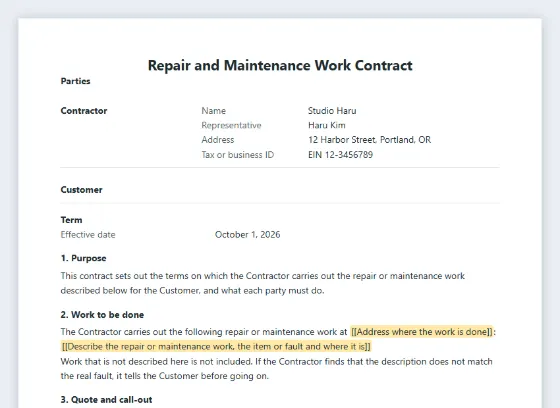
Repair and Maintenance Work Contract
Parties: Contractor · Customer
1. Purpose
This contract sets out the terms on which the Contractor carries out the repair or maintenance work described below for the Customer, and what each party must do.
2. Work to be done
The Contractor carries out the following repair or maintenance work at [[Address where the work is done]]:
[[Describe the repair or maintenance work, the item or fault and where it is]]
Work that is not described here is not included. If the Contractor finds that the description does not match the real fault, it tells the Customer before going on.
3. Quote and call-out
The Customer pays the price shown in the price schedule of this contract, which is [[a fixed price / an estimate based on the description / an hourly rate]]. A call-out or assessment fee of [[Amount, or none]] is charged for [[the visit / the first hour / nothing]].
If the cost is likely to exceed an estimate by more than [[10]]%, the Contractor tells the Customer first and goes on only when the Customer agrees in writing or in electronic form, for example by message. Prices exclude tax unless the price schedule says otherwise.
4. Access and the Customer’s duties
The Customer makes sure that the Contractor can reach the place of work at the agreed time, clears a safe working space and provides water and electricity where the work needs them. The Customer tells the Contractor of any hazard it knows of, such as old wiring, damp, hazardous materials, pets or an unsafe floor, and confirms that it owns the item or is entitled to have the work done.
If the work is in a rented or shared building, the Customer obtains any consent from the landlord, the owner or the building management that is needed.
5. Parts and materials
The Contractor supplies the parts and materials needed, unless the parties agree that the Customer will supply them, and shows their cost separately if the Customer asks. Parts are new and suitable for the purpose, unless used or reconditioned parts are agreed. Parts that are replaced are handed to the Customer on request, unless the law requires the Contractor to dispose of them.
Where the Customer supplies parts, the Contractor is not responsible for defects in the parts themselves or for a failure of the repair that they cause.
6. Appointments and missed visits
The parties agree a time window for the visit: [[Date and time window]]
Either party may change the appointment by telling the other at least [[24]] hours before it starts. If the Contractor arrives as agreed and cannot do the work because nobody is there or access is not possible, it may charge [[Missed visit fee, or none]], as far as the law that applies allows. If the Contractor is late or cannot come, it tells the Customer as soon as it knows and offers a new time.
7. Extra work found on site
If the Contractor finds that more work is needed than described, such as a further fault or a damaged part behind the repair, it stops, tells the Customer what it found and what the extra work would cost, and carries it out only after the Customer has agreed in writing or in electronic form.
If work cannot wait because of danger to people or property, the Contractor may make the situation safe at once and tells the Customer immediately afterwards.
8. Safety and regulated work
Electrical, gas, water, heating, structural and other work that the law that applies reserves to licensed or qualified persons is done only by such persons. The Contractor confirms that it, or the person it uses, holds the licence or qualification required: [[Licence or qualification details, or not applicable]]
The Contractor says so if the work needs a person it cannot supply, and may refuse work that is unsafe or unlawful. It gives the Customer the certificate or record of the work where the law requires one.
9. Completion and payment
When the work is finished, the Contractor shows the result to the Customer, and the Customer checks that it works as agreed or reports any problem at once. Payment is due as stated in the payment terms of this contract.
Where the job is large or takes several days, the Contractor may ask for payment in stages or for an advance for materials as stated here, within what the law that applies allows: [[Stages or advance, or none]]
10. Guarantee on the work
For [[3]] months after completion, or any longer period that the law that applies requires, the Contractor puts right free of charge and within a reasonable time any fault in the work it carried out or in the parts it supplied, if the Customer reports it in that period.
The guarantee does not cover wear and tear, misuse, damage caused by others, faults unrelated to the work or parts supplied by the Customer. The Customer’s rights under the law that applies are not limited by this clause.
11. Cancellation and termination
The Customer may cancel the job without cost by telling the Contractor at least [[24]] hours before the appointment. If the Customer cancels later, or after the work has started, it pays for the work done, for parts already bought for the job that cannot be returned and [[Cancellation fee, or none]], as far as the law that applies allows.
Either party may end the contract by notice in writing or in electronic form if the other party seriously breaches it and does not put it right within [[7]] days of being asked to. Rights that the law that applies gives the Customer to cancel or withdraw are not limited by this clause.
12. Liability
The Contractor carries out the work with reasonable care and skill and holds liability insurance with cover of at least [[Amount, or none]]. The Contractor is liable, as the law provides, for damage it causes to the Customer’s property or to people while doing the work, and is not liable for faults that were there before and are not part of the work.
Except for intent, gross negligence, personal injury or where the law does not allow a limitation, the Contractor’s total liability under this contract is limited to [[the contract price / Amount]].
13. Governing law and disputes
This agreement is governed by the law stated under Governing law. The parties will first try to settle any dispute in good faith. Otherwise the courts stated under Jurisdiction decide, unless mandatory law provides otherwise.
Payment terms
The price is payable on completion of the work or, if the Contractor sends an invoice, within [[7]] days of receiving it, by bank transfer to the account stated on the invoice or by [[cash / card / other payment method]].
Governing law
[[Country or state whose law applies]]
Jurisdiction
[[Courts that decide disputes, e.g. the courts of your city]]
How to use it
Choose the template
Press the button to use this template. If you are not signed in, you first sign in or sign up for free and then come straight back to it.
Start a draft
The new-contract page opens with this template marked. Press its card to create a draft. Your company details fill in Party A, and you fill in the blanks, the other party and, where the template has one, the price schedule.
Send it for signature
You sign first, then send each signer a secure link and, by another route, an access code. Signers need no account.
Next steps
Your client opens the link on any device and needs no account. See what the signing looks like on the E-Contracts page, and read which kind of electronic signature is enough for which document.
Already signed? Make the invoice from the signed contract: the parties and the price lines carry over, in full or for a deposit. The guide on turning a quotation into an invoice shows how to review the new draft, its dates and the PDF.
What it is, and what it is not
QuoteBill creates a simple electronic signature with an audit trail. In the EU, the UK, the US and Korea a signature is not denied legal effect only because it is electronic, and in Japan most contracts need no particular form at all. What a simple electronic signature proves in a dispute depends on the evidence behind it, and some documents need another form.
It is not a qualified or advanced electronic signature, and QuoteBill does not verify who the signers are. It records the use of the link and access code you delivered, so anyone who has both can sign. The signature certificate lists every link issued and, for each action by the sender or a signer, its IP address and browser where they could be read.
Some documents need another form. Wills, many real-estate transfers, guarantees and some employment documents must, in some countries, be handwritten, notarised or signed with a qualified signature. The templates are samples, not legal advice: review them with a lawyer.
Other contract templates
Building and construction works contract
Works and plans, permits, programme, price and stages, variations, handover, defects warranty and insurance.
Home or office renovation contract (interior works)
Scope and materials, access, permits, schedule, payment plan, hidden conditions, acceptance and guarantee.
Architectural or interior design services agreement
Project stages, client brief, fees, permits, cost estimates, site visits, and who owns and may use the designs.
Property management agreement (owner and manager)
Appointment and spending limit, letting, rent and deposits, repairs, compliance, fees, reports and ending the agreement.