Sublease agreement for non-residential premises template
A tenant sublets part of its business premises: the landlord’s consent as a condition, rent, deposit, use and handback. A sample contract you can read in full, edit in QuoteBill and sign online with a secure link.
Sample — review with a lawyer · Simple electronic signature with an audit trail
Who it is for
For a business tenant that sublets spare space in an office, studio or workshop to another business, and the subtenant, who want the landlord’s consent, rent, deposit and handback agreed in writing.
Subletting often needs the landlord’s consent, and rules on form, registration and a subtenant’s rights differ by country; this sample is for business premises only, never for subletting a home.
What it covers
15 clauses, in this order. Each one is in the sample text below, and you can edit, remove or add clauses before you send.
1. Purpose
What the agreement is for: the Sublandlord, who rents business premises under a main lease, sublets all or part of them to the Subtenant for business use. It is not for subletting a home.
2. Main lease and landlord’s consent
The Sublandlord confirms the main lease is in force and gives the Subtenant the relevant parts. The sublease takes effect only once the landlord has consented, and either side may withdraw if consent is not given by a date.
3. Premises
Blanks for the address and description of the sublet space, the floor area and shared areas such as the kitchen or parking. Both record the condition on handover in an inventory or photographs.
4. Permitted use and the main lease
The space is used only for the stated business purpose and nobody lives there. The Subtenant follows the law and house rules and does nothing that would breach the main lease. The Sublandlord keeps the main lease in force and pays its rent.
5. Term
A set number of months, ending no later than the main lease unless agreed otherwise in writing. A blank says whether it then ends or renews monthly. If the main lease ends early, the Subtenant is told at once.
6. Rent and payment
The monthly rent comes from the price schedule or a blank, with tax added where the law requires it. A blank allows a yearly rent review and states how it is worked out.
7. Service charges and utilities
A blank says whether service charges, utilities and property taxes are in the rent or paid on top. If on top, the Sublandlord gives a yearly statement with the records and any difference is settled in a set time.
8. Security deposit
The Subtenant pays a deposit of a stated amount. The Sublandlord holds it as security and returns it within a set number of days after handback, less amounts owed that it can show.
9. Condition, repairs and alterations
The Subtenant keeps the space clean, does minor repairs inside and pays for damage it or its visitors cause. Defects go to the Sublandlord and on to the landlord. Alterations and signs need the needed consents.
10. Access and inspection
The Sublandlord may enter to inspect, repair or show the space on a set number of hours’ notice, or at once in an emergency. The landlord and its contractors may enter as the main lease and the law provide.
11. Insurance and liability
The Subtenant insures its contents and liability as a blank states, and the Sublandlord keeps the insurance the main lease requires. Each answers for damage it causes. Other loss is capped at a set number of months’ rent.
12. Termination
Either side may end the sublease early on a set number of months’ notice at the end of a month, not before a stated date. A serious unremedied breach allows immediate ending. It also ends if consent is withdrawn or the main lease ends.
13. Handback
The Subtenant returns the space empty, clean and in the same condition apart from normal wear, with all keys. They inspect together and record the result.
14. Changes, notices and registration
This contract is the whole agreement on the sublease. Changes need both sides’ agreement in writing or in electronic form. Where the law asks for registration or a special form, both complete it without delay.
15. Governing law and disputes
The law you name applies. The sides first try to settle a dispute in good faith, and otherwise the courts you name decide.
A price schedule is optional: add one if you want the amounts in a table, or write the agreed amount into the payment clause.
The sample text
The whole sample, as QuoteBill starts it. Text in double square brackets, like [[10]], is a blank to fill in or check. A figure or time such as [[10]] that you leave as it is is used as shown when you send; a blank that needs your own words must be filled first. The clause text is written in English, Korean, Japanese and German; in other languages a contract starts in English for you to translate.
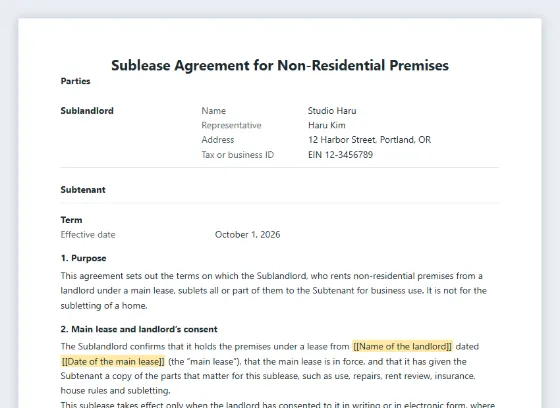
Read the sample text
Sublease Agreement for Non-Residential Premises
Parties: Sublandlord · Subtenant
1. Purpose
This agreement sets out the terms on which the Sublandlord, who rents non-residential premises from a landlord under a main lease, sublets all or part of them to the Subtenant for business use. It is not for the subletting of a home.
2. Main lease and landlord’s consent
The Sublandlord confirms that it holds the premises under a lease from [[Name of the landlord]] dated [[Date of the main lease]] (the “main lease”), that the main lease is in force, and that it has given the Subtenant a copy of the parts that matter for this sublease, such as use, repairs, rent review, insurance, house rules and subletting.
This sublease takes effect only when the landlord has consented to it in writing or in electronic form, where the main lease or the law requires consent. Landlord’s consent: [[Date of the consent, or to be obtained before the start date]]
The Sublandlord asks for the consent without delay. If it has not been given by [[Date]], either party may withdraw, and money paid by the Subtenant is returned at once. The Subtenant takes no possession before consent is given.
3. Premises
The Sublandlord sublets the following premises: [[Address and description of the premises or of the part sublet, e.g. two rooms on the second floor]]
Floor area: about [[Area]]
Shared use: [[Entrances, kitchen, toilets, meeting rooms, parking, or none]]
The parties record the condition of the premises on handover in an inventory or in photographs, and each keeps a copy.
4. Permitted use and the main lease
The Subtenant uses the premises only for [[Use, e.g. an office or a studio]] and for no other purpose. Nobody lives in the premises. The Subtenant follows the laws, permits and house rules that apply to its use and does not do or allow anything that would put the Sublandlord in breach of the main lease or entitle the landlord to end it. The Sublandlord keeps the main lease in force and pays the rent under it for as long as this sublease runs.
5. Term
This sublease starts on [[Start date]] and runs for [[12]] months, but it ends no later than the main lease unless the Sublandlord and the landlord have agreed otherwise in writing. After that period it [[ends / renews month by month, as long as the main lease allows]]. If the main lease ends earlier, the Sublandlord tells the Subtenant at once, and the rights that the law gives a subtenant in that case remain.
6. Rent and payment
The Subtenant pays the rent shown in the price schedule of this contract or, if there is none, [[Rent per month and currency]], on the payment terms stated in this contract. Where the law requires tax on rent, it is added.
Rent review: [[none / the yearly adjustment and how it is calculated]]
7. Service charges and utilities
Service charges, utilities and property taxes for the sublet premises are [[included in the rent / paid by the Subtenant in addition to the rent, as described here: details]]. Where they are paid in addition, the Sublandlord gives a statement, with the records of what it has been charged under the main lease, at least once a year, and the parties settle any difference within [[30]] days.
8. Security deposit
On signing, the Subtenant pays a security deposit of [[Amount]]. The Sublandlord keeps it as security for amounts that the Subtenant owes under this agreement and returns it within [[30]] days after the Subtenant has handed back the premises, less amounts that are owed and that the Sublandlord can show.
9. Condition, repairs and alterations
The Subtenant takes the premises in the condition recorded on handover, keeps them clean and in good condition, carries out minor repairs inside them and pays for damage caused by it, its staff and its visitors. It tells the Sublandlord without delay of any defect or damage, and the Sublandlord passes on to the landlord those that the landlord must put right. The Subtenant makes alterations or puts up signs only with the Sublandlord’s consent and, where the main lease requires it, the landlord’s consent, in writing or in electronic form, and removes them at the end if asked.
10. Access and inspection
The Sublandlord may enter the premises to inspect them, to carry out repairs or to show them, on at least [[24]] hours’ notice and at reasonable times, or at once in an emergency. The Subtenant allows the landlord and its contractors access as the main lease and the law provide.
11. Insurance and liability
The Subtenant insures its own contents and equipment and its liability for damage in the premises as follows: [[Insurance cover required]] The Sublandlord keeps the insurance that the main lease requires. Each party is liable for damage it causes, as the law provides. Except for intent, gross negligence, personal injury or where the law does not allow a limitation, each party’s liability for other loss is limited to [[12]] months’ rent.
12. Termination
Either party may end this sublease early by giving [[3]] months’ notice in writing or in electronic form, effective at the end of a month, but not before [[Earliest date, or none]]. Either party may end it at once if the other seriously breaches it and does not remedy the breach within [[14]] days of being asked to. Not paying rent within [[30]] days after a reminder is a serious breach. As far as the law allows, the sublease also ends if the landlord’s consent is refused or withdrawn or if the main lease ends.
13. Handback
When the sublease ends, the Subtenant hands the premises back empty and clean, in the same condition apart from normal wear, with all keys, removes its own goods and fittings and makes good any damage that removing them causes. The parties inspect the premises together at handback and record the result.
14. Changes, notices and registration
This contract, including its price schedule, is the entire agreement on the sublease. Changes are valid only if both parties agree to them in writing or in electronic form. Where the law requires a sublease of this kind to be registered or to take a particular form, the parties complete this without delay. Notices go to the addresses stated for the parties, or to another address a party has notified.
15. Governing law and disputes
This agreement is governed by the law stated under Governing law. The parties will first try to settle any dispute in good faith. Otherwise the courts stated under Jurisdiction decide, unless mandatory law provides otherwise.
Payment terms
The rent is payable [[monthly in advance, by the 5th day of each month]] by bank transfer to the account stated on the invoice or in this contract.
Governing law
[[Country or state whose law applies]]
Jurisdiction
[[Courts that decide disputes, e.g. the courts of your city]]
How to use it
Choose the template
Press the button to use this template. If you are not signed in, you first sign in or sign up for free and then come straight back to it.
Start a draft
The new-contract page opens with this template marked. Press its card to create a draft. Your company details fill in Party A, and you fill in the blanks, the other party and, where the template has one, the price schedule.
Send it for signature
You sign first, then send each signer a secure link and, by another route, an access code. Signers need no account.
Next steps
Your client opens the link on any device and needs no account. See what the signing looks like on the E-Contracts page, and read which kind of electronic signature is enough for which document.
Already signed? Make the invoice from the signed contract: the parties and the price lines carry over, in full or for a deposit. The guide on turning a quotation into an invoice shows how to review the new draft, its dates and the PDF.
What it is, and what it is not
QuoteBill creates a simple electronic signature with an audit trail. In the EU, the UK, the US and Korea a signature is not denied legal effect only because it is electronic, and in Japan most contracts need no particular form at all. What a simple electronic signature proves in a dispute depends on the evidence behind it, and some documents need another form.
It is not a qualified or advanced electronic signature, and QuoteBill does not verify who the signers are. It records the use of the link and access code you delivered, so anyone who has both can sign. The signature certificate lists every link issued and, for each action by the sender or a signer, its IP address and browser where they could be read.
Some documents need another form. Wills, many real-estate transfers, guarantees and some employment documents must, in some countries, be handwritten, notarised or signed with a qualified signature. The templates are samples, not legal advice: review them with a lawyer.
Other contract templates
Building and construction works contract
Works and plans, permits, programme, price and stages, variations, handover, defects warranty and insurance.
Home or office renovation contract (interior works)
Scope and materials, access, permits, schedule, payment plan, hidden conditions, acceptance and guarantee.
Repair and maintenance work contract
Work and price, extra work found on site, regulated trades, completion, guarantee and cancellation.
Architectural or interior design services agreement
Project stages, client brief, fees, permits, cost estimates, site visits, and who owns and may use the designs.