Storage space and parking space rental agreement template
Space and use, prohibited items, rent and deposit, access and security, goods and insurance, unpaid rent, ending. A sample contract you can read in full, edit in QuoteBill and sign online with a secure link.
Sample — review with a lawyer · Simple electronic signature with an audit trail
Who it is for
For an owner of storage units, garages or parking spaces and the person who rents one, when both want the use, prohibited items, rent, access, insurance and unpaid-rent steps settled in writing.
Rules on deposits, remedies for unpaid rent and what may be stored or parked differ by country and may limit what an owner can do with a renter’s goods; the sample follows the law that applies.
What it covers
14 clauses, in this order. Each one is in the sample text below, and you can edit, remove or add clauses before you send.
1. Purpose
What the agreement is for: the Owner rents a storage space or a parking space to the Renter. It is a rental of space only, not of a home or business premises.
2. Space
Blanks for the type, number, location, size and access route, with a condition record at handover. The Owner may move the Renter to a comparable space only for works, safety or law, on notice and at its own cost.
3. Permitted use
Only to store the Renter’s own goods or, in a parking space, to park roadworthy, registered and insured vehicles. Nobody lives or works there, and there is no business use or subletting without consent.
4. Prohibited items
No hazardous, flammable, toxic or illegal items, fuel, gas bottles, perishables, animals or restricted goods unless allowed. No repairs or leaks in a parking space. The Owner can require removal and act at once on danger.
5. Term and renewal
A start date and a choice between a fixed term, which then ends or runs month by month, or month by month from the start, until ended under the clause on ending and moving out.
6. Rent and payment
The rent comes from the price schedule or a blank and is paid monthly in advance. The Owner may change it on notice, and the Renter may leave first. A late fee in a blank applies only as far as the law allows.
7. Deposit
A set amount paid before the start, returned within a set number of days after the Renter empties the space and returns the keys, less documented amounts, itemised and without interest unless the law requires.
8. Access and security
Access hours are blanks. Codes and keys are personal, and lost ones are reported at once. The Owner lists its security measures without promising no loss, and enters on notice or in an emergency and records what it did.
9. Goods, insurance and risk
The goods stay in the Renter’s possession and at its risk. The Owner provides space only, not custody, unless a blank says otherwise. The Renter confirms the goods are its own, lists them and insures them or accepts the risk.
10. Unpaid rent
A reminder first, then the Owner may restrict access after a set number of days and give long notice before anything else, always only as the law allows. The goods stay the Renter’s, and any surplus goes back to the Renter.
11. Care and damage
The Renter keeps the space clean, causes no damage, reports leaks and pests and pays for damage it, its visitors or its goods cause. The Owner keeps the building and shared areas in reasonable repair.
12. Ending and moving out
Notice of a set number of days to the end of a month. A serious breach not put right allows ending at once, or without delay where there is danger. The space is emptied and keys returned, and left goods are handled as the law allows.
13. Liability
The Owner answers for losses its own fault or an unrepaired building defect causes, not for theft, fire, water or pests unless the law requires. The Renter answers for damage it causes. Other loss is capped, with the usual exceptions.
14. Governing law and disputes
The law you name applies. The sides first try to settle a dispute in good faith, and otherwise the courts you name decide.
A price schedule (items, quantities and prices) is part of this contract. It starts empty, in your currency, and the clauses on fees and payment point to it.
The sample text
The whole sample, as QuoteBill starts it. Text in double square brackets, like [[10]], is a blank to fill in or check. A figure or time such as [[10]] that you leave as it is is used as shown when you send; a blank that needs your own words must be filled first. The clause text is written in English, Korean, Japanese and German; in other languages a contract starts in English for you to translate.
Read the sample text
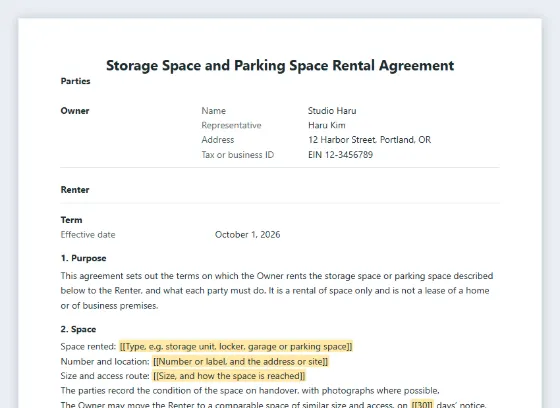
Storage Space and Parking Space Rental Agreement
Parties: Owner · Renter
1. Purpose
This agreement sets out the terms on which the Owner rents the storage space or parking space described below to the Renter, and what each party must do. It is a rental of space only and is not a lease of a home or of business premises.
2. Space
Space rented: [[Type, e.g. storage unit, locker, garage or parking space]]
Number and location: [[Number or label, and the address or site]]
Size and access route: [[Size, and how the space is reached]]
The parties record the condition of the space on handover, with photographs where possible.
The Owner may move the Renter to a comparable space of similar size and access, on [[30]] days’ notice, only where building work, safety or the law requires it, and at the Owner’s cost.
3. Permitted use
The Renter uses the space only to store its own goods or, for a parking space, to park [[Number]] roadworthy vehicle(s) that are registered and insured as the law that applies requires: [[Vehicle or goods to be kept, if known]]
Nobody may live, sleep or work in the space, run a business from it, sublet it or let anyone else use it without the Owner’s consent in writing or in electronic form.
4. Prohibited items
Unless the Owner agrees in writing or in electronic form and the law allows it, the Renter does not store hazardous, flammable, explosive, toxic or polluting substances, fuel, gas bottles or leaking batteries, perishable food, living animals or plants, firearms or other items whose keeping the law restricts, stolen or unlawful goods, or anything that can damage the space or cause a nuisance.
In a parking space the Renter does not repair or wash vehicles, store fuel or let fluids leak. The Owner may ask the Renter to remove an item that breaks this clause and, where there is danger, may act at once to make the situation safe.
5. Term and renewal
The agreement starts on [[Start date]] and runs [[for a fixed term of 6 months / month by month]]. [[After a fixed term it continues month by month / It then ends]] until it is ended under the clause on ending and moving out.
6. Rent and payment
The Renter pays the rent shown in the price schedule of this contract or, if there is none, [[Rent per month and currency]], in advance on or before the [[1st]] day of each month. The rent excludes tax unless the price schedule says otherwise.
The Owner may change the rent on [[30]] days’ notice in writing or in electronic form, and the Renter may end the agreement before the change takes effect. If rent is more than [[7]] days late, the Owner may charge a late fee of [[Late fee, or none]], as far as the law that applies allows.
7. Deposit
The Renter pays a deposit of [[Amount]] before the start. The Owner holds it as security for rent and for damage to the space, and returns it within [[14]] days after the Renter has emptied the space and handed back the keys and access devices, less the amounts that are owed and that the Owner can show, with an itemised statement. No interest is paid on the deposit unless the law requires it.
8. Access and security
The Renter may enter the space during these hours: [[Access hours]] Access codes, keys and cards are personal; the Renter does not share them and tells the Owner at once if they are lost. If the Renter uses its own lock, it gives the Owner a way to open the space in an emergency: [[Emergency access arrangement]]
The Owner provides the security measures stated here, such as gates, lighting or cameras: [[Security measures, or none]] They are for general safety only and do not promise that no loss will occur.
The Owner may enter the space with [[48]] hours’ notice for maintenance or inspection, and at once in an emergency or to prevent danger; it records what it did and tells the Renter afterwards. The Owner handles any camera recordings as the law that applies requires.
9. Goods, insurance and risk
The goods and vehicles stay in the Renter’s possession and at the Renter’s risk. The Owner provides space only and does not take the goods into its care, unless the parties state otherwise here: [[Services of the Owner for the goods, or none]]
The Renter confirms that the goods are its own or that it is entitled to store them, and keeps a list of what is stored. The Renter insures the goods and vehicles for their value or accepts the risk itself, and states their value here: [[Value of the goods and the cover needed]]
The Owner is not liable for loss of or damage to them except as stated under Liability.
10. Unpaid rent
If rent is not paid on time, the Owner reminds the Renter in writing or in electronic form.
The Owner may take the following steps only as far as the law that applies permits. If the rent is still unpaid [[14]] days after the reminder, the Owner may restrict the Renter’s access to the space until it is paid. Before it deals with the goods in any other way, the Owner gives the Renter notice of at least [[30]] days in writing or in electronic form, at the last address the Renter gave.
The goods remain the Renter’s until they are lawfully dealt with, and any money obtained from them beyond what is owed is paid to the Renter.
11. Care and damage
The Renter keeps the space clean, causes no damage to it or to the shared walkways, doors and equipment, and tells the Owner without delay of any leak, pest, damage or defect that it notices. The Renter pays for damage caused by it, its visitors or its goods.
The Owner keeps the building, roofs, doors, lighting and shared areas in reasonable repair and tells the Renter of work that affects access.
12. Ending and moving out
Either party may end the agreement by giving [[30]] days’ notice in writing or in electronic form, effective at the end of a month.
The Owner may end it at once if the Renter seriously breaches it, for example by storing prohibited items or by not paying rent after the steps under Unpaid rent, and does not remedy the breach within [[7]] days of being asked to, or without delay where there is danger.
On the last day the Renter empties and cleans the space, removes all goods and returns the keys and access devices. Goods left behind after the agreement has ended are handled only as the law that applies permits and after notice to the Renter of at least [[14]] days.
13. Liability
The Owner is liable, as the law provides, for loss of or damage to the Renter’s goods that its own fault, or a defect in the building that it has not repaired in time, causes. Otherwise it is not liable for loss of or damage to goods and vehicles, for example from theft, fire, water or pests, unless the law requires it.
The Renter is liable for damage that it, its visitors or its goods cause to the space, the building or other people. Except for intent, gross negligence, personal injury or where the law does not allow a limitation, each party’s total liability for other loss under this agreement is limited to [[Amount, e.g. twelve months’ rent]].
14. Governing law and disputes
This agreement is governed by the law stated under Governing law. The parties will first try to settle any dispute in good faith. Otherwise the courts stated under Jurisdiction decide, unless mandatory law provides otherwise.
Payment terms
The rent is payable monthly in advance, by bank transfer to the account stated in this contract or on the invoice, or by [[card / other payment method]].
Governing law
[[Country or state whose law applies]]
Jurisdiction
[[Courts that decide disputes, e.g. the courts of your city]]
How to use it
Choose the template
Press the button to use this template. If you are not signed in, you first sign in or sign up for free and then come straight back to it.
Start a draft
The new-contract page opens with this template marked. Press its card to create a draft. Your company details fill in Party A, and you fill in the blanks, the other party and, where the template has one, the price schedule.
Send it for signature
You sign first, then send each signer a secure link and, by another route, an access code. Signers need no account.
Next steps
Your client opens the link on any device and needs no account. See what the signing looks like on the E-Contracts page, and read which kind of electronic signature is enough for which document.
Already signed? Make the invoice from the signed contract: the parties and the price lines carry over, in full or for a deposit. The guide on turning a quotation into an invoice shows how to review the new draft, its dates and the PDF.
What it is, and what it is not
QuoteBill creates a simple electronic signature with an audit trail. In the EU, the UK, the US and Korea a signature is not denied legal effect only because it is electronic, and in Japan most contracts need no particular form at all. What a simple electronic signature proves in a dispute depends on the evidence behind it, and some documents need another form.
It is not a qualified or advanced electronic signature, and QuoteBill does not verify who the signers are. It records the use of the link and access code you delivered, so anyone who has both can sign. The signature certificate lists every link issued and, for each action by the sender or a signer, its IP address and browser where they could be read.
Some documents need another form. Wills, many real-estate transfers, guarantees and some employment documents must, in some countries, be handwritten, notarised or signed with a qualified signature. The templates are samples, not legal advice: review them with a lawyer.
Other contract templates
Building and construction works contract
Works and plans, permits, programme, price and stages, variations, handover, defects warranty and insurance.
Home or office renovation contract (interior works)
Scope and materials, access, permits, schedule, payment plan, hidden conditions, acceptance and guarantee.
Repair and maintenance work contract
Work and price, extra work found on site, regulated trades, completion, guarantee and cancellation.
Architectural or interior design services agreement
Project stages, client brief, fees, permits, cost estimates, site visits, and who owns and may use the designs.