Online marketplace seller agreement template
A platform and a seller on its marketplace: listings, orders, fees, payouts, buyer rights, suspension and ending. A sample contract you can read in full, edit in QuoteBill and sign online with a secure link.
Sample — review with a lawyer · Simple electronic signature with an audit trail
Who it is for
For the operator of an online marketplace and a seller who lists goods or services on it, who want listings, fees, payouts, buyer complaints and suspension rules agreed in writing.
Online platforms are regulated in many countries: seller details shown to buyers, consumer rights, ranking transparency, tax reporting and payment services. This sample covers the platform–seller contract only.
What it covers
15 clauses, in this order. Each one is in the sample text below, and you can edit, remove or add clauses before you send.
1. Purpose
The Platform runs the marketplace, which a blank names, and the Seller offers goods or services there. The sale contract is between buyer and Seller. The published Rules are part of the agreement, which prevails over them.
2. Seller account
The Seller opens one account with true details, keeps them current, protects its login and answers for what is done through the account. The Platform may ask for documents it needs to meet the law.
3. Listings and seller conduct
The Seller lists only goods it may lawfully sell and describes them truthfully and completely. No counterfeit goods, false reviews, ranking manipulation or taking payment for marketplace orders outside it.
4. Orders and fulfilment
The Seller accepts or declines orders and ships or performs within set times, packs properly, shares tracking and reports delays. Repeated cancellations without good reason can lead to suspension.
5. Buyer rights and complaints
The Seller handles buyers’ questions, returns and refunds as the law requires and replies within a set time. It joins the Platform’s dispute process, and this agreement never limits buyers’ legal rights.
6. Fees and commission
Fees come from the price schedule or a blank and are shown before listing and on each sale. The Platform may change them on notice, not for earlier sales. A blank says whether fees on a fully refunded sale are returned.
7. Payments and payouts
Buyers pay through a named provider. The Platform pays out proceeds less fees, refunds and chargebacks on a set schedule, and holds back money only while a complaint, refund, chargeback or claim is open, saying why.
8. Taxes and invoices
Each side handles the taxes the law gives it. The Seller issues invoices and charges the tax that applies. The Platform collects, pays or reports tax only where the law requires, and the Seller supplies tax details.
9. Content licence
The Seller keeps its rights in its listings and photos and confirms it may use them. It gives the Platform a limited, non-exclusive licence to show them on and promote the marketplace. Infringing content is removed.
10. Customer data
Buyer data is used only to complete and support the order and what the law requires, with no marketing unless the buyer agreed or the law allows it. A separate agreement is signed where the law requires one.
11. Suspension and removal
The Platform may remove listings or suspend an account for serious or repeated breach or unlawful listings. Except in urgent cases it gives the reason and a set time to respond. Appeals go to a named contact.
12. Changes to this agreement
The Platform may change the agreement and Rules on notice with reasons. If the Seller disagrees it may leave before the change applies, and orders already accepted are not affected.
13. Term and termination
Starts when the Seller is accepted and runs until either side ends it on notice, or at once for a serious breach not put right in time. Then accepted orders are completed and money owed is paid out.
14. Liability
Each side answers for damage it causes, capped at an amount set in a blank, with the usual exceptions. The Platform is not liable for listing content or buyers’ conduct, but must still pay out the Seller’s proceeds.
15. Governing law and disputes
The law you name applies. The sides first try to settle a dispute in good faith, and otherwise the courts you name decide.
A price schedule is optional: add one if you want the amounts in a table, or write the agreed amount into the payment clause.
The sample text
The whole sample, as QuoteBill starts it. Text in double square brackets, like [[10]], is a blank to fill in or check. A figure or time such as [[10]] that you leave as it is is used as shown when you send; a blank that needs your own words must be filled first. The clause text is written in English, Korean, Japanese and German; in other languages a contract starts in English for you to translate.
Read the sample text
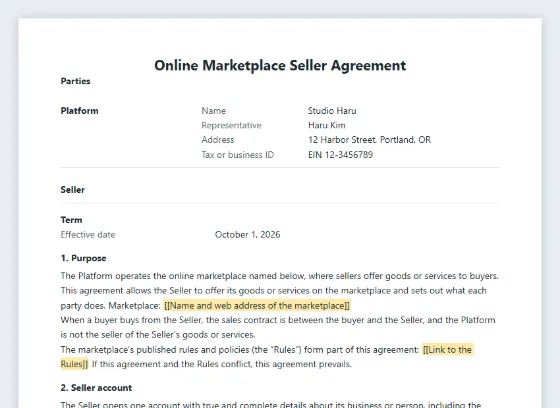
Online Marketplace Seller Agreement
Parties: Platform · Seller
1. Purpose
The Platform operates the online marketplace named below, where sellers offer goods or services to buyers. This agreement allows the Seller to offer its goods or services on the marketplace and sets out what each party does. Marketplace: [[Name and web address of the marketplace]]
When a buyer buys from the Seller, the sales contract is between the buyer and the Seller, and the Platform is not the seller of the Seller’s goods or services.
The marketplace’s published rules and policies (the “Rules”) form part of this agreement: [[Link to the Rules]] If this agreement and the Rules conflict, this agreement prevails.
2. Seller account
The Seller opens one account with true and complete details about its business or person, including the name, address and contact details that are shown to buyers, and keeps them up to date. It keeps its login details secret and is responsible for what is done through its account.
The Platform may ask for documents that it needs to meet the legal requirements that apply to it, such as proof of the Seller’s business registration, and the Seller provides them within [[7]] days.
3. Listings and seller conduct
The Seller lists only goods or services that it may lawfully sell and that the Rules allow, and describes each one truthfully and completely: title, photographs, condition, price, delivery costs and times, and the information that the law requires for buyers.
The Seller does not list counterfeit or stolen goods, does not post false or paid-for reviews, does not manipulate rankings or prices, and does not use the marketplace’s messages to take payment outside the marketplace for orders made on it.
4. Orders and fulfilment
The Seller accepts or declines an order within [[1]] business day, and ships the goods or provides the service within [[2]] business days of accepting it, as the listing states.
The Seller packs goods properly, enters the carrier’s tracking number through the marketplace where the carrier provides one, and keeps buyers informed of delays.
Repeated cancellation of accepted orders without a good reason can lead to measures under Suspension and removal.
5. Buyer rights and complaints
The Seller deals with buyers’ questions, complaints, returns and refunds as the law that applies to the sale requires, and answers a buyer’s message within [[2]] business days.
Where the Platform offers a dispute procedure, the Seller takes part in it in good faith, and the Platform decides only as the Rules state.
The Seller gives buyers the warranties, return rights and information that the law gives them; this agreement does not limit those rights.
6. Fees and commission
The Seller pays the Platform the fees shown in the price schedule of this contract or, if there is none, these fees: [[Listing fee, commission as a % of the sale price, payment-processing fee, or no fees]]
The Platform shows the fees before the Seller lists and on each sale. It may change them on [[30]] days’ notice in writing or in electronic form; a change does not apply to sales made before it takes effect.
Fees for a sale that is refunded in full are [[refunded / not refunded]] to the Seller.
7. Payments and payouts
Buyers pay in this way, under the terms of the payment provider: [[Payment provider or method]]
The Platform pays the Seller the amounts received for the Seller’s sales, less fees, refunds and chargebacks, [[weekly]] to the bank account named in the Seller’s account, within [[7]] days after [[the order is delivered / the buyer’s return period ends]].
The Platform may hold back an amount only while a complaint, refund, chargeback or legal claim about an order is open or a legal requirement says so, and it tells the Seller the reason and the amount. Amounts held back are paid out when the reason ends.
8. Taxes and invoices
Each party is responsible for the taxes that the law assigns to it. The Seller issues the invoices or receipts that the law requires for its sales and charges the sales tax or VAT that applies. The Platform collects and pays over tax on a sale, and reports information about the Seller to the authorities, only where the law requires it. The Seller provides the tax details that the Platform needs for this.
9. Content licence
The Seller keeps its rights in its listings, photographs, texts and trademarks, and confirms that it has the right to use them and that they do not infringe the rights of others. For the term of this agreement the Seller gives the Platform a non-exclusive, non-transferable licence to display, store and reproduce this content on the marketplace and in the Platform’s promotion of the marketplace, and to adjust its size and format for that purpose. The Platform removes content that is shown to infringe the rights of others, as the law that applies requires, and tells the Seller why.
10. Customer data
Buyers’ personal data that the Seller receives through the marketplace is used only to complete and support the order and for what the law requires of the Seller. The Seller does not send marketing to buyers unless the buyer has agreed to it or the law allows it, and deletes the data when it no longer needs it.
Each party follows the data protection law that applies to it. Where the law requires a separate agreement on shared or processed personal data, the parties sign one.
11. Suspension and removal
The Platform may remove a listing or suspend the Seller’s account if the Seller seriously or repeatedly breaches this agreement or the Rules, if a listing is unlawful, or if the law or an authority requires it.
Except where an immediate step is needed to protect buyers or to comply with the law, the Platform tells the Seller the reason in writing or in electronic form and gives the Seller [[7]] days to respond before it acts. The Seller can appeal a decision here: [[Contact or process for appeals]]
Orders already accepted are completed or cancelled with refunds, and payouts follow Payments and payouts.
12. Changes to this agreement
The Platform may change this agreement and the Rules on [[30]] days’ notice in writing or in electronic form, giving its reasons. If the Seller does not agree, it may end this agreement before the change takes effect without penalty. Changes required by law or by an authority may take effect sooner. A change does not affect orders accepted before it takes effect.
13. Term and termination
This agreement starts when the Platform accepts the Seller and runs until either party ends it on [[30]] days’ notice in writing or in electronic form. Either party may end it at once if the other seriously breaches it and does not remedy the breach within [[14]] days of being asked to. When it ends, the Seller completes the orders it has accepted, the Platform pays out what is due, and the Seller’s listings are removed.
14. Liability
Each party is liable for damage it causes by breaching this agreement, as the law provides. The Platform is not liable for the content of the Seller’s listings, for the goods or services sold, or for buyers’ conduct, except where the law makes it liable.
Except for intent, gross negligence, personal injury or where the law does not allow a limitation, each party’s total liability under this agreement is limited to this amount: [[Maximum amount, e.g. the fees paid or payable in the 12 months before the claim]] This does not limit the Platform’s duty to pay the Seller what it has received for the Seller’s sales.
15. Governing law and disputes
This agreement is governed by the law stated under Governing law. The parties will first try to settle any dispute in good faith. Otherwise the courts stated under Jurisdiction decide, unless mandatory law provides otherwise.
Payment terms
The Platform pays the Seller’s proceeds, less fees, refunds and chargebacks, [[weekly]] to the bank account named in the Seller’s account.
Governing law
[[Country or state whose law applies]]
Jurisdiction
[[Courts that decide disputes, e.g. the courts of your city]]
How to use it
Choose the template
Press the button to use this template. If you are not signed in, you first sign in or sign up for free and then come straight back to it.
Start a draft
The new-contract page opens with this template marked. Press its card to create a draft. Your company details fill in Party A, and you fill in the blanks, the other party and, where the template has one, the price schedule.
Send it for signature
You sign first, then send each signer a secure link and, by another route, an access code. Signers need no account.
Next steps
Your client opens the link on any device and needs no account. See what the signing looks like on the E-Contracts page, and read which kind of electronic signature is enough for which document.
Already signed? Make the invoice from the signed contract: the parties and the price lines carry over, in full or for a deposit. The guide on turning a quotation into an invoice shows how to review the new draft, its dates and the PDF.
What it is, and what it is not
QuoteBill creates a simple electronic signature with an audit trail. In the EU, the UK, the US and Korea a signature is not denied legal effect only because it is electronic, and in Japan most contracts need no particular form at all. What a simple electronic signature proves in a dispute depends on the evidence behind it, and some documents need another form.
It is not a qualified or advanced electronic signature, and QuoteBill does not verify who the signers are. It records the use of the link and access code you delivered, so anyone who has both can sign. The signature certificate lists every link issued and, for each action by the sender or a signer, its IP address and browser where they could be read.
Some documents need another form. Wills, many real-estate transfers, guarantees and some employment documents must, in some countries, be handwritten, notarised or signed with a qualified signature. The templates are samples, not legal advice: review them with a lawyer.
Other contract templates
Sales and supply agreement
Goods, orders, delivery, inspection, warranty and payment.
Simple general contract
What each party does, payment, term and termination.
Master services agreement
Standard terms for repeated work, with each job agreed in its own statement of work.
Statement of work
One piece of work under a master agreement: scope, milestones, acceptance, fees and dependencies.