Advertising placement agreement template
A media owner places an advertiser’s ad: space, creative, dates, approval, price, proof and make-good. A sample contract you can read in full, edit in QuoteBill and sign online with a secure link.
Sample — review with a lawyer · Simple electronic signature with an audit trail
Who it is for
For a website, newsletter, magazine, podcast or poster owner that sells ad space, and for the business that buys it, who want space, dates, artwork, approval and make-good terms in writing.
Rules on what an advertisement may claim, how it must be labelled and which products or audiences are restricted differ by country and medium; each side stays responsible for what the law requires of it.
What it covers
14 clauses, in this order. Each one is in the sample text below, and you can edit, remove or add clauses before you send.
1. Purpose
What the agreement is for: the Media Owner places the Advertiser’s advertisement in the space below, and what the Advertiser pays.
2. The advertising space
Blanks for the medium and format, the position, size and number of insertions or impressions, and the audience figures. A blank says whether those figures are estimates or a guaranteed minimum.
3. Schedule
The ad runs between dates in blanks or for a set number of insertions. If a date cannot be kept, the Media Owner offers the nearest one, or the Advertiser may withdraw that insertion for a refund.
4. The advertisement and materials
The Advertiser supplies the ad and materials in the specified format a set number of business days before the start; the Media Owner may only resize. A blank says who produces the ad. The Advertiser answers for its content.
5. Approval and content rules
The Media Owner reviews within a set number of days and may refuse or remove an unlawful, misleading or rights-infringing ad, one not labelled as advertising where required, or one against its rules. The Advertiser meets the rules.
6. Price and payment
The price comes from the price schedule; taxes are added as the law requires. A blank covers agency commission or discounts. Extra insertions, a longer run or a better position are agreed before booking.
7. Position and competitor separation
The ad goes in the stated position, or an equal or better one if that is not possible. Blanks say whether competitor ads are kept apart and what content the ad should not appear next to.
8. Proof of publication and reporting
After the run the Media Owner sends proof (a tear sheet, screenshots or a recording) and a report of insertions or impressions. A blank names the source of the figures, and the Advertiser may ask how they were counted.
9. Make-good for errors and under-delivery
If the ad runs in the wrong place or on the wrong date, with a technical fault or too few insertions, the Advertiser may choose a re-run, credit or refund and must claim within a set time. No results are promised.
10. Changes, cancellation and termination
The Advertiser may change the creative until a set time before the start. Cancelling is free early, costs a share later and the full price last. A serious breach not put right in time allows termination.
11. Rights in the advertisement
The Advertiser keeps its rights in the ad and licenses the Media Owner to show it for the placement. It says it has the rights to third-party images, music, texts and marks. A blank settles who owns an ad the Media Owner makes.
12. Data and tracking
Each side follows its own privacy rules for tracking, cookies, targeting and measurement. No personal data is exchanged without a separate agreement, and reports contain aggregated figures.
13. Liability and events beyond control
Neither side is liable for failure caused by events beyond its control, such as a power or platform outage; they agree a new date or a refund. Liability is capped by a blank, with the legal exceptions.
14. Governing law and disputes
The law you name applies. The sides first try to settle a dispute in good faith, and otherwise the courts you name decide.
A price schedule (items, quantities and prices) is part of this contract. It starts empty, in your currency, and the clauses on fees and payment point to it.
The sample text
The whole sample, as QuoteBill starts it. Text in double square brackets, like [[10]], is a blank to fill in or check. A figure or time such as [[10]] that you leave as it is is used as shown when you send; a blank that needs your own words must be filled first. The clause text is written in English, Korean, Japanese and German; in other languages a contract starts in English for you to translate.
Read the sample text
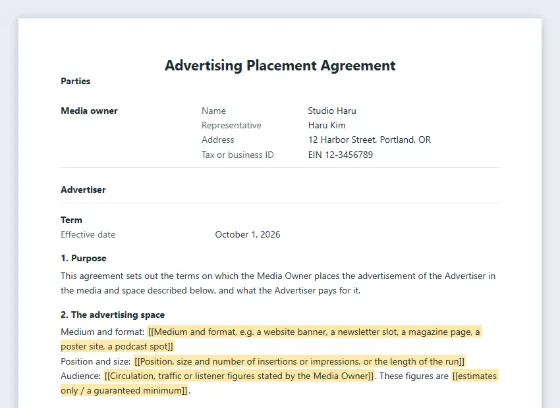
Advertising Placement Agreement
Parties: Media owner · Advertiser
1. Purpose
This agreement sets out the terms on which the Media Owner places the advertisement of the Advertiser in the media and space described below, and what the Advertiser pays for it.
2. The advertising space
Medium and format: [[Medium and format, e.g. a website banner, a newsletter slot, a magazine page, a poster site, a podcast spot]]
Position and size: [[Position, size and number of insertions or impressions, or the length of the run]]
Audience: [[Circulation, traffic or listener figures stated by the Media Owner]]. These figures are [[estimates only / a guaranteed minimum]].
3. Schedule
The advertisement runs from [[Start date]] to [[End date]] or for the number of insertions stated above. If the Media Owner cannot run the advertisement on a date, it offers the nearest available date that suits the Advertiser. The Advertiser may instead withdraw that insertion and receive a refund of the price for it.
4. The advertisement and materials
The Advertiser supplies the advertisement (the “Advertisement”) and all materials for it, in [[the technical format and size that the Media Owner specifies]], at least [[10]] business days before the start. The Media Owner may make small technical adjustments, such as resizing, but does not change the content.
[[The Advertiser produces the Advertisement / The Media Owner produces the Advertisement at the cost stated in the price schedule]]. The Advertiser is responsible for the content of the Advertisement.
5. Approval and content rules
The Media Owner checks the Advertisement within [[3]] business days of receiving it and approves it or says what must change. It may refuse or remove an advertisement that is unlawful, misleading or infringes the rights of others, that is not recognisable as advertising where the law requires this, or that does not meet [[the Media Owner’s published advertising rules]]. The Advertiser makes sure that the Advertisement and the claims in it meet the rules that apply to its products, services and audience, including any labelling or warnings that the law requires.
If the Advertisement is removed because it does not meet this clause, the price stays payable. If the Media Owner removes it without a reason under this clause, the Advertiser is refunded the price for the time it did not run.
6. Price and payment
The Advertiser pays the prices shown in the price schedule of this contract. Taxes are added as the law that applies requires. Agency commission or discounts: [[none / the commission or discount agreed]]. The price is for the placement stated in this agreement; extra insertions, a longer run or a better position are priced and agreed before they are booked.
7. Position and competitor separation
The Media Owner places the Advertisement in the position stated under The advertising space. If that position is not technically possible, it offers an equal or better one.
Separation from competing advertisements: [[none promised / no advertisement of a competitor named by the Advertiser on the same page or in the same break]]
Placement next to content: [[no restriction / the kinds of content the Advertiser does not want to appear next to]]
8. Proof of publication and reporting
Within [[7]] days after the run the Media Owner sends the Advertiser proof of publication, such as a tear sheet, screenshots or a recording, and a report of insertions or impressions [[and clicks]]. The figures come from [[the Media Owner’s own ad server / an independent measurement service]]. On reasonable notice the Advertiser may ask to see how the figures were counted.
9. Make-good for errors and under-delivery
If the Advertisement is not run as agreed, for example in the wrong place or on the wrong date, with a technical fault that the Advertiser did not cause, or with fewer insertions or impressions than booked, the Media Owner offers, as the Advertiser chooses, a re-run of equal value, a credit or a refund. The Advertiser makes the claim within [[14]] days after it receives the proof of publication.
The Media Owner does not promise results such as sales, clicks or awareness of the brand. Further claims are excluded as far as the law allows.
10. Changes, cancellation and termination
The Advertiser may change the creative up to [[3]] business days before the start. It may cancel a booking in writing or in electronic form: more than [[14]] days before the start free of charge, between [[14]] and [[3]] days before the start against [[50]]% of the price, and later against the full price, unless the Media Owner can sell the space to someone else.
Either party may terminate this agreement by notice in writing or in electronic form if the other party seriously breaches it and does not put this right within [[7]] days of being asked to. The agreement ends when the run ends.
11. Rights in the advertisement
The Advertiser keeps all rights in the Advertisement and gives the Media Owner a non-exclusive licence to show it for the placement stated in this agreement. The Advertiser states that it has the rights it needs in the images, music, texts, trade marks and statements of third parties that appear in the Advertisement.
The Media Owner keeps its rights in its own media, formats and material, [[except for the Advertisement itself, which belongs to the Advertiser / including the Advertisement that it produces]].
12. Data and tracking
Each party follows the rules on privacy and data protection that apply to it for tracking, cookies, targeting and measurement connected with the Advertisement. The parties do not exchange personal data unless they agree separately in writing or in electronic form on how it is handled. Reports to the Advertiser contain aggregated figures, not personal data, unless the parties have agreed otherwise as the law that applies allows.
13. Liability and events beyond control
Neither party is responsible for a failure or delay caused by an event beyond its reasonable control, such as a power or network failure, an outage of a platform, a strike or an order of the authorities. It tells the other party without delay, and the parties agree a replacement date or a refund for the part that did not run.
Except for intent, gross negligence, personal injury or where the law does not allow a limitation, each party’s total liability under this agreement is limited to [[the price paid or payable for the booking / a fixed amount]].
14. Governing law and disputes
This agreement is governed by the law stated under Governing law. The parties will first try to settle any dispute in good faith. Otherwise the courts stated under Jurisdiction decide, unless mandatory law provides otherwise.
Payment terms
The price is payable within [[14]] days of receiving the invoice, which the Media Owner issues [[before the start / after the run]], by bank transfer to the account stated on the invoice.
Governing law
[[Country or state whose law applies]]
Jurisdiction
[[Courts that decide disputes, e.g. the courts of your city]]
How to use it
Choose the template
Press the button to use this template. If you are not signed in, you first sign in or sign up for free and then come straight back to it.
Start a draft
The new-contract page opens with this template marked. Press its card to create a draft. Your company details fill in Party A, and you fill in the blanks, the other party and, where the template has one, the price schedule.
Send it for signature
You sign first, then send each signer a secure link and, by another route, an access code. Signers need no account.
Next steps
Your client opens the link on any device and needs no account. See what the signing looks like on the E-Contracts page, and read which kind of electronic signature is enough for which document.
Already signed? Make the invoice from the signed contract: the parties and the price lines carry over, in full or for a deposit. The guide on turning a quotation into an invoice shows how to review the new draft, its dates and the PDF.
What it is, and what it is not
QuoteBill creates a simple electronic signature with an audit trail. In the EU, the UK, the US and Korea a signature is not denied legal effect only because it is electronic, and in Japan most contracts need no particular form at all. What a simple electronic signature proves in a dispute depends on the evidence behind it, and some documents need another form.
It is not a qualified or advanced electronic signature, and QuoteBill does not verify who the signers are. It records the use of the link and access code you delivered, so anyone who has both can sign. The signature certificate lists every link issued and, for each action by the sender or a signer, its IP address and browser where they could be read.
Some documents need another form. Wills, many real-estate transfers, guarantees and some employment documents must, in some countries, be handwritten, notarised or signed with a qualified signature. The templates are samples, not legal advice: review them with a lawyer.
Other contract templates
Sales and supply agreement
Goods, orders, delivery, inspection, warranty and payment.
Simple general contract
What each party does, payment, term and termination.
Master services agreement
Standard terms for repeated work, with each job agreed in its own statement of work.
Statement of work
One piece of work under a master agreement: scope, milestones, acceptance, fees and dependencies.