Sponsorship agreement template
A sponsor backs an event, team or channel for visibility: the fee, benefits, logos, cancellation and advertising rules. A sample contract you can read in full, edit in QuoteBill and sign online with a secure link.
Sample — review with a lawyer · Simple electronic signature with an audit trail
Who it is for
For a business or person that sponsors an event, team, channel or project, and the organiser or creator who receives the support, who want fee, benefits, logo use and cancellation terms written down.
How sponsored content must be labelled, and which products may be advertised (alcohol, gambling, health, finance), depends on the country and platform. Sport and event sponsorship can have extra rules.
What it covers
15 clauses, in this order. Each one is in the sample text below, and you can edit, remove or add clauses before you send.
1. Purpose
The Sponsor supports the activity by paying the fee or providing the sponsorship, and receives the visibility and benefits listed. The sponsorship is support only; the Sponsor does not run the activity.
2. The sponsored activity
Blanks name and describe the event, team, channel or project and give the place, dates and expected audience. The Sponsored Party runs it at its own responsibility and reports material changes.
3. Sponsorship fee
The sponsorship comes from the price schedule: money, goods, services or a mix, with an agreed value for goods and services. The Sponsor pays on the payment terms.
4. Sponsor’s benefits
A blank lists the benefits, such as logos, mentions, tickets or posts. Benefits not listed are not included, and the Sponsored Party sends proof of the main ones within a set time after the activity.
5. Sponsored Party’s duties
The Sponsored Party holds the activity as described, reports anything serious, names a contact and looks after the Sponsor’s materials. It does not present the Sponsor as the organiser or pass its benefits to others.
6. Logos and brand use
Each side uses the other’s marks only for this sponsorship, in the form it provides, with samples approved within a set time (silence counts as approval). Use stops at the end, except in material already out.
7. Advertising rules and disclosure
Both follow the advertising, platform and consumer rules that apply, and sponsored posts show the relationship as those rules require. The Sponsor warns of age or content limits on its products and answers for its claims.
8. Category exclusivity
Optional: for this activity only, the Sponsored Party takes no other sponsor in the named category. Sponsors from other categories may join, and neither side’s other business is restricted.
9. Changes, postponement and cancellation
A postponed activity gets a new date, and a cancelled one means a refund or accepted replacements. If neither side controls the cause: a new date, refund or credit. A Sponsor who cancels without cause pays part of the fee.
10. Conduct and reputation
Neither side seriously damages the other’s reputation. Unlawful conduct or a harmful public statement that is not put right in time lets the other end the agreement, with the fee settled in proportion.
11. Audience data
Neither side gets the other’s customer, attendee or follower data unless the agreement or the law and the person allow it. A blank lists any data to be shared and why, and each side follows data protection law.
12. Term and termination
Runs until the activity has taken place and benefits are delivered and paid for. Renewal needs both sides’ agreement. A serious breach not put right in time allows early ending, with the fee settled in proportion.
13. Safety, insurance and liability
The Sponsored Party answers for safety, permits and insurance, with a blank for its liability cover. Each side answers for damage it causes, capped at the sponsorship fee, with the usual exceptions.
14. Independent parties
No partnership, joint venture, agency or employment arises, and neither side can bind the other. Each handles its own staff, taxes and permits.
15. Governing law and disputes
The law you name applies. The sides first try to settle a dispute in good faith, and otherwise the courts you name decide.
A price schedule (items, quantities and prices) is part of this contract. It starts empty, in your currency, and the clauses on fees and payment point to it.
The sample text
The whole sample, as QuoteBill starts it. Text in double square brackets, like [[10]], is a blank to fill in or check. A figure or time such as [[10]] that you leave as it is is used as shown when you send; a blank that needs your own words must be filled first. The clause text is written in English, Korean, Japanese and German; in other languages a contract starts in English for you to translate.
Read the sample text
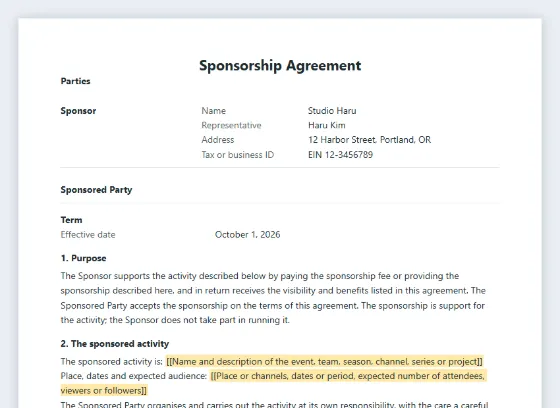
Sponsorship Agreement
Parties: Sponsor · Sponsored Party
1. Purpose
The Sponsor supports the activity described below by paying the sponsorship fee or providing the sponsorship described here, and in return receives the visibility and benefits listed in this agreement. The Sponsored Party accepts the sponsorship on the terms of this agreement. The sponsorship is support for the activity; the Sponsor does not take part in running it.
2. The sponsored activity
The sponsored activity is: [[Name and description of the event, team, season, channel, series or project]]
Place, dates and expected audience: [[Place or channels, dates or period, expected number of attendees, viewers or followers]]
The Sponsored Party organises and carries out the activity at its own responsibility, with the care a careful organiser uses, and keeps the Sponsor informed of material changes.
3. Sponsorship fee
The Sponsor provides the sponsorship shown in the price schedule of this contract, which may be money, goods, services or a mix: [[Amount and currency, or the value and description of goods and services]]
Where the sponsorship is in goods or services, the price schedule states their agreed value, and the Sponsored Party uses them for the activity as described. The Sponsor pays on the payment terms stated in this contract.
4. Sponsor’s benefits
The Sponsored Party gives the Sponsor these benefits: [[Logo placement, mentions, banners, tickets or passes, social media posts, speaking slot, product display or other benefits, with quantity and size]]
Benefits that are not listed here are not included. The Sponsored Party delivers each benefit in the quality and at the time agreed, and within [[14]] days after the activity sends the Sponsor proof of the main benefits, such as photographs, links or statistics.
5. Sponsored Party’s duties
The Sponsored Party holds the activity as described, tells the Sponsor without delay of anything that could seriously affect it, names this contact person for the Sponsor: [[Name and contact details of the Sponsored Party’s contact person]], and keeps the Sponsor’s materials and products that it receives in good order. It does not present the Sponsor as the organiser or as responsible for the content of the activity, and does not give the Sponsor’s benefits to another party.
6. Logos and brand use
Each party may use the other’s name, logo and trademarks only to carry out this sponsorship, in the form and under the guidelines the other party provides, and acquires no rights in them.
Before each use of the Sponsor’s marks in print, on screen or online, the Sponsored Party sends the Sponsor a sample for approval at least [[5]] days ahead. The Sponsor approves it or asks for changes within [[3]] business days, and silence counts as approval.
When this agreement ends, each party stops using the other’s marks, except in material that has already been published or printed and cannot reasonably be withdrawn.
7. Advertising rules and disclosure
Both parties comply with the advertising, broadcasting, platform and consumer rules that apply to the activity and to the sponsor messages. Where a post, broadcast or announcement is paid for or supported by the Sponsor, it makes that relationship clear in the way the rules that apply where it is seen require.
The Sponsor tells the Sponsored Party in good time if its products or services are subject to advertising restrictions, such as for age or content, and the Sponsored Party takes them into account in its materials and its audience. The Sponsor is responsible for the truth of its own claims.
8. Category exclusivity
[[Optional: keep or delete this clause]] For this activity the Sponsored Party does not accept another sponsor, and does not give another sponsor the same benefits, in this category: [[Product category]]
The Sponsor accepts that sponsors from other categories may be accepted. This clause concerns this activity only; it does not restrict either party’s other business.
9. Changes, postponement and cancellation
If the Sponsored Party postpones the activity, it offers the Sponsor a new date and the benefits are given then. If the Sponsored Party cancels the activity, or cannot deliver a main benefit for reasons within its control, it refunds the part of the fee that relates to what is not delivered or gives equal replacement benefits that the Sponsor accepts.
If the activity cannot go ahead for reasons beyond both parties’ control, they agree in good faith on a new date, or the part of the fee that relates to what is not delivered is dealt with as follows: [[refunded / credited towards a later activity]]
If the Sponsor cancels for a reason that is not stated in this agreement, it pays [[50]]% of the fee, and anything it has already paid above that is refunded to it.
10. Conduct and reputation
Each party avoids conduct that would seriously damage the other’s reputation in connection with this sponsorship. If a party acts unlawfully or makes a public statement that seriously damages the relationship, and does not put it right within [[7]] days of being asked to where it can be put right, the other party may end this agreement by notice in writing or in electronic form. The fee is then settled in proportion to the benefits already delivered.
11. Audience data
Neither party receives the other’s customer, attendee or follower data unless this agreement, or the law and the person concerned, allow it. Where the parties agree to share data from a contest, registration or ticket sales, they state here what is shared, for what purpose and under whose responsibility: [[None, or the data to be shared and its purpose]]
Each party follows the data protection law that applies to it.
12. Term and termination
This agreement starts on the effective date and runs until the sponsored activity or period described above has ended and the benefits have been delivered and paid for. It can be renewed only by agreement of both parties in writing or in electronic form. Either party may end it early by notice if the other seriously breaches it and does not remedy the breach within [[14]] days of being asked to; the fee is then settled in proportion to the benefits delivered.
13. Safety, insurance and liability
The Sponsored Party is responsible for the safety of the activity and of the people who take part in or attend it, and for the permits, licences and insurance that the law requires for it. It holds liability insurance for the activity as follows: [[Cover and amount, or none]] The Sponsor is responsible for its own materials, products and statements.
Each party is liable for damage it causes by breaching this agreement, as the law provides. Except for intent, gross negligence, personal injury or where the law does not allow a limitation, each party’s total liability under this agreement is limited to the sponsorship fee.
14. Independent parties
The parties are independent. This agreement creates no partnership, joint venture, agency or employment between them, and neither party may make commitments for the other. Each party is responsible for its own staff, taxes and permits.
15. Governing law and disputes
This agreement is governed by the law stated under Governing law. The parties will first try to settle any dispute in good faith. Otherwise the courts stated under Jurisdiction decide, unless mandatory law provides otherwise.
Payment terms
The Sponsor pays [[50]]% of the sponsorship fee on signing and the rest [[before the activity / within 14 days after the activity]], by bank transfer to the account stated on the invoice.
Governing law
[[Country or state whose law applies]]
Jurisdiction
[[Courts that decide disputes, e.g. the courts of your city]]
How to use it
Choose the template
Press the button to use this template. If you are not signed in, you first sign in or sign up for free and then come straight back to it.
Start a draft
The new-contract page opens with this template marked. Press its card to create a draft. Your company details fill in Party A, and you fill in the blanks, the other party and, where the template has one, the price schedule.
Send it for signature
You sign first, then send each signer a secure link and, by another route, an access code. Signers need no account.
Next steps
Your client opens the link on any device and needs no account. See what the signing looks like on the E-Contracts page, and read which kind of electronic signature is enough for which document.
Already signed? Make the invoice from the signed contract: the parties and the price lines carry over, in full or for a deposit. The guide on turning a quotation into an invoice shows how to review the new draft, its dates and the PDF.
What it is, and what it is not
QuoteBill creates a simple electronic signature with an audit trail. In the EU, the UK, the US and Korea a signature is not denied legal effect only because it is electronic, and in Japan most contracts need no particular form at all. What a simple electronic signature proves in a dispute depends on the evidence behind it, and some documents need another form.
It is not a qualified or advanced electronic signature, and QuoteBill does not verify who the signers are. It records the use of the link and access code you delivered, so anyone who has both can sign. The signature certificate lists every link issued and, for each action by the sender or a signer, its IP address and browser where they could be read.
Some documents need another form. Wills, many real-estate transfers, guarantees and some employment documents must, in some countries, be handwritten, notarised or signed with a qualified signature. The templates are samples, not legal advice: review them with a lawyer.
Other contract templates
Sales and supply agreement
Goods, orders, delivery, inspection, warranty and payment.
Simple general contract
What each party does, payment, term and termination.
Master services agreement
Standard terms for repeated work, with each job agreed in its own statement of work.
Statement of work
One piece of work under a master agreement: scope, milestones, acceptance, fees and dependencies.