Solar module commercial invoice template
Solar module commercial invoice template: modules by power class, inverters, cable and mounting parts with HS code and origin per line.
Templates by industry
- Monocrystalline PV modules, 550 W, per piece
- String inverters, 50 kW, per unit
- DC solar cable, 6 mm², 500 m drums
- Aluminium mounting rails and clamps, per set
Preparation guide
Example workflow
Describe the goods
Example: describe "Monocrystalline PV modules, 550 W, per piece" precisely enough for customs, with HS code, origin, quantity and unit value.
Add the shipment details
Enter the Incoterms, ports of loading and discharge, gross and net weight and packages, and check "Aluminium mounting rails and clamps, per set" matches the packing list.
Sign and send
Sign the declaration and send the invoice to the importer and your freight forwarder or customs broker with the other shipping documents.
A solar shipment is a pallet list as much as an invoice: hundreds of modules of the same type, each with a serial number, plus the inverters and cable that go with them. The customs side looks at two things in particular, the tariff line of each part and where the modules and their cells were made, because some importing countries treat solar goods differently by origin. This template separates modules, inverters, cable and mounting, each with its own HS code and origin.
Fields to prepare
- Deliverables and line items
- Monocrystalline PV modules, 550 W, per piece, String inverters, 50 kW, per unit, DC solar cable, 6 mm², 500 m drums, Aluminium mounting rails and clamps, per set: give each line a precise description, its HS code, country of origin, quantity and value.
- Monocrystalline PV modules, 550 W, per piece
- State the wattage class, the cell technology and the dimensions; modules of 540 W and 550 W are different goods and are counted on different lines.
- String inverters, 50 kW, per unit
- Give the model, rated output and phase configuration of each inverter, as the importer matches them to the module strings.
- DC solar cable, 6 mm², 500 m drums
- Write the cross-section and the drum length, and keep the cable on a line of its own; it often has a different tariff heading and a different origin from the modules.
- Aluminium mounting rails and clamps, per set
- Describe the material and the number of rails and clamps in a set, so that the quantity on the invoice can be counted against the packing list.
- Parties and terms
- Name the exporter, the importer and, if the goods go to someone else, the consignee, with the Incoterms, the currency and the payment terms.
- Shipment
- Give the ports of loading and discharge, the shipping method, the gross and net weight, the number of packages and the reason for export.
- Scope to agree
- Group modules by power class, quote the pallet and serial-number list the invoice refers to, and write the country where the cells and the finished modules were made on the line or in the notes.
Before sending
- Does “Monocrystalline PV modules, 550 W, per piece” have the HS code and country of origin customs will check?
- Is the value of “String inverters, 50 kW, per unit” the price actually paid, in the invoice currency?
- Do the quantity and weight of “DC solar cable, 6 mm², 500 m drums” match the packing list?
Show 4 more
- Does “Aluminium mounting rails and clamps, per set” have the HS code and country of origin customs will check?
- Check the Incoterms, ports, weights and package count against the shipping documents, and the importing country's customs requirements.
- Check each HS code and country of origin with your freight forwarder or customs broker; QuoteBill does not look them up.
- Check the tax rate: it starts at 0% because exports are often zero-rated, so change it if your sale is taxed.
Worked example: a solar shipment of four product types
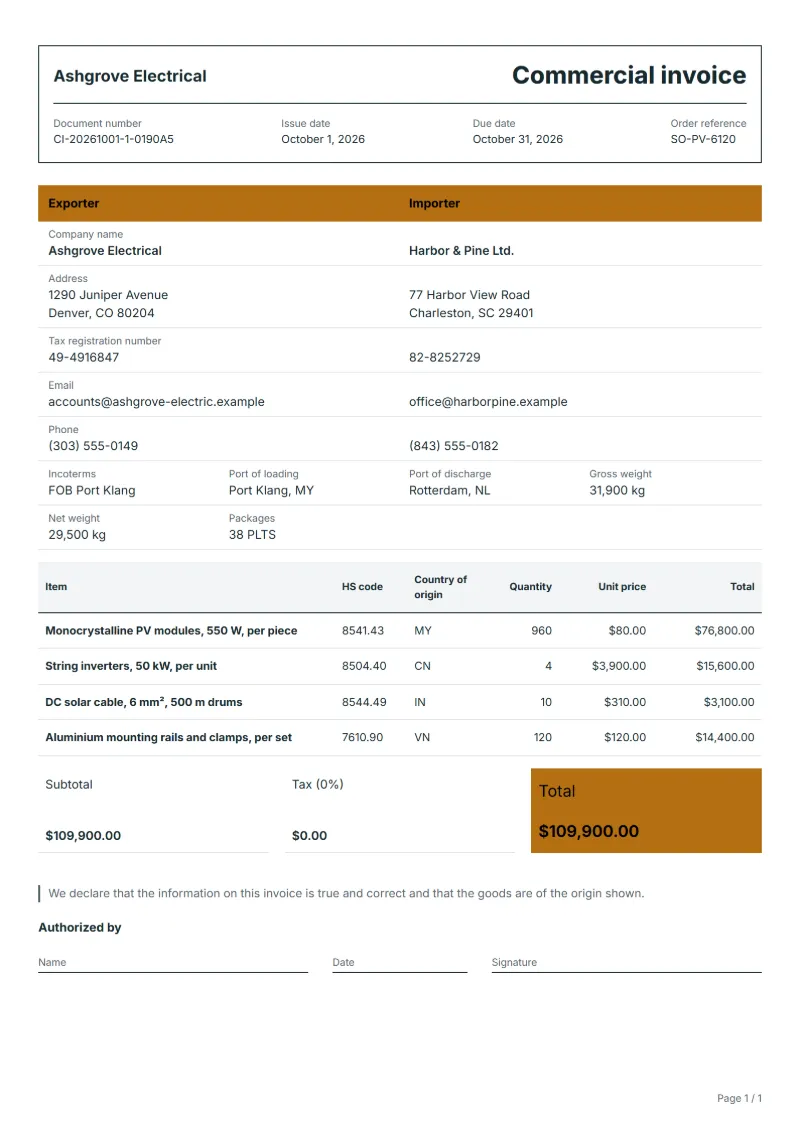
The figures are an example, in dollars. An exporter invoices 960 modules, 4 inverters, 10 drums of cable and 120 sets of mounting rails to an installer abroad. Each line carries its own HS code and origin, and no tax is added on the export.
| Item | Quantity × unit price | Amount |
|---|---|---|
| Monocrystalline PV modules, 550 W, per piece | 960 × $80.00 | $76,800.00 |
| String inverters, 50 kW, per unit | 4 × $3,900.00 | $15,600.00 |
| DC solar cable, 6 mm², 500 m drums | 10 × $310.00 | $3,100.00 |
| Aluminium mounting rails and clamps, per set | 120 × $120.00 | $14,400.00 |
| Total | $109,900.00 | |
The four lines come to $109,900.00, which is the invoice total of $109,900.00. The module line makes up most of it, so the module count is the figure the importer checks first against the pallet list.
Common mistakes on a solar module commercial invoice
- Merging different power classes into one line with an average price.
- Giving the origin of the exporting country when the modules were made, or the cells produced, in another.
- Leaving the pallet and serial-number list out, so the module count cannot be checked.
- Showing the inverters and the cable under the module’s HS code, which belongs to the modules alone.
- Including goods that ship later on the same invoice, so the total does not match the shipment.
What the document must show
These details make a commercial invoice easier to approve and to file.
- Exporter and importer names and addresses, and the consignee if different
- Invoice number and date
- Each item with description, HS code, origin, quantity, unit price and value
- Incoterms, currency and payment terms
- Ports of loading and discharge, shipping method
- Gross and net weight, number of packages
- A signed declaration
A commercial invoice starts at 0%, because exports are often zero-rated; change the rate if your sale is taxed. The sales tax depends on where the work is supplied, so set the rate that applies to your customer before sending.
Official rate reference: US government: state and local taxes
Frequently asked questions
Where do the serial numbers of 960 modules go?
Not on the invoice itself. Attach the pallet and serial-number list, quote its reference in the description of the module line, and keep the module count on the invoice equal to the count on that list.
Should modules of different wattage be separate lines?
Yes. Each power class has its own price, and customs and the installer count them as separate items. A single line with an average price hides the real unit values.
What do I enter as origin when cells and modules come from different countries?
Enter the origin your supplier’s documents give for the finished module and write the cell origin in the notes. How origin is decided differs between markets, so ask the importer’s broker what proof it needs.
Can the inverters ship on the same invoice if they leave a week later?
No. An invoice covers one shipment, so a later shipment gets its own invoice with its own date and weights. Splitting them keeps each consignment matched to its transport documents.
How is tax calculated on this template?
A commercial invoice starts at 0%, because exports are often zero-rated; change the rate if your sale is taxed. The sales tax depends on where the work is supplied, so set the rate that applies to your customer before sending. The editor keeps the net amount, the tax and the total apart, and recalculates all three when you change a quantity, a unit price or the country setting.
Is this commercial invoice enough for customs?
It carries the details customs usually ask for, but each country sets its own requirements and some need other documents, such as a certificate of origin. Check with the importing country's customs authority, your freight forwarder or a customs broker before you ship.
Read next
Reading for the Solar module commercial invoice template: Proforma vs invoice and down payment invoice and Quote, proforma, invoice, receipt, credit note: which to use. The currency converter converts the amounts when you invoice in another currency.