Septic tank pumping invoice template
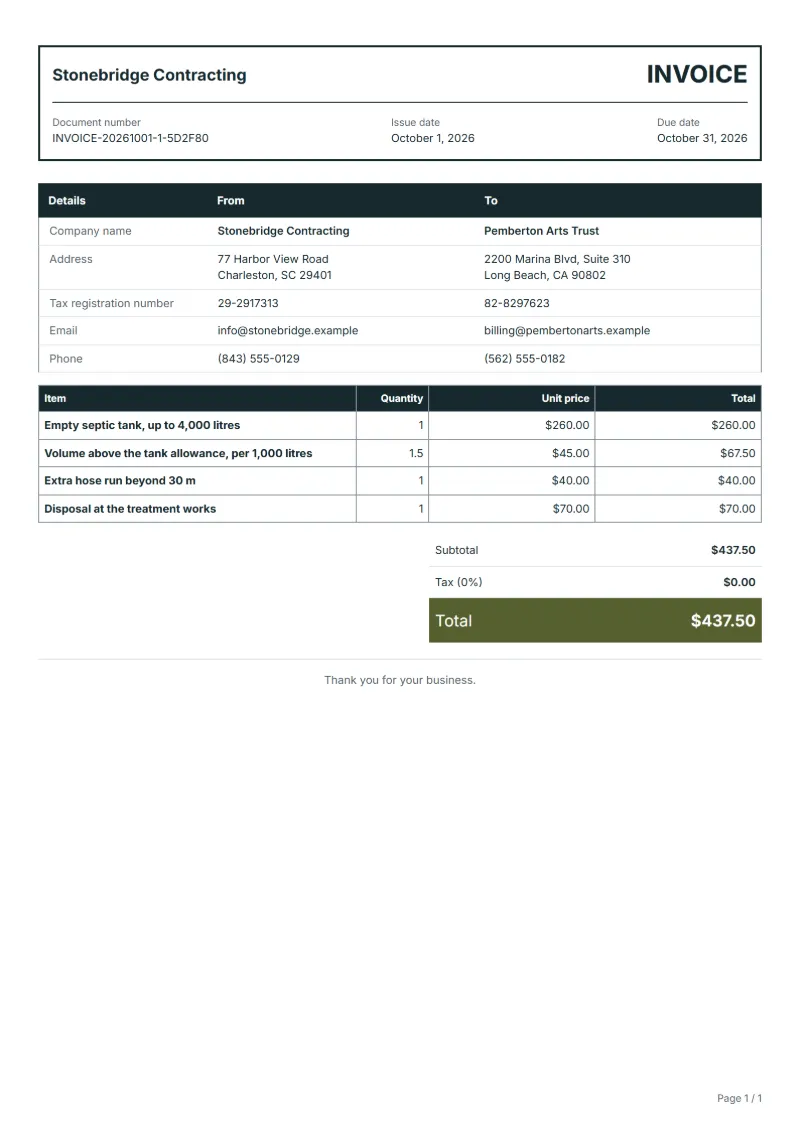
Septic tank pumping invoice template: the volume removed in litres, extra volume and hose length, disposal charges and notes on the tank’s condition.
Templates by industry
- Empty septic tank, up to 4,000 litres
- Volume above the tank allowance, per 1,000 litres
- Extra hose run beyond 30 m
- Disposal at the treatment works
Preparation guide
Example workflow
Confirm scope and quantities
Example: reconcile the approval and work record for "Empty septic tank, up to 4,000 litres" to establish the quantity for this invoice.
Record delivery and acceptance
Check completion for every line, including "Disposal at the treatment works". Deliver the service record, materials used, unresolved issues and the agreed next visit date.
Send the billing record
Send the final charges, delivery reference and due date to the customer, then reconcile payment against the invoice number.
Emptying a septic tank is priced by what comes out and how hard it is to reach. This template starts from a standard empty up to a stated volume, then adds the litres above it and the hose needed when the tanker cannot get close. Disposal at the treatment works has its own line because its cost follows the volume. The notes record what you could see with the lid off, such as a blocked outlet or a cracked cover, which tells the owner when the next empty is due.
Fields to prepare
- Deliverables and line items
- Empty septic tank, up to 4,000 litres, Volume above the tank allowance, per 1,000 litres, Extra hose run beyond 30 m, Disposal at the treatment works: record the quantities actually supplied and the service period.
- Empty septic tank, up to 4,000 litres
- State the allowance included in the base price and the tank size the client gave you, so a larger tank explains a larger bill.
- Volume above the tank allowance, per 1,000 litres
- Read the extra volume from the tanker gauge and round it to the unit you quoted.
- Extra hose run beyond 30 m
- Measure the hose from the tanker to the lid, and note if it crossed a neighbour’s land with their permission.
- Disposal at the treatment works
- Quote the disposal ticket number from the treatment works so the volume can be traced.
- Assets and visits
- Record the asset or area, visit dates, visit count and access arrangements.
- Labor and materials used
- Separate labor hours, quantities of parts or consumables, and work outside the recurring scope.
- Scope to agree
- Record the volume removed in litres, the distance from the tanker to the tank, and what you saw of the tank’s inlet, outlet and lid while it was open.
Before sending
- Does “Empty septic tank, up to 4,000 litres” show the quantity actually supplied, not the quantity first quoted?
- Is “Volume above the tank allowance, per 1,000 litres” charged at the rate the customer agreed to, with any change approved?
- Is “Extra hose run beyond 30 m” finished and accepted, or does it belong on a later invoice?
Show 4 more
- Does “Disposal at the treatment works” show the quantity actually supplied, not the quantity first quoted?
- Match extra parts and return-visit charges to approved work.
- Record the initial condition and the post-service checks.
- Match completed work to the order or approval record, and confirm the payment due date and amounts already received.
Worked example with sample figures
The figures below are invented to show how the template adds up: 4 lines in USD, with an example tax rate of 8%.
| Item | Quantity × unit price | Amount |
|---|---|---|
| Empty septic tank, up to 4,000 litres | 1 × $260.00 | $260.00 |
| Volume above the tank allowance, per 1,000 litres | 1.5 × $45.00 | $67.50 |
| Extra hose run beyond 30 m | 1 × $40.00 | $40.00 |
| Disposal at the treatment works | 1 × $70.00 | $70.00 |
| Subtotal | $437.50 | |
| Sales tax (8%) | $35.00 | |
| Total | $472.50 | |
Net amount $437.50, sales tax $35.00, total payable $472.50.
What the document must show
The details an invoice has to show, and why each one matters, are set out in the guide below.
The sales tax depends on where the work is supplied, so set the rate that applies to your customer before sending.
Official rate reference: US government: state and local taxes
Full requirements: How to write an invoice: a step-by-step example
Frequently asked questions
How do I show the volume I took away?
Give the litres from the tanker gauge on the lines and quote the disposal ticket from the treatment works in the notes. Together they show what left the property.
Should I note the condition of the tank?
Yes, briefly: the level before pumping, the state of the inlet, the outlet and the lid. It helps the owner plan the next empty and spot a problem early.
How is the sales tax worked out on this invoice?
The worked example above uses an example rate of 8%: $35.00 on a net amount of $437.50, for a total of $472.50. The editor recalculates all three when you change a quantity, a price or the country.
How should I number invoices?
Use one unbroken sequence per business, never reuse a number, and issue a credit note rather than deleting an invoice you have already sent.
Can I use it in another language or currency?
Yes. The document language can be set to any of 33 languages, and changing the country setting updates the currency, the date format and the tax rate.
Read next
Reading for the Septic tank pumping invoice template: How to write an invoice: a step-by-step example and Credit note vs invoice (and credit memo): how to issue one. The VAT and GST calculator works out the tax line for you.