Non-hazardous chemicals commercial invoice template
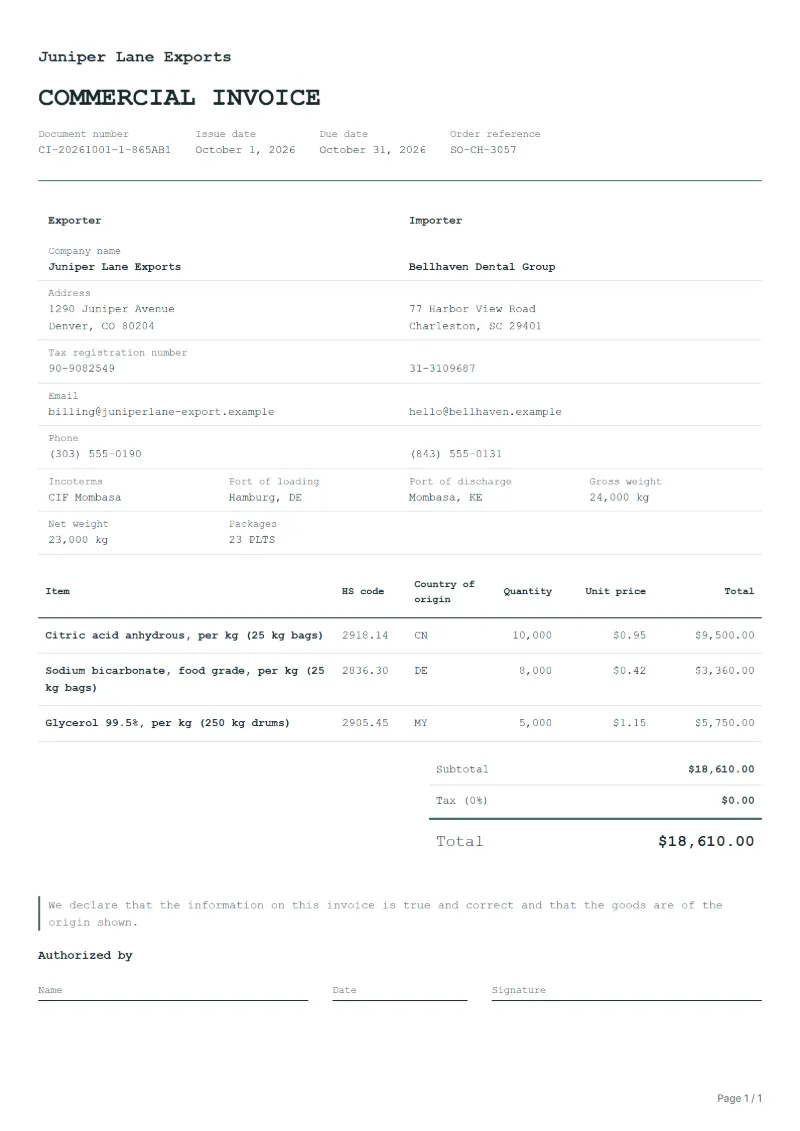
Non-hazardous chemicals commercial invoice template: chemical name, grade, HS code and origin per line, with packaging and lot for customs.
Templates by industry
- Citric acid anhydrous, per kg (25 kg bags)
- Sodium bicarbonate, food grade, per kg (25 kg bags)
- Glycerol 99.5%, per kg (250 kg drums)
Preparation guide
Example workflow
Describe the goods
Example: describe "Citric acid anhydrous, per kg (25 kg bags)" precisely enough for customs, with HS code, origin, quantity and unit value.
Add the shipment details
Enter the Incoterms, ports of loading and discharge, gross and net weight and packages, and check "Glycerol 99.5%, per kg (250 kg drums)" matches the packing list.
Sign and send
Sign the declaration and send the invoice to the importer and your freight forwarder or customs broker with the other shipping documents.
Customs officers cannot judge a chemical by its trade name, so the commercial invoice for a chemical shipment describes it the way the tariff does: by chemical name, purity and form. For ordinary products such as food acids, salts and glycerol, the invoice also tells the importer how the goods are packed and which lot they come from. HS code and origin are entered per line, not once for the shipment, because a mixed load often comes from several plants in several countries.
Fields to prepare
- Deliverables and line items
- Citric acid anhydrous, per kg (25 kg bags), Sodium bicarbonate, food grade, per kg (25 kg bags), Glycerol 99.5%, per kg (250 kg drums): give each line a precise description, its HS code, country of origin, quantity and value.
- Citric acid anhydrous, per kg (25 kg bags)
- Write the chemical name, the form and the purity, for example “anhydrous, 99.5% minimum”; the tariff heading depends on these, not on the producer’s brand.
- Sodium bicarbonate, food grade, per kg (25 kg bags)
- Add the grade, such as food or technical, because the same compound is classified and priced by quality, and quote the lot numbers of the bags.
- Glycerol 99.5%, per kg (250 kg drums)
- For drums, give the net content of each and the CAS number, and keep the description on the invoice identical to the safety data sheet.
- Parties and terms
- Name the exporter, the importer and, if the goods go to someone else, the consignee, with the Incoterms, the currency and the payment terms.
- Shipment
- Give the ports of loading and discharge, the shipping method, the gross and net weight, the number of packages and the reason for export.
- Scope to agree
- Describe each product by its chemical name, grade and CAS number, give the packaging and lot numbers, and confirm from the safety data sheet that nothing in the shipment needs dangerous-goods papers.
Before sending
- Does “Citric acid anhydrous, per kg (25 kg bags)” have the HS code and country of origin customs will check?
- Is the value of “Sodium bicarbonate, food grade, per kg (25 kg bags)” the price actually paid, in the invoice currency?
- Do the quantity and weight of “Glycerol 99.5%, per kg (250 kg drums)” match the packing list?
Show 3 more
- Check the Incoterms, ports, weights and package count against the shipping documents, and the importing country's customs requirements.
- Check each HS code and country of origin with your freight forwarder or customs broker; QuoteBill does not look them up.
- Check the tax rate: it starts at 0% because exports are often zero-rated, so change it if your sale is taxed.
Worked example: three chemicals from three countries of origin
The figures are an example, in dollars, and the quantities are kilograms. A trader invoices 10,000 kg of citric acid, 8,000 kg of sodium bicarbonate and 5,000 kg of glycerol, each with its own HS code and country of origin. No tax is added on this export.
| Item | Quantity × unit price | Amount |
|---|---|---|
| Citric acid anhydrous, per kg (25 kg bags) | 10000 × $0.95 | $9,500.00 |
| Sodium bicarbonate, food grade, per kg (25 kg bags) | 8000 × $0.42 | $3,360.00 |
| Glycerol 99.5%, per kg (250 kg drums) | 5000 × $1.15 | $5,750.00 |
| Total | $18,610.00 | |
The three lines come to $18,610.00, which is the invoice total of $18,610.00. The origin sits on every line because the three products are made in three countries, and the importer’s customs value normally starts from this total.
Common mistakes on a chemicals commercial invoice
- Describing a product only by its trade name, so customs and the broker cannot tell what it is.
- Writing “chemicals, assorted” on one line for a load that has three different tariff headings.
- Giving a purity or grade on the invoice that differs from the certificate of analysis that travels with the goods.
- Leaving the country of origin at the country of shipment when the product was made elsewhere.
- Treating a product as safe to ship without checking its safety data sheet for a transport classification.
What the document must show
These details make a commercial invoice easier to approve and to file.
- Exporter and importer names and addresses, and the consignee if different
- Invoice number and date
- Each item with description, HS code, origin, quantity, unit price and value
- Incoterms, currency and payment terms
- Ports of loading and discharge, shipping method
- Gross and net weight, number of packages
- A signed declaration
A commercial invoice starts at 0%, because exports are often zero-rated; change the rate if your sale is taxed. The sales tax depends on where the work is supplied, so set the rate that applies to your customer before sending.
Official rate reference: US government: state and local taxes
Frequently asked questions
Does this invoice replace the safety data sheet?
No. The safety data sheet describes the hazards and handling, and some carriers and importers ask for it separately. The invoice states value, origin and classification, and its description should match the sheet word for word.
What if the supplier calls the product by a brand name?
Put the chemical name first and the brand in brackets. Customs and the importer’s broker look for the chemical identity, and the brand alone gives them nothing to classify.
How do I show different lots in one line?
List the lot numbers in the description or add one line per lot if prices differ. Importers of food-grade material often trace by lot, so a mixed line makes a recall or a complaint hard to follow.
Is a harmless chemical free of import conditions?
Not necessarily. Some chemicals that are safe to ship are still controlled at import or need a licence because of what they can be used for. Ask the importer’s broker before you ship, and keep the answer with the order.
How is tax calculated on this template?
A commercial invoice starts at 0%, because exports are often zero-rated; change the rate if your sale is taxed. The sales tax depends on where the work is supplied, so set the rate that applies to your customer before sending. The editor keeps the net amount, the tax and the total apart, and recalculates all three when you change a quantity, a unit price or the country setting.
Can I use it in another language or currency?
Yes. The document language can be set to any of 33 languages, and changing the country setting updates the currency, the date format and the tax rate.
Read next
Reading for the Non-hazardous chemicals commercial invoice template: Proforma vs invoice and down payment invoice and Quote, proforma, invoice, receipt, credit note: which to use. The currency converter converts the amounts when you invoice in another currency.