Blanket purchase order template
Blanket purchase order template: commit to a yearly volume at a fixed price, add the fees charged per release, and write each call-off against one order number.
Templates by industry
- Kiln-dried oak boards, 27 mm: committed volume (m³)
- Kiln-dried beech boards, 32 mm: committed volume (m³)
- Cutting to the joiner’s list, per call-off
- Storage at the supplier’s yard until called off, per month
Preparation guide
Example workflow
Match the quotation
Example: take "Kiln-dried oak boards, 27 mm: committed volume (m³)" from the supplier's quotation and copy its quantity, unit price and specification exactly.
Approve and send
Confirm the delivery date and address for every line, including "Storage at the supplier’s yard until called off, per month", then sign the authorized-by line and send the order.
Receive and reconcile
When the goods arrive, check them against the order, then match the supplier's invoice to the order number before paying.
A blanket order commits a buyer to a total over a period, usually a year, at a price fixed up front. The goods are not delivered at once: the buyer calls them off in releases as the work needs them. This template carries the committed volume, the extras charged per release and a space for the order’s end date, so each call-off can be written against one order number instead of a new quote.
Fields to prepare
- Deliverables and line items
- Kiln-dried oak boards, 27 mm: committed volume (m³), Kiln-dried beech boards, 32 mm: committed volume (m³), Cutting to the joiner’s list, per call-off, Storage at the supplier’s yard until called off, per month: state the quantity, unit and agreed price for each line, as the supplier quoted it.
- Kiln-dried oak boards, 27 mm: committed volume (m³)
- Quote the committed volume for the whole period, then put the expected split by quarter in the notes; the supplier plans its drying schedule from that split.
- Kiln-dried beech boards, 32 mm: committed volume (m³)
- A second species can have its own minimum order and lead time, so give each its own committed volume instead of one lump for “hardwood”.
- Cutting to the joiner’s list, per call-off
- The number of call-offs times the fee gives this line, so write the expected count; releases beyond the plan then cost the same.
- Storage at the supplier’s yard until called off, per month
- Free storage rarely lasts a whole year; say how many months are included and what a month costs after that, so unused timber does not quietly collect a charge.
- Supplier and quotation
- Name the supplier and quote the number of the quotation this order accepts, so each price can be traced to the offer.
- Delivery
- Give the delivery date, the address the goods go to, the shipping method and who receives them.
- Scope to agree
- State the total quantity or value committed, the period it covers, the price it holds for, and the smallest and largest amount one call-off may ask for.
Before sending
- Does “Kiln-dried oak boards, 27 mm: committed volume (m³)” match the supplier’s quotation in specification, quantity and price?
- Are a delivery date and a receiver agreed for “Kiln-dried beech boards, 32 mm: committed volume (m³)”?
- Has the budget holder approved the spend on “Cutting to the joiner’s list, per call-off”?
Show 4 more
- Does “Storage at the supplier’s yard until called off, per month” match the supplier’s quotation in specification, quantity and price?
- Check the supplier's quotation number, the delivery date and address, and who approved the order.
- Check that each quantity, unit and unit price matches the supplier's quotation.
- Give the order a number of its own, so the supplier can quote it on the delivery note and the invoice.
Worked example: a year of timber in six call-offs
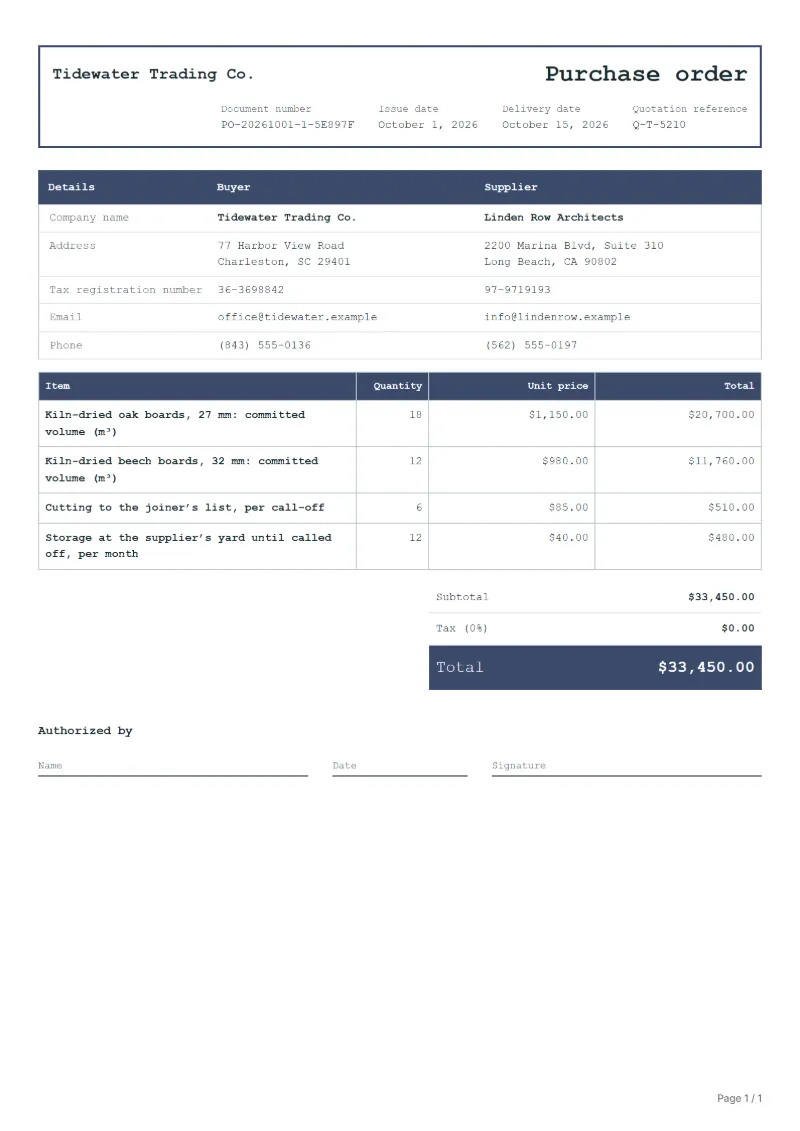
The figures are an example, in dollars. A joinery commits to 18 m³ of oak and 12 m³ of beech for the year, to be called off in six releases, with twelve months of storage at the supplier’s yard.
| Item | Quantity × unit price | Amount |
|---|---|---|
| Kiln-dried oak boards, 27 mm: committed volume (m³) | 18 × $1,150.00 | $20,700.00 |
| Kiln-dried beech boards, 32 mm: committed volume (m³) | 12 × $980.00 | $11,760.00 |
| Cutting to the joiner’s list, per call-off | 6 × $85.00 | $510.00 |
| Storage at the supplier’s yard until called off, per month | 12 × $40.00 | $480.00 |
| Total | $33,450.00 | |
The four lines come to $33,450.00, the most the joinery can be asked to pay under this order. Each release then draws on it: after three call-offs the notes show how much of each species has gone and how much remains, and the price per cubic metre stays as written.
Common mistakes on a blanket order
- Giving every call-off a fresh order number, so nobody can see what is left of the commitment.
- Leaving out the end date, which lets the price and the commitment run on without limit.
- Calling off more than the committed quantity without amending the order first.
- Skipping the smallest release size, so the supplier ships half a truck for each request.
- Forgetting the storage clause and finding at the end of the year that unused stock has been charged monthly.
What the document must show
These details make a purchase order easier to approve and to file.
- Your company name and address as the buyer
- The supplier's name and address
- Order number and date
- Each item with quantity, unit price and amount
- Delivery date, delivery address and shipping method
- Payment terms and the total, with tax shown separately
- Who authorized the order
The sales tax depends on where the work is supplied, so set the rate that applies to your customer before sending.
Official rate reference: US government: state and local taxes
Frequently asked questions
How do I number each call-off against the blanket order?
Keep the blanket order’s number and add a release number, for example PO-2210 release 3. Note the quantity released and the quantity still open each time, so both sides can see the balance without re-reading the whole year.
What if we do not take the whole committed volume?
That depends on what you agreed. Write it in the notes: the shortfall is paid at a reduced rate, rolls into the next period or simply lapses. Without that sentence the supplier may ask for the full commitment.
Can the supplier raise the price during the year?
Only if the order says how. The usual choices are a fixed price for the whole period or a price tied to a named index with a review date. State which one applies, because an order that says nothing leaves the first rise to be argued out.
How much notice does a call-off need?
Write the lead time from release to delivery, such as ten working days, and the smallest and largest quantity one release may ask for. A supplier cannot cut to your list overnight, and a release of a single board will not justify a truck.
Should the order total be a quantity or a value?
Either works, but say which one governs. A quantity commitment fixes the volume and the price per cubic metre stands on its own; a value cap limits what you can spend even if the price moves. The lines above show the value of the planned volume.
How is tax calculated on this template?
The sales tax depends on where the work is supplied, so set the rate that applies to your customer before sending. The editor keeps the net amount, the tax and the total apart, and recalculates all three when you change a quantity, a unit price or the country setting.
How is the document numbered?
QuoteBill gives each new document a unique number of its own. A member can switch to numbers in sequence in settings, such as PO-2026-0001: one sequence for each kind of document, starting again every calendar year. A number you type yourself is kept as it is.
Read next
Reading for the Blanket purchase order template: Quote, proforma, invoice, receipt, credit note: which to use and Estimate vs quote: what binds you, with a remodeling example. When the goods arrive, match them to this order with the Delivery note template.