Markdown allowance credit note template
Markdown allowance credit note template: credit a retailer for agreed markdowns on slow-selling stock, style by style, from its sell-through report.
Templates by industry
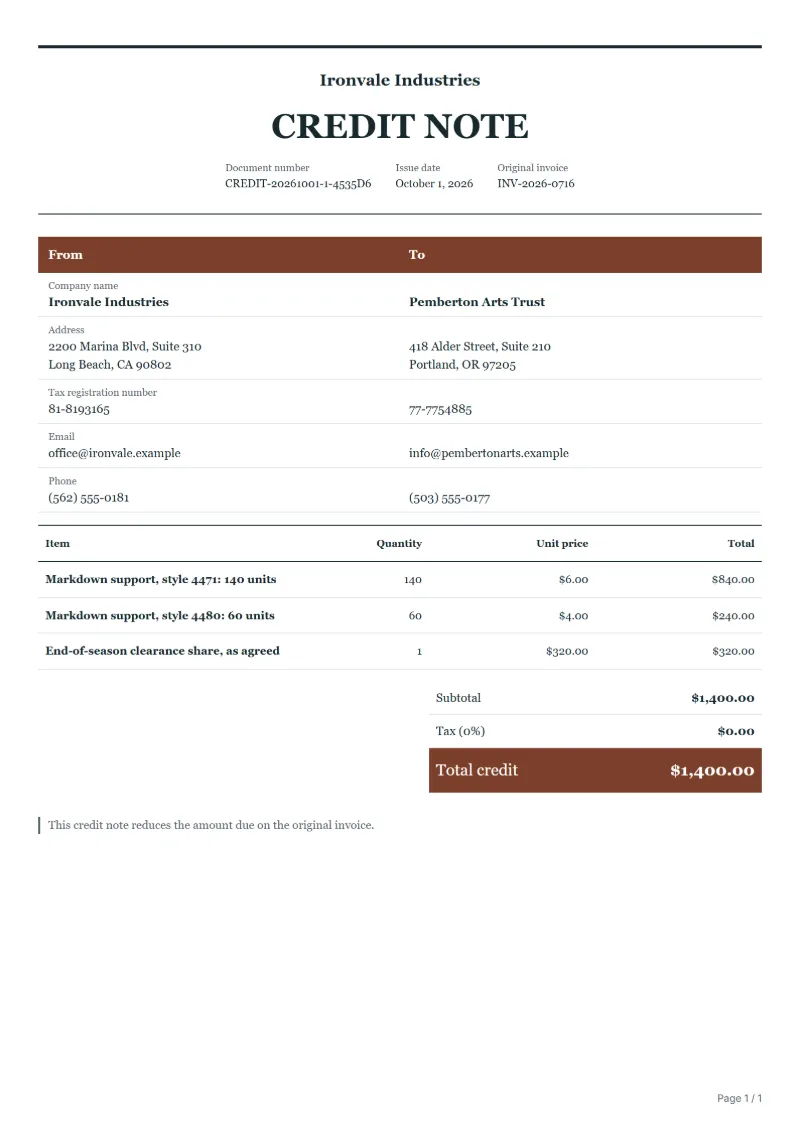
- Markdown support, style 4471: 140 units
- Markdown support, style 4480: 60 units
- End-of-season clearance share, as agreed
Preparation guide
Example workflow
Identify the invoice and the reason
Example: for "Markdown support, style 4471: 140 units", find the original invoice, note its number and date, and record the reason: a return, a price reduction or a cancellation.
Credit the affected lines
Enter the quantity or amount credited for each affected line, down to "End-of-season clearance share, as agreed", so the tax on it is reversed in proportion.
Send and settle the credit
Send the credit note to the customer, then refund the amount or set it off against the next invoice, and keep both documents together.
In fashion, footwear and seasonal goods, a retailer often agrees to mark slow lines down only if the supplier shares the loss. That share is the markdown allowance. After the promotion, the retailer reports the units sold at the reduced price, and the supplier credits the agreed amount per unit against the original purchase invoice. Basing every line on that report, style by style, prevents the usual argument over how many units really moved.
Fields to prepare
- Deliverables and line items
- Markdown support, style 4471: 140 units, Markdown support, style 4480: 60 units, End-of-season clearance share, as agreed: only the lines being reduced or cancelled, with the quantity or amount credited.
- Markdown support, style 4471: 140 units
- Take the units from the retailer’s report for the promotion period and the per-unit support from the agreement, not from the original price.
- Markdown support, style 4480: 60 units
- Keep each style on its own line even when the rate is the same; returns and later claims are made style by style.
- End-of-season clearance share, as agreed
- A lump-sum clearance share needs the written agreement quoted, because it does not follow from units.
- Original invoice
- Quote the number and date of the invoice being corrected, and the reason: a return, a price reduction or a cancellation.
- Settlement
- Say how the credit is settled: refunded to the customer or set off against the next invoice.
- Scope to agree
- Base the credit on the retailer’s markdown or sell-through report, give style numbers, units and the agreed amount per unit, and quote the deal the support comes from.
Before sending
- Is “Markdown support, style 4471: 140 units” one of the lines being corrected, at the price on the original invoice?
- Is the quantity or amount credited for “Markdown support, style 4480: 60 units” no more than was invoiced?
- Does the customer know why “End-of-season clearance share, as agreed” is credited: a return, a price change or a cancellation?
Show 3 more
- Credit only the affected lines, and reverse the tax on them at the rate the original invoice used.
- Give the credit note a number of its own rather than reusing or changing the original invoice number.
- Agree with the customer whether the credit is refunded or set off before you send it.
Worked example with sample figures
The figures below are invented to show how the template adds up: 3 lines in USD, with an example tax rate of 8%.
| Item | Quantity × unit price | Amount |
|---|---|---|
| Markdown support, style 4471: 140 units | 140 × $6.00 | $840.00 |
| Markdown support, style 4480: 60 units | 60 × $4.00 | $240.00 |
| End-of-season clearance share, as agreed | 1 × $320.00 | $320.00 |
| Subtotal | $1,400.00 | |
| Sales tax (8%) | $112.00 | |
| Total | $1,512.00 | |
Credit before tax $1,400.00, sales tax reversed $112.00, total credited $1,512.00.
- The credit corrects invoice INV-2026-0716.
What the document must show
The details a credit note has to show, and why each one matters, are set out in the guide below.
The sales tax depends on where the work is supplied, so set the rate that applies to your customer before sending.
Official rate reference: US government: state and local taxes
Full requirements: Credit note vs invoice (and credit memo): how to issue one
Frequently asked questions
Credit note from the supplier or invoice from the retailer?
Both are used. Treated as a price reduction on goods already sold, it is usually a credit note from the supplier; some retailers instead invoice the support as a service. The tax treatment can differ, so agree the method and check it with your adviser.
The retailer’s report includes units we never supplied. What now?
Credit only the units that match your delivery records for the style, and list the difference in the notes. Ask the retailer to check the report before a second credit note is considered.
How is the sales tax worked out on this credit note?
The worked example above uses an example rate of 8%: $112.00 on a net amount of $1,400.00, for a total of $1,512.00. The editor recalculates all three when you change a quantity, a price or the country.
Can I use it in another language or currency?
Yes. The document language can be set to any of 33 languages, and changing the country setting updates the currency, the date format and the tax rate.
Can I change the layout and colour?
Yes. The editor offers other layouts and a document colour for the printed page. Changing them moves no figure: the lines and totals stay as they are, and the PDF, Word and Excel files follow the layout you pick.
Read next
Reading for the Markdown allowance credit note template: Credit note vs invoice (and credit memo): how to issue one and Invoice numbering: sequences and corrections. The VAT and GST calculator helps you credit the tax that went with the goods.