Apparel commercial invoice template
Apparel commercial invoice template: knitted or woven, fiber content, HS code and origin per style, quantities by size, Incoterms, ports and weights.
Templates by industry
- Knitted cotton sweaters
- Woven denim jeans
- Polyester jackets
Preparation guide
Example workflow
Describe the goods
Example: describe "Knitted cotton sweaters" precisely enough for customs, with HS code, origin, quantity and unit value.
Add the shipment details
Enter the Incoterms, ports of loading and discharge, gross and net weight and packages, and check "Polyester jackets" matches the packing list.
Sign and send
Sign the declaration and send the invoice to the importer and your freight forwarder or customs broker with the other shipping documents.
Garment factories and apparel brands use this commercial invoice to ship finished clothing to importers and retailers abroad. Clothing is classified by how the fabric is made and what it is made of, so customs expect knitted or woven, the fibre content and the garment type for every style, and a vague description is a frequent reason for a query. Quantities are given per style, which also lets the importer check the cartons against its own order when the container is opened.
Fields to prepare
- Deliverables and line items
- Knitted cotton sweaters, Woven denim jeans, Polyester jackets: give each line a precise description, its HS code, country of origin, quantity and value.
- Knitted cotton sweaters
- State knitted, the fibre percentages and whether the sweaters are men’s or women’s, since all three steer the tariff line, and add the style number.
- Woven denim jeans
- Write woven and the cotton share, and give the style number with the quantity, attaching the size breakdown rather than crowding the line.
- Polyester jackets
- Describe the shell and lining materials and whether the jacket is padded, which can change its classification.
- Parties and terms
- Name the exporter, the importer and, if the goods go to someone else, the consignee, with the Incoterms, the currency and the payment terms.
- Shipment
- Give the ports of loading and discharge, the shipping method, the gross and net weight, the number of packages and the reason for export.
- Scope to agree
- Describe the fiber content and whether each garment is knitted or woven, since that decides its HS heading, and split quantities by style and size.
Before sending
- Does “Knitted cotton sweaters” have the HS code and country of origin customs will check?
- Is the value of “Woven denim jeans” the price actually paid, in the invoice currency?
- Do the quantity and weight of “Polyester jackets” match the packing list?
Show 3 more
- Check the Incoterms, ports, weights and package count against the shipping documents, and the importing country's customs requirements.
- Check each HS code and country of origin with your freight forwarder or customs broker; QuoteBill does not look them up.
- Check the tax rate: it starts at 0% because exports are often zero-rated, so change it if your sale is taxed.
Worked example with sample figures
The figures below are invented to show how the template adds up: 3 lines in USD, with no tax added.
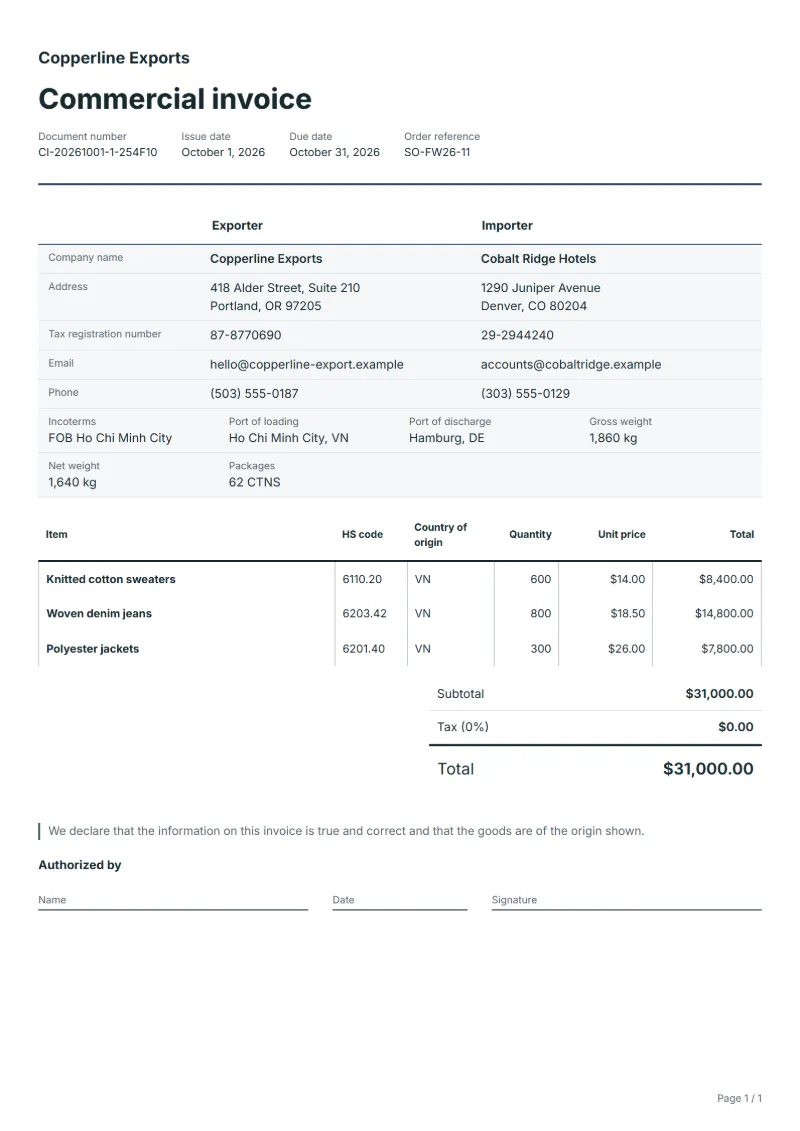
- Knitted cotton sweaters (HS 6110.20, origin VN): 600 × $14.00 = $8,400.00
- Woven denim jeans (HS 6203.42, origin VN): 800 × $18.50 = $14,800.00
- Polyester jackets (HS 6201.40, origin VN): 300 × $26.00 = $7,800.00
Value of the goods $31,000.00, tax $0.00, invoice total $31,000.00.
- Sales order SO-FW26-11.
- Shipment: FOB Ho Chi Minh City, from Ho Chi Minh City, VN to Hamburg, DE; gross weight 1,860 kg, net weight 1,640 kg, 62 CTNS.
What the document must show
These details make a commercial invoice easier to approve and to file.
- Exporter and importer names and addresses, and the consignee if different
- Invoice number and date
- Each item with description, HS code, origin, quantity, unit price and value
- Incoterms, currency and payment terms
- Ports of loading and discharge, shipping method
- Gross and net weight, number of packages
- A signed declaration
A commercial invoice starts at 0%, because exports are often zero-rated; change the rate if your sale is taxed. The sales tax depends on where the work is supplied, so set the rate that applies to your customer before sending.
Official rate reference: US government: state and local taxes
Frequently asked questions
How precise does the fibre content need to be?
Give percentages by weight as on the care label, for example 100% cotton or 80% cotton and 20% polyester. A phrase such as cotton blend leaves customs to guess and is a common reason for a hold.
Should every size be listed on the invoice?
Customs mainly needs the total per style and tariff line. The importer usually wants the size split for receiving, so put it on the packing list or an attached sheet and keep the invoice organised by style.
The garments carry a foreign brand label. Does that change the country of origin?
Not in itself. Origin generally follows where the garment was made, not where the brand is based. If the importer claims a preferential duty rate, the origin rules can be stricter, so check them with a customs broker.
How is the sales tax worked out on this commercial invoice?
A commercial invoice starts at 0%, because exports are often zero-rated; change the rate if your sale is taxed. The sales tax depends on where the work is supplied, so set the rate that applies to your customer before sending. With nothing added, the total in the worked example above stays at the net amount of $31,000.00.
Can I change the layout and colour?
Yes. The editor offers other layouts and a document colour for the printed page. Changing them moves no figure: the lines and totals stay as they are, and the PDF, Word and Excel files follow the layout you pick.
Read next
Reading for the Apparel commercial invoice template: Proforma vs invoice and down payment invoice and International invoice payment: currency, IBAN and SWIFT. The currency converter converts the amounts when you invoice in another currency.