Japanese delivery note template
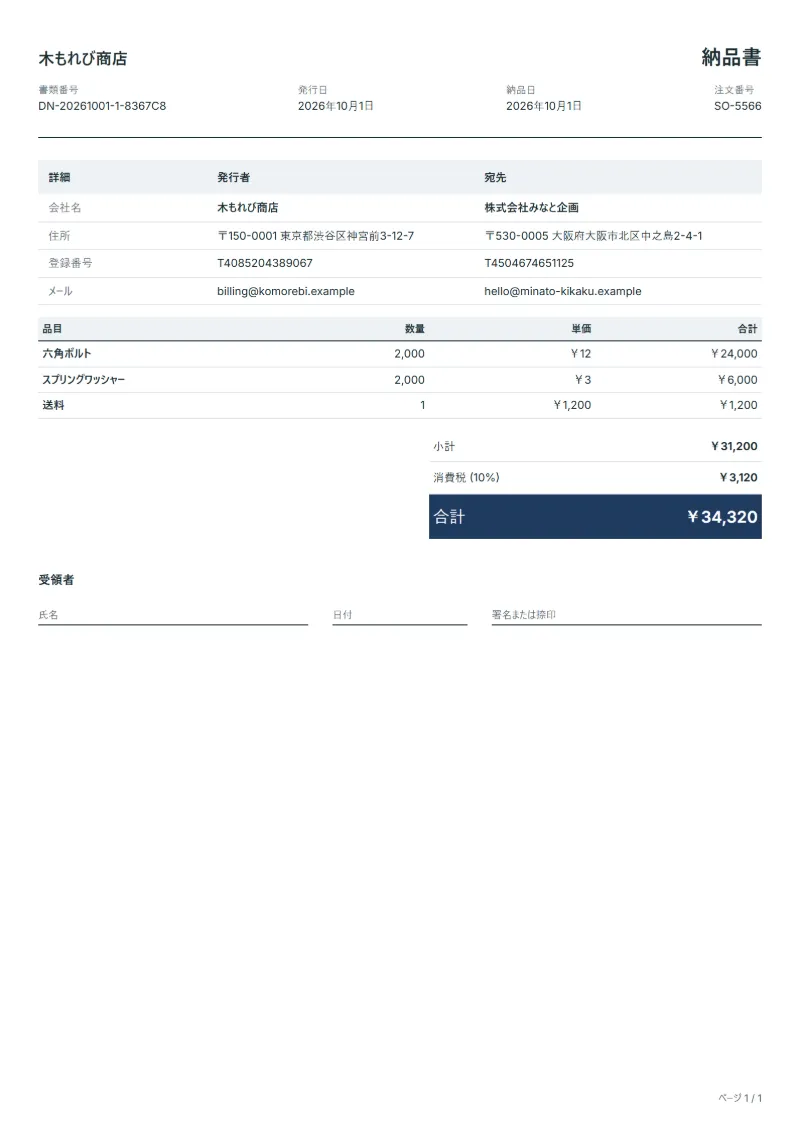
Japanese delivery note (nohinsho) template in Japanese: item codes, quantities, unit prices and consumption tax in yen, with a line for the customer's seal.
Templates by country
- Hex bolts
- Spring washers
- Delivery fee
Preparation guide
Example workflow
Pick and pack
Example: count "Hex bolts" and the other lines against the order, and note anything that ships later.
Ship with the note
Put the note in or on the shipment with the tracking number and package count, and check "Delivery fee" is listed.
Get it signed
Ask the recipient to sign and date the received-by line, and keep the signed copy as proof of delivery.
Suppliers to Japanese businesses usually send a nohinsho with every delivery, and in business-to-business trade it often shows unit prices and consumption tax, so the buyer can check each delivery against the invoice that follows at the month’s closing date. This template is set up that way, in Japanese and in yen, for a fastener supplier: item codes, quantities, prices, a delivery fee line and a received-by line for the customer’s seal or signature.
Fields to prepare
- Deliverables and line items
- Hex bolts, Spring washers, Delivery fee: record the quantity actually shipped for each line, with its unit price and amount.
- Hex bolts
- Give the thread size and length, material and finish with your item code, and count in pieces even if they ship in bags of a hundred.
- Spring washers
- Match the washer size to the bolt it goes with and keep the same piece count, so the customer can see the pairs are complete.
- Delivery fee
- Keep the delivery fee on its own line, taxed like the goods, and if it was waived above an order value, show it at zero so the customer sees why.
- Order and delivery
- Quote the order or invoice number the delivery belongs to, the delivery date and the address the goods go to.
- Shipment
- Give the number of packages, the carrier or shipping method and the tracking number.
- Scope to agree
- Show item codes, quantities, unit prices and the consumption tax, as a Japanese delivery note usually does, and leave the received-by line for the customer's seal or signature.
Before sending
- Was “Hex bolts” counted when it was packed, and does the count match the order?
- If “Spring washers” ships short, does the note say how many follow and when?
- Will the receiver be able to check “Delivery fee” against this note on arrival?
Show 4 more
- Check the delivery address, the number of packages and the order or invoice number the delivery belongs to.
- Count each line against the order, and list anything that ships later rather than leaving it off.
- Check each unit price and amount against the order, so the figures agree with the invoice that follows.
- Confirm document language (ja), country setting (JP), and the customer's currency and date-format requirements.
Worked example with sample figures
The figures below are invented to show how the template adds up: 3 lines in JPY, with consumption tax at 10%.
| Item | Quantity × unit price | Amount |
|---|---|---|
| Hex bolts | 2,000 × ¥12 | ¥24,000 |
| Spring washers | 2,000 × ¥3 | ¥6,000 |
| Delivery fee | 1 × ¥1,200 | ¥1,200 |
| Subtotal | ¥31,200 | |
| Consumption tax (10%) | ¥3,120 | |
| Total | ¥34,320 | |
Total payable ¥34,320, of which consumption tax ¥3,120.
- The goods ship against sales order SO-5566.
What the document must show
These details make a delivery note easier to approve and to file.
- Your company name and address
- The customer's name and delivery address
- Note number and delivery date
- The order or invoice it belongs to
- Each item with the quantity delivered, its unit price and amount
- Packages and carrier or tracking number
- A line for the recipient's signature and date
The consumption tax here is 10%, applied to the net amount and shown as its own line.
Official rate reference: Japan NTA: consumption tax rates
Frequently asked questions
How does this delivery note relate to the monthly invoice?
Many Japanese customers pay on a closing-date invoice that lists every delivery of the month. Quote each delivery note’s number on that invoice, or attach the list, so the customer can tick off the notes they have already checked and stamped.
The customer asks for a juryosho as well. What is that?
A receipt-of-goods slip the customer stamps and returns, often printed as a second copy of the delivery note. You can print this note twice and ask for the seal or signature on the copy that comes back to you.
Should the delivery note show our invoice registration number?
It depends on how you issue qualified invoices in Japan: some suppliers let the delivery notes and the monthly invoice work together, others put everything on the invoice. Check with your tax adviser, and keep the arrangement the same for every delivery.
How is the consumption tax worked out on this delivery note?
In the worked example above, consumption tax at 10% on the net amount of ¥31,200 is ¥3,120, so the total is ¥34,320. The editor recalculates all three when you change a quantity, a price or the country.
Does a delivery note show prices?
This one does: each line carries its unit price and amount, which the recipient can check against the order, while the invoice that follows asks for payment. Switch the line columns to quantities if a note without prices suits the customer better.
Read next
Reading for the Japanese delivery note template: Quote, proforma, invoice, receipt, credit note: which to use and Unpaid invoice: follow-ups, part payments and statements. The order this delivery answers is written on the Purchase order template.