Damaged goods credit note template
Credit note template for goods damaged in transit: units damaged per line, the delivery note and damage report, freight and disposal costs.
Templates by industry
- Units damaged in transit
- Delivery charge on damaged units
- Disposal of damaged stock
Preparation guide
Example workflow
Identify the invoice and the reason
Example: for "Units damaged in transit", find the original invoice, note its number and date, and record the reason: a return, a price reduction or a cancellation.
Credit the affected lines
Enter the quantity or amount credited for each affected line, down to "Disposal of damaged stock", so the tax on it is reversed in proportion.
Send and settle the credit
Send the credit note to the customer, then refund the amount or set it off against the next invoice, and keep both documents together.
Suppliers issue this credit note when part of a delivery arrived damaged and the customer will not pay for those units. It quotes the delivery note and the damage report or photos, credits the damaged quantity at the invoiced price and, where you agreed, the share of delivery on those units and the cost of disposing of them. Whether you then recover the loss from the carrier depends on your delivery terms, so keep the evidence together with this note.
Fields to prepare
- Deliverables and line items
- Units damaged in transit, Delivery charge on damaged units, Disposal of damaged stock: only the lines being reduced or cancelled, with the quantity or amount credited.
- Units damaged in transit
- Credit only the units recorded as damaged on the delivery note or the report, with the photo or report reference in the description.
- Delivery charge on damaged units
- Credit the share of the delivery charge that relates to the damaged units, or the whole charge if the delivery was of no use to the customer.
- Disposal of damaged stock
- If the customer disposed of the goods at your request, credit their documented cost; if the goods come back to you instead, leave this line out.
- Original invoice
- Quote the number and date of the invoice being corrected, and the reason: a return, a price reduction or a cancellation.
- Settlement
- Say how the credit is settled: refunded to the customer or set off against the next invoice.
- Scope to agree
- Link the credit to the delivery note and the damage report or photos, give the quantity damaged per line and whether the goods are returned or destroyed.
Before sending
- Is “Units damaged in transit” one of the lines being corrected, at the price on the original invoice?
- Is the quantity or amount credited for “Delivery charge on damaged units” no more than was invoiced?
- Does the customer know why “Disposal of damaged stock” is credited: a return, a price change or a cancellation?
Show 3 more
- Credit only the affected lines, and reverse the tax on them at the rate the original invoice used.
- Give the credit note a number of its own rather than reusing or changing the original invoice number.
- Agree with the customer whether the credit is refunded or set off before you send it.
Worked example with sample figures
The figures below are invented to show how the template adds up: 3 lines in USD, with an example tax rate of 8%.
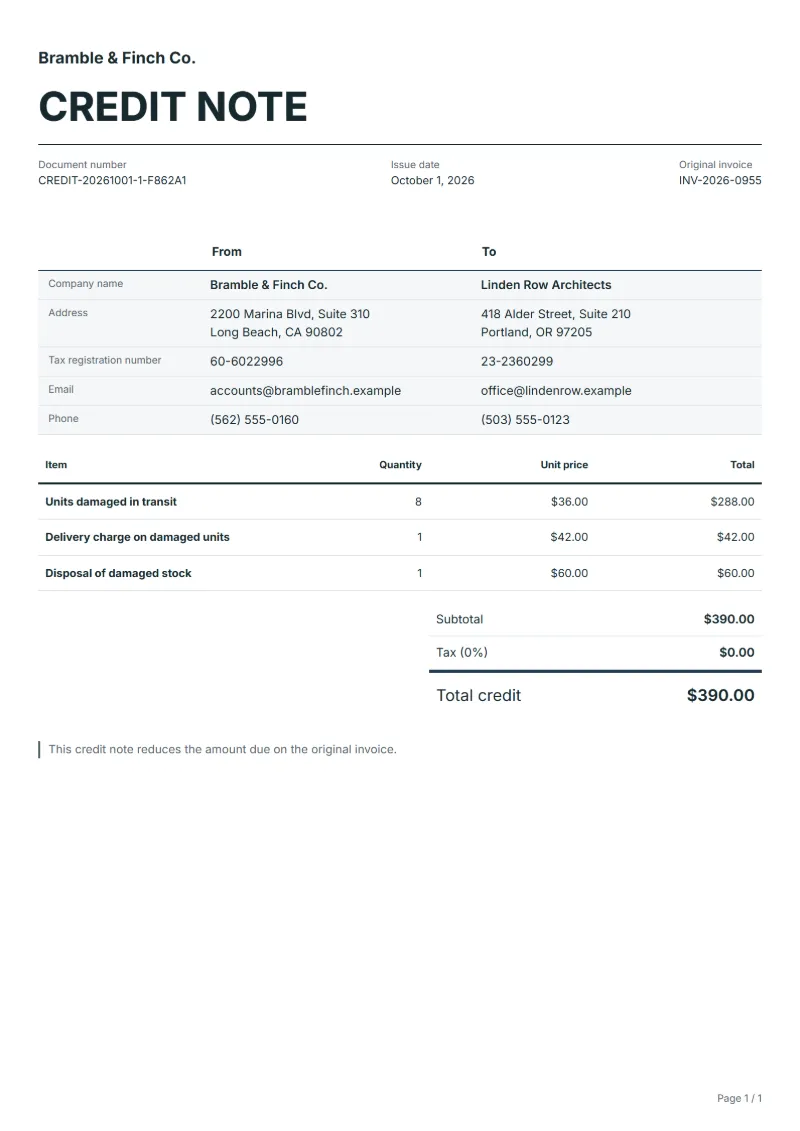
| Item | Quantity × unit price | Amount |
|---|---|---|
| Units damaged in transit | 8 × $36.00 | $288.00 |
| Delivery charge on damaged units | 1 × $42.00 | $42.00 |
| Disposal of damaged stock | 1 × $60.00 | $60.00 |
| Subtotal | $390.00 | |
| Sales tax (8%) | $31.20 | |
| Total | $421.20 | |
Credit before tax $390.00, sales tax reversed $31.20, total credited $421.20.
- The credit corrects invoice INV-2026-0955.
What the document must show
The details a credit note has to show, and why each one matters, are set out in the guide below.
The sales tax depends on where the work is supplied, so set the rate that applies to your customer before sending.
Official rate reference: US government: state and local taxes
Full requirements: Credit note vs invoice (and credit memo): how to issue one
Frequently asked questions
Should I send replacements or credit the damaged units?
Ask the customer which they prefer. If replacements go out, invoice them separately or ship them free under the original invoice, and issue this credit note only for what is not replaced.
How quickly must damage be reported to the carrier?
Carriers usually set short deadlines for damage claims, sometimes only days from delivery. Ask the customer to note damage on the delivery note at once and send photos, then check the carrier’s terms before the deadline passes.
How is the sales tax worked out on this credit note?
The worked example above uses an example rate of 8%: $31.20 on a net amount of $390.00, for a total of $421.20. The editor recalculates all three when you change a quantity, a price or the country.
Can I add my logo and signature?
Yes. The From section of the editor has a place for your company logo and for a signature or seal image. Uploading a picture needs a free account, and a member can keep both in settings so that every new document starts with them.
How is the document numbered?
QuoteBill gives each new document a unique number of its own. A member can switch to numbers in sequence in settings, such as CN-2026-0001: one sequence for each kind of document, starting again every calendar year. A number you type yourself is kept as it is.
Read next
Reading for the Damaged goods credit note template: Credit note vs invoice (and credit memo): how to issue one and Invoice numbering: sequences and corrections. The VAT and GST calculator helps you credit the tax that went with the goods.