Bill of sale for goods or equipment template
One seller sells goods or equipment to one buyer: the goods, price, handover, ownership, condition and papers. A sample contract you can read in full, edit in QuoteBill and sign online with a secure link.
Sample — review with a lawyer · Simple electronic signature with an audit trail
Who it is for
For a business or individual selling a machine, vehicle, tool or stock item to another business, who wants goods, price, handover and condition written down, and a record that ownership has passed.
Warranty and consumer rules differ by country, and registered goods such as vehicles have their own transfer formalities; this sample is for movable goods, not property.
What it covers
13 clauses, in this order. Each one is in the sample text below, and you can edit, remove or add clauses before you send.
1. Purpose
What the agreement is for: it records the sale of the goods below by the Seller to the Buyer and when ownership passes.
2. Goods sold
The goods described in a blank, with blanks for serial numbers or other identifiers, the quantity and any accessories, parts and papers that come with them.
3. Price and payment
The price comes from the price schedule or a blank. It covers the goods only; transport, installation, taxes and registration are dealt with in other clauses.
4. Delivery and handover
Blanks for the date and place, whether the Buyer collects or the Seller delivers, and who pays transport. Both record visible damage or missing items at handover.
5. Ownership and risk
Ownership passes on full payment or on handover (you choose). Until then the Buyer may not sell or pledge the goods. The risk of loss or damage passes on handover.
6. Seller’s title
The Seller confirms it owns the goods free of liens and third-party claims. If someone proves a right to them, the Seller refunds the price or clears the right, and compensates proven loss as far as the law provides.
7. Condition and inspection
Blanks for the condition and any known defects. The Buyer has inspected or could inspect. A blank sets the warranty, sold as seen or a set number of days; it never excuses defects the Seller knew of and hid.
8. Documents and registration
The Seller hands over keys, manuals, certificates and ownership papers. Where the law requires registration or a transfer, as for a vehicle, both complete it. A blank can split the costs.
9. Taxes and costs
A blank says whether the price includes VAT or sales tax. Customs, import taxes and registration fees fall on the Buyer unless a blank says otherwise.
10. Late payment
After a written reminder and a set number of extra days, the Seller may withdraw and take back goods not paid for. Interest is charged only as the applicable law provides.
11. Liability
Each side answers for damage it causes. The Seller’s liability is capped at the price paid, with the usual exceptions such as intent, gross negligence and personal injury.
12. Changes and notices
This contract is the whole agreement on the sale. Changes need both sides’ written or electronic agreement, and notices go to the addresses stated.
13. Governing law and disputes
The law you name applies. The sides first try to settle a dispute in good faith, and otherwise the courts you name decide.
A price schedule (items, quantities and prices) is part of this contract. It starts empty, in your currency, and the clauses on fees and payment point to it.
The sample text
The whole sample, as QuoteBill starts it. Text in double square brackets, like [[10]], is a blank to fill in or check, and QuoteBill does not let you send a contract while one is left. The clause text is written in English, Korean, Japanese and German; in other languages a contract starts in English for you to translate.
Read the sample text
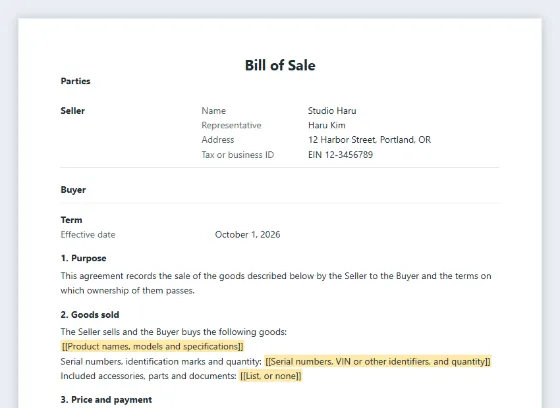
Bill of Sale
Parties: Seller · Buyer
1. Purpose
This agreement records the sale of the goods described below by the Seller to the Buyer and the terms on which ownership of them passes.
2. Goods sold
The Seller sells and the Buyer buys the following goods:
[[Product names, models and specifications]]
Serial numbers, identification marks and quantity: [[Serial numbers, VIN or other identifiers, and quantity]]
Included accessories, parts and documents: [[List, or none]]
3. Price and payment
The Buyer pays the price shown in the price schedule of this contract or, if there is none, [[Price and currency]], on the payment terms stated in this contract. The price covers the goods only; transport, installation, taxes and registration costs are as stated under Delivery and handover and Taxes and costs.
4. Delivery and handover
The Seller hands the goods over to the Buyer on [[Date]] at [[Place]]. [[The Buyer collects the goods / The Seller delivers the goods to the Buyer’s address]]
The costs of transport and packing are borne by [[the Buyer / the Seller]].
The Buyer checks the goods on handover, and both parties record any visible damage or missing items in writing or in electronic form.
5. Ownership and risk
Ownership of the goods passes to the Buyer [[when the price has been paid in full / on handover]]. Until ownership passes, the Buyer does not sell, pledge or give the goods to anyone else.
The risk of loss or damage passes to the Buyer on handover.
6. Seller’s title
The Seller confirms that it owns the goods, that they are free of liens, pledges, security interests and claims of third parties, and that it is free to sell them. If a third party proves a right to the goods, the Seller [[refunds the price / removes the right at its own cost]] and compensates the Buyer’s reasonable and proven losses as far as the law provides.
7. Condition and inspection
The Seller states that the goods are in this condition: [[Condition, e.g. used, in working order, with normal signs of wear]]
The Seller discloses these known defects: [[Known defects, or none]]
The Buyer has inspected the goods or has had the opportunity to do so.
Warranty: [[sold as seen, without further warranty, as far as the law allows / a warranty of 90 days against defects that were not disclosed]]
A limit on the warranty does not apply to defects the Seller knew of and did not disclose, or where the law does not allow it.
8. Documents and registration
The Seller hands over the keys, manuals, certificates, invoices, registration and ownership documents and anything else needed to use and, where required, register the goods. Where the law requires a registration or transfer, such as for a vehicle, the parties complete it without delay and the Seller signs the forms needed. Each party bears its own costs of this, unless the parties agree otherwise here: [[none / the agreed split]]
9. Taxes and costs
The price is [[inclusive / exclusive]] of sales tax or VAT; where tax is due, it is shown on the invoice. The Buyer bears customs duties, import taxes and registration fees for the goods, unless the parties agree otherwise here: [[none / the agreed split]]
10. Late payment
If the Buyer does not pay on time, the Seller may remind it in writing or in electronic form and set a further period of [[7]] days to pay. If the Buyer still does not pay, the Seller may withdraw from the sale and take back goods that were handed over and not paid for, and the Buyer pays the Seller’s reasonable costs of doing so. Interest on late payment is charged only as the applicable law provides.
11. Liability
Each party is liable for damage it causes by breaching this agreement, as the law provides. Except for intent, gross negligence, personal injury or where the law does not allow a limitation, the Seller’s total liability under this agreement is limited to the price paid.
12. Changes and notices
This contract, including its price schedule, is the entire agreement between the parties on the sale of the goods. Changes are valid only if both parties agree to them in writing or in electronic form. Notices are given to the addresses stated for the parties, or to another address a party has notified.
13. Governing law and disputes
This agreement is governed by the law stated under Governing law. The parties will first try to settle any dispute in good faith. Otherwise the courts stated under Jurisdiction decide, unless mandatory law provides otherwise.
Payment terms
The price is payable [[in full on handover of the goods / within 7 days of signing]] by [[bank transfer to the account stated on the invoice / cash against a receipt]].
Governing law
[[Country or state whose law applies]]
Jurisdiction
[[Courts that decide disputes, e.g. the courts of your city]]
How to use it
Choose the template
Press the button to use this template. If you are not signed in, you first sign in or sign up for free and then come straight back to it.
Start a draft
The new-contract page opens with this template marked. Press its card to create a draft. Your company details fill in Party A, and you fill in the blanks, the other party and, where the template has one, the price schedule.
Send it for signature
You sign first, then send each signer a secure link and, by another route, an access code. Signers need no account.
Next steps
Your client opens the link on any device and needs no account. See what the signing looks like on the E-Contracts page, and read which kind of electronic signature is enough for which document.
Already signed? Make the invoice from the signed contract: the parties and the price lines carry over, in full or for a deposit. The guide on turning a quotation into an invoice shows how to review the new draft, its dates and the PDF.
What it is, and what it is not
QuoteBill creates a simple electronic signature with an audit trail. In the EU, the UK, the US and Korea a signature is not denied legal effect only because it is electronic, and in Japan most contracts need no particular form at all. What a simple electronic signature proves in a dispute depends on the evidence behind it, and some documents need another form.
It is not a qualified or advanced electronic signature, and QuoteBill does not verify who the signers are. It records the use of the link and access code you delivered, so anyone who has both can sign. The signature certificate lists every link issued and, for each action by the sender or a signer, its IP address and browser where they could be read.
Some documents need another form. Wills, many real-estate transfers, guarantees and some employment documents must, in some countries, be handwritten, notarised or signed with a qualified signature. The templates are samples, not legal advice: review them with a lawyer.
Other contract templates
Sales and supply agreement
Goods, orders, delivery, inspection, warranty and payment.
Simple general contract
What each party does, payment, term and termination.
Master services agreement
Standard terms for repeated work, with each job agreed in its own statement of work.
Statement of work
One piece of work under a master agreement: scope, milestones, acceptance, fees and dependencies.