Affiliate or referral agreement template
A business pays a commission on sales that come through a partner’s link or code: tracking, payment and ad rules. A sample contract you can read in full, edit in QuoteBill and sign online with a secure link.
Sample — review with a lawyer · Simple electronic signature with an audit trail
Who it is for
For a shop or service that pays creators or partners a commission for customers they send through a link or code, and for partners who want the commission, payment dates and ad rules agreed.
Rules on advertising disclosure, tracking cookies and tax on commission differ by country; the affiliate must label paid promotion as the law and platform rules require.
What it covers
14 clauses, in this order. Each one is in the sample text below, and you can edit, remove or add clauses before you send.
1. Purpose
What the agreement is for: the Affiliate promotes the Merchant’s products or services and earns a commission on the sales that follow.
2. Programme and promotion
Blanks for the products and the channels. The Merchant supplies a tracking link or code and materials. It is non-exclusive unless a blank adds a restriction.
3. Qualifying sales and tracking
A sale counts if the customer arrives through the link or code and buys within a set number of days. Own purchases, fraud and cancelled or refunded orders do not count. The Merchant’s tracking records decide.
4. Commission
A blank for the percentage of the net sale value, which excludes taxes, shipping and discounts, and a blank for other terms such as tiers or a fixed amount.
5. Statements and payment
A monthly statement within a set number of days, payment within a set time once a minimum is reached, and smaller sums carried over. Each side bears its own taxes, and withholding is allowed where the law requires it.
6. Cancelled and refunded orders
Commission on an order cancelled, returned or refunded within a set period is deducted from a later payment or repaid within a set number of days.
7. Advertising rules and disclosure
The Affiliate follows advertising, consumer and data protection law and platform rules, makes clear it earns a commission and makes no false claims. No spam, fake reviews or paid search on the brand name unless a blank allows it.
8. Brand and materials
A limited, revocable right to use the Merchant’s name, logo and materials only to promote its products. No confusingly similar domains or accounts. Use stops when the agreement ends.
9. Customer data and privacy
Each side handles personal data as the law requires, and the Affiliate gets no customer data unless it is agreed in writing. Cookies and tracking need notice and consent where the law asks.
10. Term and termination
It runs until a party ends it on a set number of days’ notice. The Merchant may end it at once for serious breach, fraud or broken ad rules. Commission already earned is still paid, except for fraudulent sales.
11. Changes to the programme
The Merchant may change the rate or terms for future sales on a set number of days’ notice, and the Affiliate may leave instead.
12. Liability
No level of sales or earnings is promised. Each side answers for damage it causes. Other loss is capped at the commission of a set number of months, with the usual exceptions such as intent and personal injury.
13. Independent parties
The Affiliate is independent, not an employee or agent, and cannot make agreements or promises on the Merchant’s behalf.
14. Governing law and disputes
The law you name applies. The sides first try to settle a dispute in good faith, and otherwise the courts you name decide.
There is no price schedule: this agreement involves no payment.
The sample text
The whole sample, as QuoteBill starts it. Text in double square brackets, like [[10]], is a blank to fill in or check, and QuoteBill does not let you send a contract while one is left. The clause text is written in English, Korean, Japanese and German; in other languages a contract starts in English for you to translate.
Read the sample text
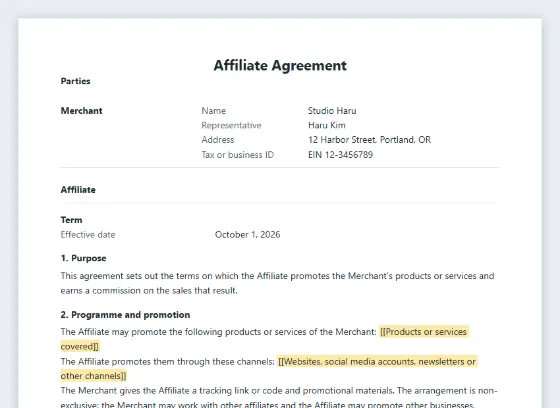
Affiliate Agreement
Parties: Merchant · Affiliate
1. Purpose
This agreement sets out the terms on which the Affiliate promotes the Merchant’s products or services and earns a commission on the sales that result.
2. Programme and promotion
The Affiliate may promote the following products or services of the Merchant: [[Products or services covered]]
The Affiliate promotes them through these channels: [[Websites, social media accounts, newsletters or other channels]]
The Merchant gives the Affiliate a tracking link or code and promotional materials. The arrangement is non-exclusive: the Merchant may work with other affiliates and the Affiliate may promote other businesses, except as agreed here: [[none / the restriction]]
3. Qualifying sales and tracking
A sale qualifies for commission if the customer reaches the Merchant through the Affiliate’s tracking link or code, completes the purchase within [[30]] days of that visit and pays for it. The following do not qualify: purchases by the Affiliate or by people connected to it, purchases made through fraud or against these terms, and orders that are cancelled, returned or refunded. The Merchant’s tracking records decide which sales qualify, and the Affiliate may ask for the records behind its statement.
4. Commission
The Merchant pays the Affiliate [[10]]% of the net value of each qualifying sale. The net value is the price the customer paid, excluding taxes, shipping and discounts.
Other commission terms: [[none / e.g. a higher rate above a sales target, or a fixed amount per sale]]
5. Statements and payment
The Merchant sends the Affiliate a statement of qualifying sales and commission within [[15]] days after the end of each month. It pays the commission shown within [[30]] days after the statement, by [[bank transfer / the payment method agreed]], once the commission owed reaches [[Minimum payout]]; smaller amounts carry over to the next month.
Each party is responsible for its own taxes. Where the law requires the Merchant to withhold tax from the commission, it may do so and gives the Affiliate proof of the amount.
6. Cancelled and refunded orders
If an order for which commission was paid is cancelled, returned or refunded within [[60]] days, the commission for it is deducted from a later payment or, if there is none, repaid by the Affiliate within [[14]] days of the Merchant’s request.
7. Advertising rules and disclosure
The Affiliate complies with the advertising, consumer protection and data protection laws and the platform rules that apply to its promotion. It makes clear to its audience that it earns a commission, in the way those laws and rules require, and does not make claims about the Merchant’s products or services that are false, misleading or not approved by the Merchant.
The Affiliate does not send unsolicited messages, post fake reviews or use the Merchant’s brand name as a paid search term, unless the parties write otherwise here: [[none / the exception]]
8. Brand and materials
The Merchant gives the Affiliate a non-exclusive, revocable right to use its name, logo and promotional materials only to promote the products or services under this agreement. The Affiliate does not register a domain name or social media account that is confusingly similar to the Merchant’s brand. All rights in the Merchant’s brand and materials stay with the Merchant, and the Affiliate stops using them when this agreement ends.
9. Customer data and privacy
Each party handles personal data as the law that applies to it requires. The Affiliate does not receive customers’ personal data from the Merchant unless the parties agree in writing or in electronic form on how it is handled. Where the Affiliate’s promotion uses cookies or similar tracking, it informs visitors and obtains their consent where the law requires.
10. Term and termination
This agreement starts on the effective date and continues until a party ends it. Either party may end it by giving [[14]] days’ notice in writing or in electronic form. The Merchant may end it immediately if the Affiliate seriously breaches it, commits fraud or breaks the advertising rules. Commission earned on qualifying sales before the end is still paid, except for sales made through fraud or against these terms.
11. Changes to the programme
The Merchant may change the commission rate or other terms for future sales by giving at least [[30]] days’ notice in writing or in electronic form. If the Affiliate does not agree, it may end this agreement before the change takes effect.
12. Liability
The Merchant does not promise the Affiliate any level of sales or earnings. Each party is liable for damage it causes by breaching this agreement, as the law provides. Except for intent, gross negligence, personal injury or where the law does not allow a limitation, each party’s liability for other loss is limited to the commission paid or payable in the [[12]] months before the event that caused the damage.
13. Independent parties
The Affiliate is an independent business or individual. This agreement does not create an employment, partnership or agency relationship, and the Affiliate has no authority to make agreements for the Merchant or to promise anything on its behalf.
14. Governing law and disputes
This agreement is governed by the law stated under Governing law. The parties will first try to settle any dispute in good faith. Otherwise the courts stated under Jurisdiction decide, unless mandatory law provides otherwise.
Governing law
[[Country or state whose law applies]]
Jurisdiction
[[Courts that decide disputes, e.g. the courts of your city]]
How to use it
Choose the template
Press the button to use this template. If you are not signed in, you first sign in or sign up for free and then come straight back to it.
Start a draft
The new-contract page opens with this template marked. Press its card to create a draft. Your company details fill in Party A, and you fill in the blanks, the other party and, where the template has one, the price schedule.
Send it for signature
You sign first, then send each signer a secure link and, by another route, an access code. Signers need no account.
Next steps
Your client opens the link on any device and needs no account. See what the signing looks like on the E-Contracts page, and read which kind of electronic signature is enough for which document.
What it is, and what it is not
QuoteBill creates a simple electronic signature with an audit trail. In the EU, the UK, the US and Korea a signature is not denied legal effect only because it is electronic, and in Japan most contracts need no particular form at all. What a simple electronic signature proves in a dispute depends on the evidence behind it, and some documents need another form.
It is not a qualified or advanced electronic signature, and QuoteBill does not verify who the signers are. It records the use of the link and access code you delivered, so anyone who has both can sign. The signature certificate lists every link issued and, for each action by the sender or a signer, its IP address and browser where they could be read.
Some documents need another form. Wills, many real-estate transfers, guarantees and some employment documents must, in some countries, be handwritten, notarised or signed with a qualified signature. The templates are samples, not legal advice: review them with a lawyer.
Other contract templates
Sales and supply agreement
Goods, orders, delivery, inspection, warranty and payment.
Simple general contract
What each party does, payment, term and termination.
Master services agreement
Standard terms for repeated work, with each job agreed in its own statement of work.
Statement of work
One piece of work under a master agreement: scope, milestones, acceptance, fees and dependencies.