Retainer invoice template
Retainer invoice template for advisers on a monthly fee: bill the retainer in advance, and overage hours from last month and expenses on separate lines.
Templates by industry
- Monthly retainer: up to 20 hours, next month
- Hours above the allowance last month
- Travel to client site, return trips
Preparation guide
Example workflow
Confirm scope and quantities
Example: reconcile the approval and work record for "Monthly retainer: up to 20 hours, next month" to establish the quantity for this invoice.
Record delivery and acceptance
Check completion for every line, including "Travel to client site, return trips". Hand over the final report or activity record with the versions of the inputs reviewed.
Send the billing record
Send the final charges, delivery reference and due date to the customer, then reconcile payment against the invoice number.
A retainer pays an adviser a fixed sum each month to keep time available, whether that is a lawyer, an accountant, an IT consultant or a marketing adviser. The invoice usually goes out before the month starts and covers an agreed number of hours. Work beyond that allowance is billed afterwards, once the time log is closed. Keeping the fee, the overage and expenses apart lets the client see at a glance whether the arrangement still fits.
Fields to prepare
- Deliverables and line items
- Monthly retainer: up to 20 hours, next month, Hours above the allowance last month, Travel to client site, return trips: record the quantities actually supplied and the service period.
- Monthly retainer: up to 20 hours, next month
- Write the month and the hours included, so the fee reads as reserved time rather than a payment for nothing.
- Hours above the allowance last month
- Bill overage at the agreed hourly rate with the number of hours, and attach or summarise the time log.
- Travel to client site, return trips
- List travel by trip or date; if the agreement includes local visits, charge only the ones outside it.
- Assignment and inputs
- Identify the subject, source versions, and the inputs the client will supply with their due dates.
- Time and completion basis
- State the hourly or fixed-fee basis, meeting allowance, output format and review rounds.
- Scope to agree
- State the period the retainer covers and the hours it includes, bill hours beyond the allowance a month later with the log, and keep expenses out of the fee line.
Before sending
- Does “Monthly retainer: up to 20 hours, next month” show the quantity actually supplied, not the quantity first quoted?
- Is “Hours above the allowance last month” charged at the rate the customer agreed to, with any change approved?
- Is “Travel to client site, return trips” finished and accepted, or does it belong on a later invoice?
Show 3 more
- Check whether meeting preparation and follow-up revisions are included in the fee.
- Name the person who can approve additional research or a change in scope.
- Match completed work to the order or approval record, and confirm the payment due date and amounts already received.
Worked example: next month’s retainer and last month’s extra hours
The figures are an example, with an example tax rate of 8%. A consultant’s agreement sets $3,000 a month for up to 20 hours, billed in advance, with further hours at $165 billed the month after. Last month ran six hours over, and there were two site visits.
- Retainer: one line for next month at $3,000, with the 20 hours named.
- Overage: six hours at $165 from the closed time log.
- Travel: two return trips at the agreed flat rate.
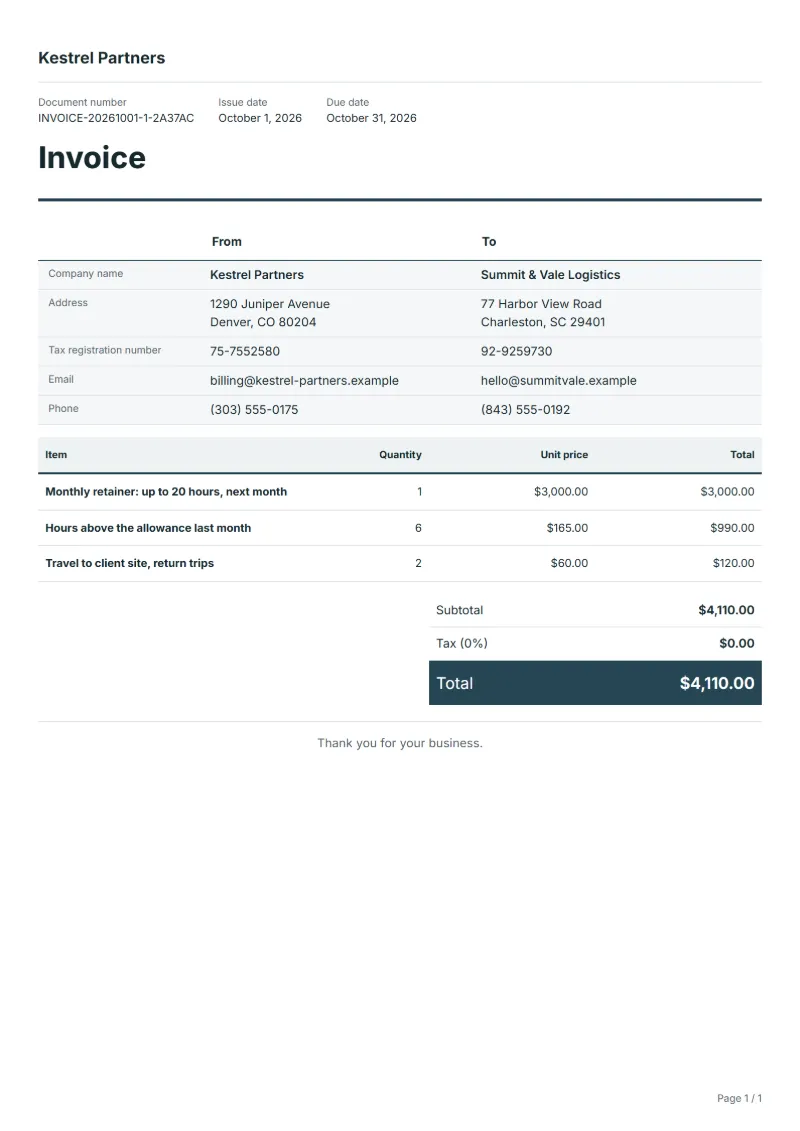
| Item | Quantity × unit price | Amount |
|---|---|---|
| Monthly retainer: up to 20 hours, next month | 1 × $3,000.00 | $3,000.00 |
| Hours above the allowance last month | 6 × $165.00 | $990.00 |
| Travel to client site, return trips | 2 × $60.00 | $120.00 |
| Subtotal | $4,110.00 | |
| Sales tax (8%) | $328.80 | |
| Total | $4,438.80 | |
Together the lines come to $4,110.00; tax at 8% is $328.80; the invoice total is $4,438.80. Under this agreement unused hours lapse, so the notes show the hours used last month and nothing carried forward.
Common mistakes on a retainer invoice
- Leaving out the period, so two invoices seem to bill the same month.
- Billing extra hours with no record of when they were worked.
- Mixing travel or software costs into the retainer line.
- Letting unused hours build up without ever stating the balance.
- Keeping the old fee after an agreed increase, or applying a new one without notice.
What the document must show
These details make an invoice easier to approve and to file.
- Your business name, address and registration or tax number
- The customer's name and address
- Issue date and a document number you do not reuse
- Each line item with quantity, unit price and amount
- Tax shown separately from the net amount, and the total payable
- Payment terms: due date, bank details or accepted payment methods
The sales tax depends on where the work is supplied, so set the rate that applies to your customer before sending.
Official rate reference: US government: state and local taxes
Frequently asked questions
Do I invoice a retainer before or after the month?
Most agreements bill the fee in advance, at the start of the period it covers, and any hours above the allowance in arrears. Put the covered period on each line, so the client never wonders which month an amount belongs to.
What happens to hours the client did not use?
The agreement decides. If unused hours lapse, say so in a note; if they roll over, show the balance carried forward. Where the agreement refunds them, issue a credit note at the end of the period instead of quietly reducing the next fee.
Do I need to show hours when the fee is fixed?
Not for the fee to be due, but a short summary of the hours used builds trust and makes the conversation about raising or cutting the retainer much easier.
How do I raise the retainer fee?
Give the notice your agreement requires, then show the new fee from the first period it applies to. A line in the notes of the invoice before announcing the change helps the client budget.
Can money held for future legal fees go on this invoice?
Money paid into a client account to cover future work may fall under professional rules on client money. This template is for fees for services; check with your professional body before you invoice amounts held on account.
How is tax calculated on this template?
The sales tax depends on where the work is supplied, so set the rate that applies to your customer before sending. The editor keeps the net amount, the tax and the total apart, and recalculates all three when you change a quantity, a unit price or the country setting.
Can I email it to the customer?
Yes, from your own mail app. With a free account, the editor’s download menu offers Email this document, which opens your mail app with a message about the document already written. QuoteBill sends nothing itself, so save the PDF and attach it before you send.
Read next
Reading for the Retainer invoice template: How to write an invoice: a step-by-step example and Credit note vs invoice (and credit memo): how to issue one. The VAT and GST calculator works out the tax line for you.