Medical consumables commercial invoice template
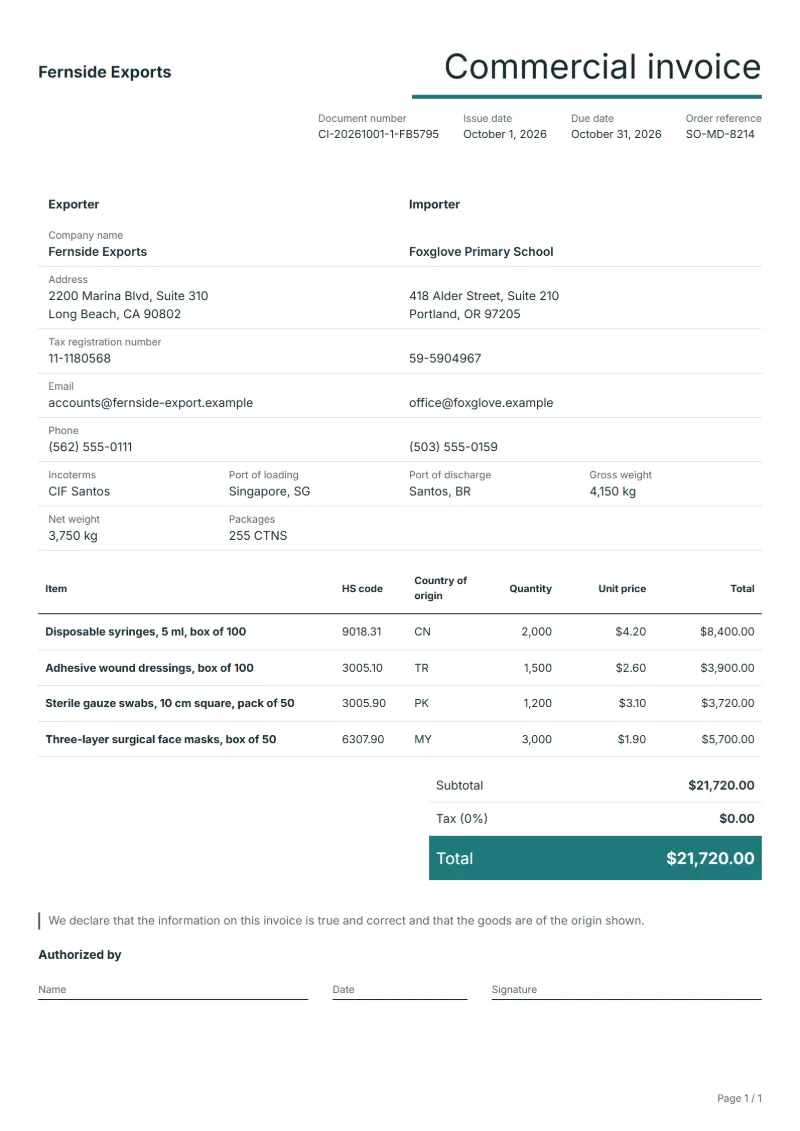
Medical consumables commercial invoice template: syringes, dressings, gauze and masks with HS code, origin, lot and expiry details for customs.
Templates by industry
- Disposable syringes, 5 ml, box of 100
- Adhesive wound dressings, box of 100
- Sterile gauze swabs, 10 cm square, pack of 50
- Three-layer surgical face masks, box of 50
Preparation guide
Example workflow
Describe the goods
Example: describe "Disposable syringes, 5 ml, box of 100" precisely enough for customs, with HS code, origin, quantity and unit value.
Add the shipment details
Enter the Incoterms, ports of loading and discharge, gross and net weight and packages, and check "Three-layer surgical face masks, box of 50" matches the packing list.
Sign and send
Sign the declaration and send the invoice to the importer and your freight forwarder or customs broker with the other shipping documents.
Syringes, dressings, gauze and masks look alike to a layperson but not to a tariff. Which heading a product falls under depends on what it is made of and what it is meant for, so a commercial invoice for medical supplies must describe both. Each line therefore carries its HS code and origin, with a place beside it for lot numbers and expiry dates, since sterile single-use goods are traced by lot and can be refused when they arrive close to expiry.
Fields to prepare
- Deliverables and line items
- Disposable syringes, 5 ml, box of 100, Adhesive wound dressings, box of 100, Sterile gauze swabs, 10 cm square, pack of 50, Three-layer surgical face masks, box of 50: give each line a precise description, its HS code, country of origin, quantity and value.
- Disposable syringes, 5 ml, box of 100
- Say whether needles are attached, which fitting the syringe has and how it was sterilised; importers match these details against their approval and their tender.
- Adhesive wound dressings, box of 100
- Describe the backing and the adhesive, the size and whether each dressing is wrapped individually; hospitals compare dressings on these points and customs asks what they are made of.
- Sterile gauze swabs, 10 cm square, pack of 50
- Write sterile or non-sterile on the line, together with the fabric and the size; sterile gauze is handled and priced differently from non-sterile.
- Three-layer surgical face masks, box of 50
- Describe the construction, such as three layers with a nose wire and ear loops, and the intended use, because masks are classified by what they are and what they protect against.
- Parties and terms
- Name the exporter, the importer and, if the goods go to someone else, the consignee, with the Incoterms, the currency and the payment terms.
- Shipment
- Give the ports of loading and discharge, the shipping method, the gross and net weight, the number of packages and the reason for export.
- Scope to agree
- Describe each product by what it is, how it is made and what it is for, quote lot numbers and expiry dates, and ask the importer which registration or licence its health authority wants to see.
Before sending
- Does “Disposable syringes, 5 ml, box of 100” have the HS code and country of origin customs will check?
- Is the value of “Adhesive wound dressings, box of 100” the price actually paid, in the invoice currency?
- Do the quantity and weight of “Sterile gauze swabs, 10 cm square, pack of 50” match the packing list?
Show 4 more
- Does “Three-layer surgical face masks, box of 50” have the HS code and country of origin customs will check?
- Check the Incoterms, ports, weights and package count against the shipping documents, and the importing country's customs requirements.
- Check each HS code and country of origin with your freight forwarder or customs broker; QuoteBill does not look them up.
- Check the tax rate: it starts at 0% because exports are often zero-rated, so change it if your sale is taxed.
Worked example: four single-use products from four countries
The figures are an example, in dollars. A distributor invoices 2,000 boxes of syringes, 1,500 boxes of dressings, 1,200 packs of sterile gauze and 3,000 boxes of masks, with lot and expiry details in an attached list. No tax is added on this export.
| Item | Quantity × unit price | Amount |
|---|---|---|
| Disposable syringes, 5 ml, box of 100 | 2000 × $4.20 | $8,400.00 |
| Adhesive wound dressings, box of 100 | 1500 × $2.60 | $3,900.00 |
| Sterile gauze swabs, 10 cm square, pack of 50 | 1200 × $3.10 | $3,720.00 |
| Three-layer surgical face masks, box of 50 | 3000 × $1.90 | $5,700.00 |
| Total | $21,720.00 | |
The four lines come to $21,720.00, so the invoice total is $21,720.00. Each line keeps its own HS code and origin, and the quantities are in boxes and packs, the same units as the cartons, so the count at the port agrees with the document.
Common mistakes on a medical consumables commercial invoice
- Describing everything as “medical supplies”, so customs cannot tell syringes from dressings.
- Leaving out whether the goods are sterile, which affects both handling and price.
- Printing lot numbers or expiry dates on the invoice that differ from the labels on the cartons.
- Quoting an approval or registration number the exporter cannot show if the importer is asked.
- Counting in pieces on the invoice while the cartons and the importer’s order count boxes.
What the document must show
These details make a commercial invoice easier to approve and to file.
- Exporter and importer names and addresses, and the consignee if different
- Invoice number and date
- Each item with description, HS code, origin, quantity, unit price and value
- Incoterms, currency and payment terms
- Ports of loading and discharge, shipping method
- Gross and net weight, number of packages
- A signed declaration
A commercial invoice starts at 0%, because exports are often zero-rated; change the rate if your sale is taxed. The sales tax depends on where the work is supplied, so set the rate that applies to your customer before sending.
Official rate reference: US government: state and local taxes
Frequently asked questions
Do I need to put lot numbers and expiry dates on the invoice?
It is wise to, either in the description or in an attached list. Importers of sterile goods trace by lot and check remaining life on arrival, so the invoice should agree with the labels on the cartons.
Who checks that the product may be imported?
The importer, usually through its health authority, and often through a licence or registration held in its own name. Ask which number it wants quoted on the invoice, and do not state an approval that you cannot show.
Why do the dressings and the gauze have different HS codes?
Because the tariff separates products by what they are. A ready-made adhesive dressing and a plain sterile compress are different items, so each gets its own line, code and, if needed, its own origin.
Is a free replacement shipment invoiced?
Yes, with a value for customs even if you charge nothing. Mark the reason for export as replacement and keep the original invoice number in the notes, so customs can see the goods are not a new sale.
How is tax calculated on this template?
A commercial invoice starts at 0%, because exports are often zero-rated; change the rate if your sale is taxed. The sales tax depends on where the work is supplied, so set the rate that applies to your customer before sending. The editor keeps the net amount, the tax and the total apart, and recalculates all three when you change a quantity, a unit price or the country setting.
How is the document numbered?
QuoteBill gives each new document a unique number of its own. A member can switch to numbers in sequence in settings, such as CI-2026-0001: one sequence for each kind of document, starting again every calendar year. A number you type yourself is kept as it is.
Read next
Reading for the Medical consumables commercial invoice template: Proforma vs invoice and down payment invoice and Unpaid invoice: follow-ups, part payments and statements. The currency converter converts the amounts when you invoice in another currency.