Lecturer fee invoice template
Lecturer fee invoice for a seminar, training or talk: the speaking fee, course materials and travel on separate lines, with the date and topic of the session.
Templates by industry
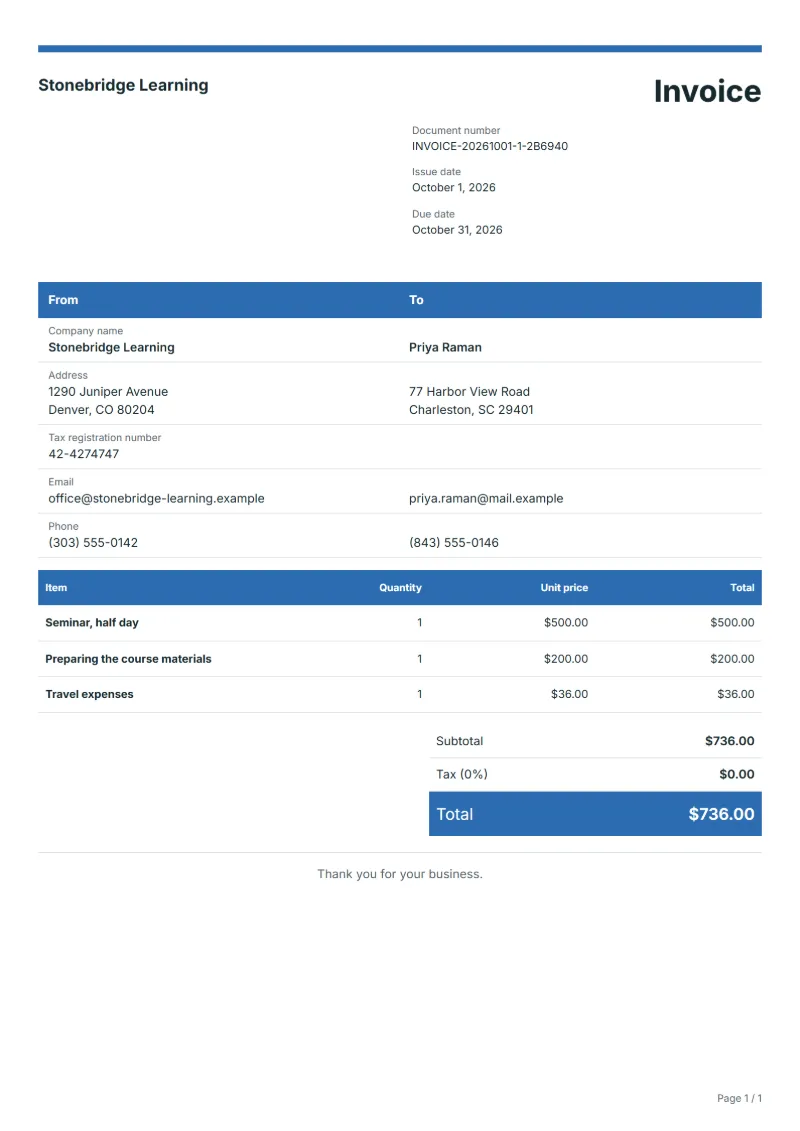
- Seminar, half day
- Preparing the course materials
- Travel expenses
How to invoice a speaking or training fee
Example workflow
Bill the session
Start with "Seminar, half day": the title of the session, the date, the length and the agreed fee.
Add materials and travel
Add the materials and expense lines down to "Travel expenses", with travel at cost and the tickets kept for the organiser.
Send and reconcile
Send the invoice soon after the session, and reconcile payment against the invoice number.
Trainers, guest lecturers and speakers send this invoice to the organiser who booked them: a company’s training department, a university, a public body or a conference. Such organisers pay through accounts departments that check the invoice against the booking, so the session title, date and booking reference should match what the organiser holds. If the talk is recorded and published, or the organiser needs personal details for its own reporting, settle that apart from the fee.
Fields to prepare
- Deliverables and line items
- Seminar, half day, Preparing the course materials, Travel expenses: bill the session at the agreed fee, the preparation of materials as its own line, and travel at cost on a separate line.
- Seminar, half day
- Write the title of the seminar and its date and times exactly as on the organiser’s programme, which their accounts team checks against.
- Preparing the course materials
- Bill preparation only if it was agreed, and say what was produced, such as a 40-slide deck and a printed handout.
- Travel expenses
- Enter the actual fare or mileage and attach the tickets; organisers often reimburse only the class of travel they agreed.
- Session, date and audience
- Name the seminar or talk, its date and length, the venue or the online platform, and the group it was for, as the organiser’s booking describes it.
- Fee, materials and expenses
- Keep the speaking fee, the preparation of handouts or slides, and travel or accommodation on separate lines, and say whether expenses are billed at cost.
- Scope to agree
- State the date, length and topic of the session and the audience, and keep the materials and travel on lines apart from the speaking fee.
Before sending
- Does “Seminar, half day” show the quantity actually supplied, not the quantity first quoted?
- Is “Preparing the course materials” charged at the rate the customer agreed to, with any change approved?
- Is “Travel expenses” finished and accepted, or does it belong on a later invoice?
Show 3 more
- Quote the organiser’s booking or purchase reference, which many accounts departments need before they pay.
- Ask the organiser whether they deduct tax from speakers’ fees, and keep the fee and the tax line separate so they can work it out.
- List the completed work with the session date, then state the due date and any amount already received.
Worked example: a half-day seminar
The figures are an example, in dollars, with an example tax rate of 8%. A trainer bills a half-day seminar, the preparation of the course materials and the train fare to the venue.
| Item | Quantity × unit price | Amount |
|---|---|---|
| Seminar, half day | 1 × $500.00 | $500.00 |
| Preparing the course materials | 1 × $200.00 | $200.00 |
| Travel expenses | 1 × $36.00 | $36.00 |
| Subtotal | $736.00 | |
| Sales tax (8%) | $58.88 | |
| Total | $794.88 | |
The fee, the materials and the travel add up to $736.00; tax at 8% is $58.88; the organiser pays $794.88. If the organiser deducts tax from speakers’ fees, the amount you receive is lower; agree it before the session.
Common mistakes on a speaker’s invoice
- Billing "Seminar, 1" without the date, the title or the audience.
- Adding travel to the fee, so the organiser cannot check it against tickets.
- Leaving out the organiser’s booking reference.
- Billing preparation that was not agreed.
- Sending the invoice weeks after the session, when the budget has closed.
What the document must show
These details make an invoice easier to approve and to file.
- Your business name, address and registration or tax number
- The customer's name and address
- Issue date and a document number you do not reuse
- Each line item with quantity, unit price and amount
- Tax shown separately from the net amount, and the total payable
- Payment terms: due date, bank details or accepted payment methods
The sales tax depends on where the work is supplied, so set the rate that applies to your customer before sending.
Official rate reference: US government: state and local taxes
Frequently asked questions
Lecturer fee invoice template: what should it include?
Start with the lines the template carries (Seminar, half day, Preparing the course materials, Travel expenses) and change them to the session you gave. Then add the organiser, their booking reference, the date and a number you have not used before.
Should travel be on a separate line?
Yes. Organisers often handle expenses differently from fees, and a separate line at cost lets them check it against your tickets.
The organiser deducts tax from my fee. What goes on the invoice?
Invoice the fee and the tax line as agreed and leave the deduction to the organiser, who knows the rule that applies to them. You can note the amount you expect to receive.
How do I bill a full-day workshop?
Use one line for the day at the agreed rate, or two half-days if that is how you quoted. Add preparation separately only if it was agreed.
Can I invoice before the session?
If the organiser asks for it, yes, but say which date the session is on. Most organisers pay after the event, against an invoice that names it.
What if the event is cancelled?
Bill only what your booking terms allow, such as a cancellation fee or costs already incurred, and name them as such on the invoice.
Read next
Reading for the Lecturer fee invoice template: How to write an invoice: a step-by-step example and Invoice payment terms: Net 15, Net 30, due dates. The VAT and GST calculator works out the tax line for you.