Game development quotation template
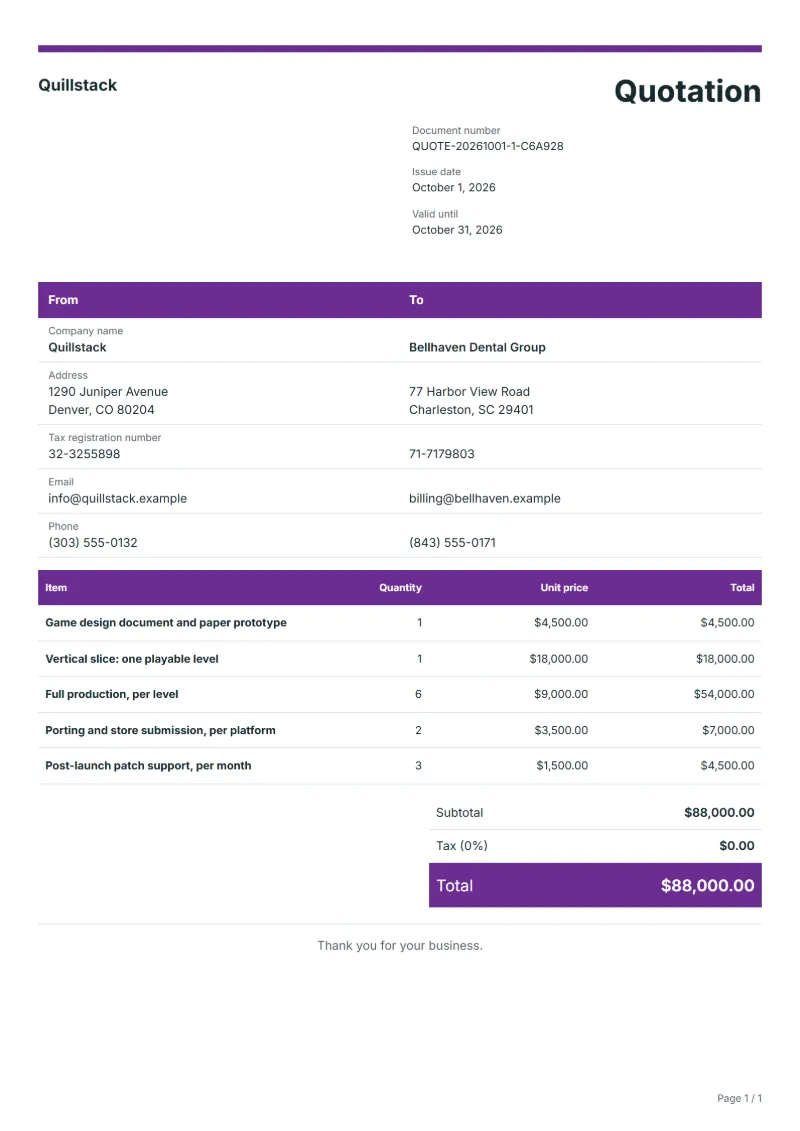
Game development quotation template: design document, a vertical slice, production per level, porting per platform and post-launch patch support.
Templates by industry
- Game design document and paper prototype
- Vertical slice: one playable level
- Full production, per level
- Porting and store submission, per platform
- Post-launch patch support, per month
Preparation guide
Example workflow
Confirm scope and quantities
Example: start with "Game design document and paper prototype", confirm the required quantity and client inputs, then agree completion criteria for each item.
Review and approve the quotation
Confirm acceptance evidence for "Post-launch patch support, per month", all line quantities, exclusions and quote validity with the customer, and retain the approved version.
Deliver and prepare billing
Deliver the agreed test results and configuration notes, and assign owners for outstanding items. When the agreed milestone is complete, prepare an invoice using actual quantities and approved changes.
Games are notoriously hard to quote because nobody knows how fun an idea is until it can be played. Studios handle this by quoting in stages. A design document and paper prototype come first, then a vertical slice, one level built to final quality that proves the look and the controls. Only then is full production priced per level, followed by porting to each platform and patch support after launch. This template follows that order, so each stage can be approved before the next.
Fields to prepare
- Deliverables and line items
- Game design document and paper prototype, Vertical slice: one playable level, Full production, per level, Porting and store submission, per platform, Post-launch patch support, per month: specify the planned quantity and delivery scope for each item.
- Game design document and paper prototype
- Say what the design document covers, such as core loop, controls and level list, and that it becomes the reference for change requests.
- Vertical slice: one playable level
- Describe what the slice must prove and how the client will judge it, for example a playtest with a set number of players.
- Full production, per level
- Define a level by its size and content so a request for bigger levels can be priced against it.
- Porting and store submission, per platform
- Name each platform and say whether certification fees and developer accounts are paid by the client.
- Post-launch patch support, per month
- State what patch support covers, such as crash fixes, and that new content is quoted separately.
- Environment and dependencies
- Record target systems, integration counts, data volume and who supplies test access.
- Acceptance and support
- Set acceptance scenarios, the review window, support duration after handover and excluded work.
- Scope to agree
- Quote a vertical slice before full production, price production per level or feature so scope changes have a visible cost, and list the platforms and store submissions included.
Before sending
- Does “Game design document and paper prototype” say what is included and what quantity the price assumes?
- Would the customer read “Vertical slice: one playable level” the way you do, including what it leaves out?
- Can you still honour the price of “Full production, per level” on the last day the quotation is valid?
Show 5 more
- Does “Porting and store submission, per platform” say what is included and what quantity the price assumes?
- Would the customer read “Post-launch patch support, per month” the way you do, including what it leaves out?
- Separate third-party service charges from implementation fees.
- Agree who handles the production transition and what recovery work is included if it fails.
- Check quote validity, the customer approval method and payment milestones.
Worked example: a puzzle game for phones
The figures are an example, with an example tax rate of 8%. A studio quotes a puzzle game: a design document, a vertical slice, six production levels, release on two phone platforms and three months of patch support.
| Item | Quantity × unit price | Amount |
|---|---|---|
| Game design document and paper prototype | 1 × $4,500.00 | $4,500.00 |
| Vertical slice: one playable level | 1 × $18,000.00 | $18,000.00 |
| Full production, per level | 6 × $9,000.00 | $54,000.00 |
| Porting and store submission, per platform | 2 × $3,500.00 | $7,000.00 |
| Post-launch patch support, per month | 3 × $1,500.00 | $4,500.00 |
| Subtotal | $88,000.00 | |
| Sales tax (8%) | $7,040.00 | |
| Total | $95,040.00 | |
The five lines come to $88,000.00; tax at 8% is $7,040.00; the quotation total is $95,040.00. Only the first two lines are committed at once; the production levels follow if the slice is accepted.
Common mistakes on a game development quotation
- Quoting full production before anything is playable, which fixes a price for an unproven idea.
- Leaving a level or a feature loosely described, so every bigger request turns into a dispute.
- Forgetting platform certification and store accounts.
- Promising post-launch support with no end date or scope.
- Leaving ownership of code and art to be settled after delivery.
What the document must show
These details make a quotation easier to approve and to file.
- Your business name, address and registration or tax number
- The customer's name and address
- Issue date and a document number you do not reuse
- Each line item with quantity, unit price and amount
- Tax shown separately from the net amount, and the total payable
- Payment terms: due date, bank details or accepted payment methods
The sales tax depends on where the work is supplied, so set the rate that applies to your customer before sending.
Official rate reference: US government: state and local taxes
Frequently asked questions
What if the vertical slice shows the idea does not work?
That is what the slice is for. The client pays for the stages done and can stop, change direction or approve production. Say in the notes that the production lines become binding only once the slice is accepted.
How do I handle a publisher that pays on milestones?
Map each line to a milestone with its acceptance test and payment date. Convert the quotation into one invoice per milestone as each is accepted, so payments follow delivered builds.
Should engine licences or purchased assets be in the price?
List them on their own lines or leave them to the client's accounts. Engine terms can depend on revenue, so name who holds the licence rather than folding it into your fee.
Who owns the source code and the art?
Write it down. Many publishers expect full ownership on payment, while some studios keep their engine tools and license them. The answer can change the price, so settle it before the quotation is accepted.
How is tax calculated on this template?
The sales tax depends on where the work is supplied, so set the rate that applies to your customer before sending. The editor keeps the net amount, the tax and the total apart, and recalculates all three when you change a quantity, a unit price or the country setting.
Can I change the layout and colour?
Yes. The editor offers other layouts and a document colour for the printed page. Changing them moves no figure: the lines and totals stay as they are, and the PDF, Word and Excel files follow the layout you pick.
Read next
Reading for the Game development quotation template: How to write a quotation: format, example and checklist and Quote to invoice: how to convert a quote, step by step. The VAT and GST calculator adds tax to your quoted prices.